高端医疗装备自主可控

Search documents
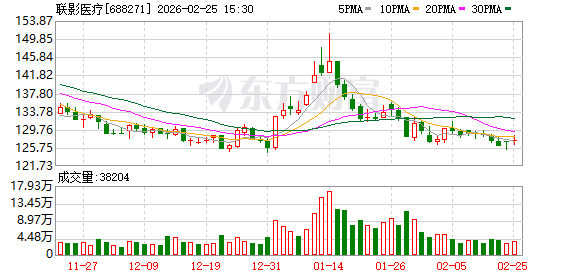
预计2025年营收超138亿元 联影医疗业绩增长与创新实力共振
Zheng Quan Ri Bao· 2026-02-25 12:42
Group 1 - The core viewpoint of the articles highlights the strong financial performance of Shanghai United Imaging Healthcare Co., Ltd. (United Imaging) in 2025, with total revenue reaching 13.821 billion yuan, a year-on-year increase of 34.18%, and a net profit attributable to shareholders of 1.888 billion yuan, up 49.60% [2] - United Imaging has maintained its leading position in the domestic market, with significant revenue growth and improved operational quality and profitability [2] - The company has also experienced rapid growth in international markets, including Europe, North America, Asia-Pacific, and emerging markets, enhancing its brand influence and customer penetration globally [2] Group 2 - As a leading domestic high-end medical equipment manufacturer, United Imaging launched several groundbreaking products in 2025, including China's first photon-counting spectral CT and the world's first "imaging" MRI, completing a comprehensive high-end medical imaging product lineup [3] - The company introduced ten innovative technologies in interventional diagnosis and treatment, further enhancing the self-sufficiency of high-end medical equipment in China and leading global industry development [3] - Looking ahead, United Imaging anticipates entering a new phase of growth driven by technological innovation, improved efficiency through intelligent management, and enhanced scale advantages through global collaboration [3]


零磁医学,走到拐点
3 6 Ke· 2025-12-21 07:51
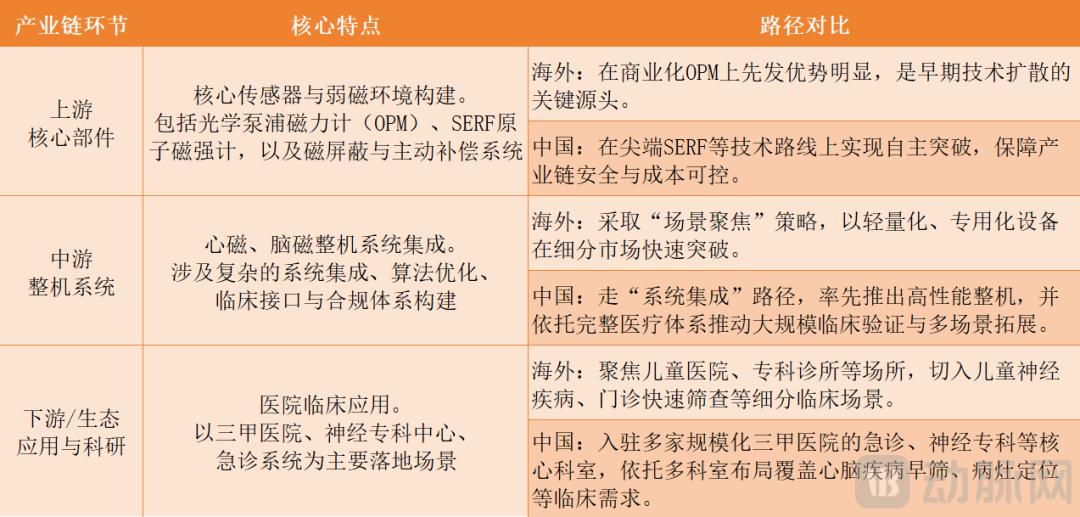
Core Insights - Zero Magnetic Medicine (ZMM) is an emerging technology that allows for non-invasive, rapid, and intuitive visualization of organ functional activity, addressing a critical need in clinical settings [1][4] - The technology captures extremely weak biological magnetic signals generated by organs, enabling early detection of functional changes associated with diseases [1][3] - Recent advancements have led to significant milestones, including FDA approvals for systems like CardioFlux in the U.S. and the first domestic brain magnetic imaging system in China, marking a shift from laboratory research to clinical application [1][6] Technology Foundation - ZMM is built on the evolution of medical, electromagnetic, and engineering technologies, moving from traditional electrode-based methods to magnetic signal detection, which offers better spatial resolution and accuracy [2][3] - The technology overcomes historical limitations of magnetic measurement by utilizing advanced sensors like Optical Pumped Magnetometers (OPM), which operate at room temperature and are more suitable for clinical deployment [3][4] Industrialization Pathway - The industrialization of ZMM is driven by urgent clinical needs in cardiovascular and neurological diseases, with a focus on early detection of functional abnormalities [6][8] - The market is still in its early stages, with commercialization relying on regulatory approvals and the establishment of clinical applications, rather than large-scale deployment [6][7] Market Dynamics - ZMM is characterized by a cautious development pace, with high equipment costs and the need for real-world clinical validation influencing its adoption [7][8] - The industry is divided into two main segments: cardiac imaging, which has clearer commercial pathways, and brain imaging, which is still in the innovation and pilot stages [8][9] Global Landscape - A diverse ecosystem of companies is emerging globally, with significant capital interest in ZMM, highlighting the market's valuation logic and expectations [10][11] - Key players include Genetesis in the U.S. with its CardioFlux system, and various Chinese companies like Hangzhou Zero Magnetic Medical, which are rapidly advancing in system integration and clinical validation [10][12] Competitive Advantages - Chinese companies are leveraging government support and a collaborative healthcare system to accelerate the development and deployment of ZMM technologies, focusing on system integration rather than isolated technological advancements [13][14] - In contrast, overseas companies are emphasizing lightweight, scene-oriented approaches, aiming for agile penetration into specialized markets [12][13] Future Prospects - The integration of ZMM with artificial intelligence and big data is anticipated to create smarter diagnostic and intervention platforms, expanding its application boundaries [9][17] - Despite the promising outlook, challenges remain in clinical validation, cost management, and market acceptance, which are critical for transitioning from technology approval to routine clinical use [18][19]
填补高端分子影像领域空白 联影医疗获2024年度上海市科技进步奖一等奖
Zheng Quan Shi Bao Wang· 2025-08-27 11:19
Core Insights - The project "Independent R&D and Industrialization of Multimodal Molecular Imaging Equipment" by United Imaging Healthcare won the first prize in the 2024 Shanghai Science and Technology Progress Award, highlighting the recognition of the company's achievements in this field [1] - The company aims to enhance product performance and application coverage to improve accessibility to medical services, driven by clinical and research needs [1] Group 1: Project Achievements - The project has led to the development of several world-first and China-first products, filling a significant gap in China's high-end molecular imaging sector [2] - It has elevated China's PET technology to an internationally leading position and fostered the collaborative development of upstream and downstream enterprises in crystal materials [2] - The project has overcome all core technologies in multimodal molecular imaging, achieving breakthroughs in key technologies such as large-size LYSO crystal growth and high-performance digital PET detectors [2] Group 2: Technical Innovations - The molecular imaging team introduced a modular, multi-unit architecture to enable seamless system expansion, supporting large-scale data collection from 560,000 detectors [3] - The sensitivity of the uEXPLORER system was enhanced by 40 times through cross-unit composite technology, and a distributed parallel signal processing architecture based on GPU clusters was implemented to address massive data processing challenges [3] - Image reconstruction time was significantly reduced from one day to 23 minutes, providing substantial technical support for clinical applications [3] Group 3: Market Impact - The project has achieved 13 national Class III medical device registrations and 12 FDA and CE certifications, with over 600 molecular imaging devices installed globally across nearly 30 countries [3] - The PET/CT products have maintained the number one market share in China's molecular imaging market for nine consecutive years, while PET/MR products reached a domestic market share of over 60% in 2022 [3] - The project has successfully reversed the historical reliance on imported nuclear medicine molecular imaging equipment, increasing the domestic production rate of such devices to over 50% [3]
中国医疗器械产业近5年年均复合增长率达10.54% 已成全球第二大市场
Xin Hua Wang· 2025-08-12 05:54
Core Viewpoint - The National Medical Products Administration (NMPA) is committed to promoting the innovative development of high-end medical devices in China, aiming to transition from a "big manufacturing country" to a "strong manufacturing country" in the medical equipment sector [1] Group 1: Policy and Strategic Initiatives - The NMPA has implemented top-level design and inter-departmental collaboration to enhance the medical device industry, including the issuance of the "14th Five-Year Plan for National Drug Safety and Promotion of High-Quality Development" and the "14th Five-Year Plan for Medical Equipment Industry Development" [2] - The establishment of two technical innovation cooperation platforms focusing on artificial intelligence medical devices and medical biomaterials aims to accelerate the transformation of scientific achievements in the medical device field [2] - The NMPA has introduced innovative review measures, such as moving technical reviews to the product development stage, particularly for high-end medical devices like ECMO and particle therapy systems [2] Group 2: Innovation and Market Growth - The NMPA has prioritized the approval of innovative medical devices, implementing special review procedures to expedite the market entry of urgently needed clinical products [2] - In recent years, the NMPA has approved 217 innovative medical devices and 130 innovative drugs, with 28 innovative medical devices approved in the first half of this year alone [3] - The Chinese medical device industry has experienced a compound annual growth rate of 10.54% over the past five years, positioning China as the second-largest medical device market globally [3] Group 3: E-commerce and Sales Trends - The rapid development of online sales has significantly boosted the sales of drugs and medical devices, with an estimated online sales revenue of 292.4 billion yuan in 2022, projected to exceed 350 billion yuan in 2023 [4]

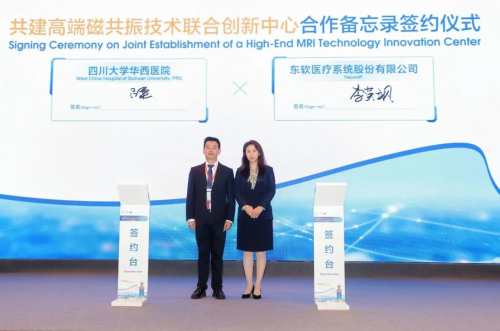
华西医院与东软医疗再携手,共建高端磁共振联合创新中心
Zhong Guo Chan Ye Jing Ji Xin Xi Wang· 2025-08-04 07:28
Core Viewpoint - The signing of a cooperation memorandum between West China Hospital and Neusoft Medical aims to establish a high-end MRI technology joint innovation center, enhancing China's global influence in the field of mental imaging [1][5][7] Group 1: Partnership Details - The cooperation memorandum was signed during the 2025 West China International Forum on Advances in Schizophrenia, attended by over 300 experts in mental illness and medical imaging [3] - Key representatives from both organizations, including hospital leaders and Neusoft Medical executives, witnessed the signing [3] Group 2: Strategic Goals - The collaboration focuses on technological research and clinical transformation, with a mission to lead MRI technology innovation and address major brain disease diagnosis and treatment challenges [5][7] - The partnership is positioned as a response to the national strategy for self-controllable high-end medical equipment, aiming to transition brain disease diagnosis from "experience-based judgment" to "molecular-level quantification" [7] Group 3: Previous Achievements - Since signing a strategic cooperation agreement in 2024, both parties have achieved multiple results in high-end CT clinical application demonstrations and medical imaging training projects under the Belt and Road Initiative [7] - The collaboration is expected to accelerate the transition of domestic MRI technology from "catching up" to "leading," contributing to brain health and the construction of a healthy China [7]