高速铁路网络

Search documents
高铁“抢跑”飞机?外媒:世界上最先进的铁路客运系统展示窗
Guan Cha Zhe Wang· 2025-09-21 10:17
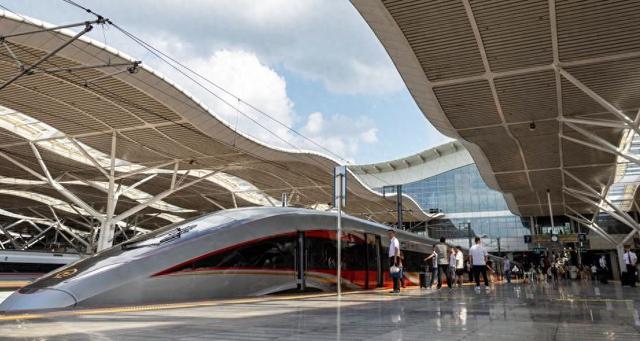
Core Insights - China's high-speed rail network is transforming domestic travel, particularly between Beijing and Shanghai, as more passengers opt for trains over planes due to improved services and infrastructure [1][5][6] Group 1: High-Speed Rail Advantages - The Beijing-Shanghai high-speed rail (known as the Jinghu High-Speed Railway) is a key part of China's extensive rail network, covering 1,318 kilometers and connecting major economic regions [1][2] - The CR400 Fuxing train operates at speeds of up to 350 km/h, setting a new benchmark for high-speed rail globally, with travel time from Beijing to Shanghai reduced to as little as 4 hours and 18 minutes [2][5] - Train frequency is high, with departures as short as 3 minutes apart, providing flexibility and convenience for travelers compared to air travel [4][6] Group 2: Economic and Demographic Impact - The regions along the Jinghu High-Speed Railway are experiencing rapid economic growth and urbanization, leading to increased demand for business and leisure travel [2][5] - In the 2023-2024 period, the high-speed rail transported approximately 53.25 million passengers, surpassing the 6.89 million passengers transported by airlines on the same route [5][6] Group 3: Changing Travel Preferences - Travelers prefer high-speed rail due to shorter total travel times when considering check-in and security processes at airports, as well as the proximity of train stations to city centers [7] - The rise of high-speed rail is reshaping the regional aviation market, prompting airlines to shift focus from saturated short-haul routes to long-haul domestic flights and underserved markets [7][8] Group 4: Future Outlook - The future of travel in China may involve a more integrated transportation ecosystem where high-speed rail and aviation coexist, enhancing regional connectivity while maintaining air travel for long-distance and international routes [7][8]


2025年全球创新指数发布 中国首次跻身前十
Zhong Guo Xin Wen Wang· 2025-09-16 21:20
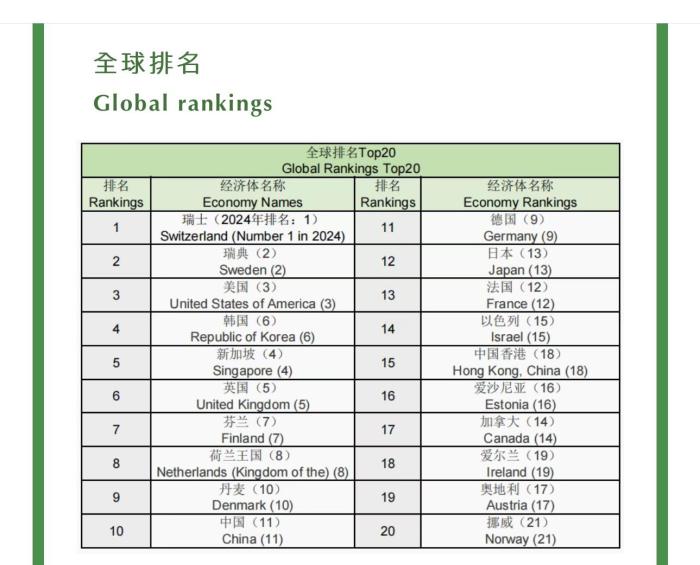
Core Insights - The 2025 Global Innovation Index (GII) indicates that China has entered the top ten for the first time, ranking 10th, while Switzerland, Sweden, the United States, South Korea, and Singapore occupy the top five positions [1][2]. Group 1: Global Rankings - The top five economies in the 2025 GII are Switzerland, Sweden, the United States, South Korea, and Singapore [2]. - The rankings from 6th to 10th place include the United Kingdom, Finland, the Netherlands, Denmark, and China [2]. - Emerging economies such as China, India, Turkey, Vietnam, the Philippines, Indonesia, and Morocco are showing continuous improvement in their rankings [2]. Group 2: Regional Insights - Southeast Asia, East Asia, and Oceania remain key drivers of global innovation, with six economies from this region in the top 25 [3]. - South Korea and Singapore lead in corporate R&D, education, and innovation infrastructure, while China maintains a strong position among middle-income economies [3]. - China has 24 of the world's top 100 innovation clusters, highlighting the region's central role in global innovation dynamics [3]. Group 3: Innovation Trends - The GII highlights significant growth in robotics and connectivity technologies, with an expansion of high-speed rail networks as a new indicator for 2025 [3]. - However, the adoption of robotics and electric vehicles has noticeably slowed down [3]. Group 4: Overall Observations - The GII reflects that economies viewing innovation as a fundamental engine for resilience, growth, and competitiveness are making the fastest progress [4]. - Despite some encouraging signs of recovery in innovation applications and impacts, the global innovation engine is not operating at full speed due to slowed R&D investments and reduced venture capital activity [4]. - The GII has been published annually since its inception in 2007, ranking approximately 140 economies based on a rich dataset of 78 indicators [4].