高铁精细化发展

Search documents
2025高铁开通5万公里 广东里程再居全国榜首
经济观察报· 2025-12-26 12:23
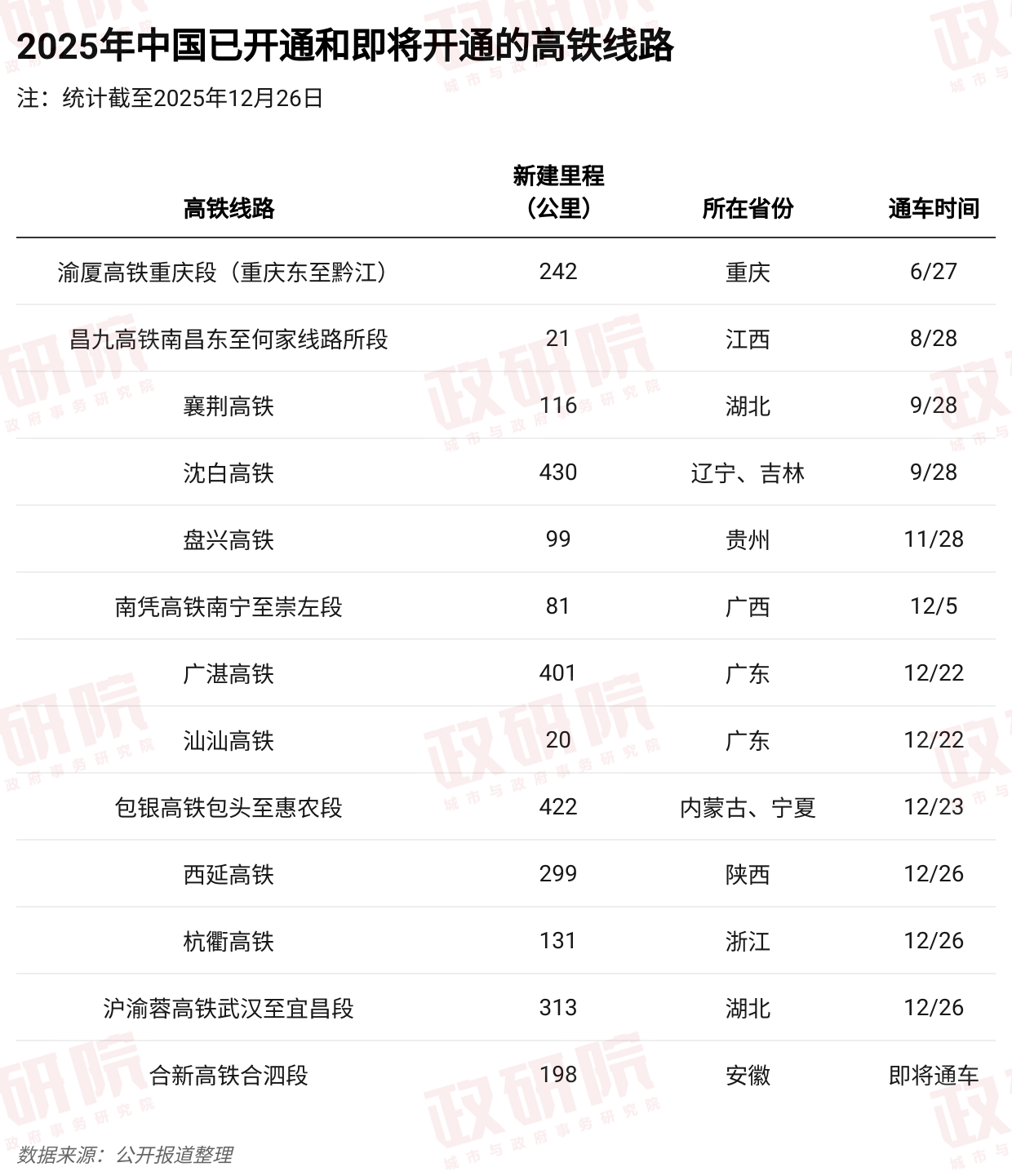
Core Viewpoint - The opening of new high-speed rail lines significantly impacts the restructuring of regional economic patterns beyond just increasing rail mileage [1][3]. Group 1: Recent High-Speed Rail Openings - As of December 26, 2025, a total of 12 new high-speed rail lines have been opened, bringing the total operational mileage to over 50,000 kilometers, with an increase of approximately 2,575 kilometers this year [2]. - The most significant growth in operational mileage was observed in Hubei, which increased by 429 kilometers [2]. Group 2: Characteristics of New High-Speed Rail Lines - New high-speed rail lines exhibit two main characteristics: enhancing the national "eight vertical and eight horizontal" main network and focusing on regional internal connections to improve traffic and logistics [5][6]. - The Baoyin High-Speed Rail is a crucial segment of the "Jinglan Passage," connecting previously unlinked areas in Inner Mongolia and significantly reducing travel time [6]. - The opening of the Huai'an-Xin High-Speed Rail enhances connectivity between Anhui and the Yangtze River Delta, while the Hangzhou-Qichun High-Speed Rail transforms Qichun into a regional railway hub [6]. Group 3: Economic Impacts of High-Speed Rail - The new high-speed rail lines create a "one-hour high-speed rail circle" among cities like Wuhan, Xiangyang, and Yichang, facilitating tighter economic interactions and supporting Hubei's economic growth [8][9]. - The opening of the Guangzhang and Shanshan High-Speed Rail lines connects major cities in Guangdong to the Guangdong-Hong Kong-Macau Greater Bay Area, enhancing regional economic integration [7][9]. Group 4: "City-to-City" High-Speed Rail Connectivity - As of now, 12 provinces have achieved "city-to-city" high-speed rail connectivity, with notable advancements in central and western provinces [11]. - The focus in these regions is on integrating dispersed economic nodes into "several hours economic circles," which is crucial for their rapid development [11]. Group 5: Future Development and Challenges - The upcoming "14th Five-Year Plan" period will see a shift towards more refined high-speed rail development, focusing on completing existing networks and optimizing operations rather than large-scale new constructions [14][15]. - The financial burden of high-speed rail projects is significant, with total liabilities reaching 6.2 trillion yuan, necessitating a more cautious approach to new project approvals [14][15].

高铁营业里程突破5万公里后,将转向“精耕”
Jing Ji Guan Cha Wang· 2025-12-26 07:50
Core Viewpoint - The recent opening of multiple high-speed rail lines in China marks a significant expansion of the national high-speed rail network, enhancing connectivity and economic integration across various regions [1][3][5]. Group 1: High-Speed Rail Expansion - As of December 26, 2025, a total of 12 new high-speed rail lines have been opened, bringing the total operational mileage to over 50,000 kilometers, with an increase of approximately 2,575 kilometers in 2025 [1][2]. - The newly opened lines include significant routes such as the Guangzhan High-Speed Railway and the Baoyin High-Speed Railway, which have improved regional connectivity and reduced travel times [1][4][5]. Group 2: Economic Impact - The new high-speed rail lines are expected to reshape regional economic structures by enhancing transportation efficiency, facilitating the movement of people and goods, and promoting economic growth in connected areas [3][6]. - The opening of the Baoyin High-Speed Railway has significantly reduced travel time between key cities, thereby enhancing economic interactions and collaboration in the northwest region [3][4]. Group 3: Regional Connectivity - The new lines contribute to the completion of the national "eight vertical and eight horizontal" high-speed rail network, improving access to major urban centers and integrating previously isolated regions into the national economy [3][4][5]. - The introduction of "city-to-city" high-speed rail connections has been achieved in several provinces, enhancing local economies and facilitating regional development [7][8]. Group 4: Future Development and Challenges - The focus of future high-speed rail development is expected to shift towards optimizing existing networks and enhancing regional connectivity rather than solely expanding mileage, in response to financial pressures and changing demographic trends [10][11]. - The financial sustainability of high-speed rail projects is a growing concern, with many lines facing operational losses, necessitating a more strategic approach to new projects and existing line evaluations [10][11].