高铁运营

Search documents
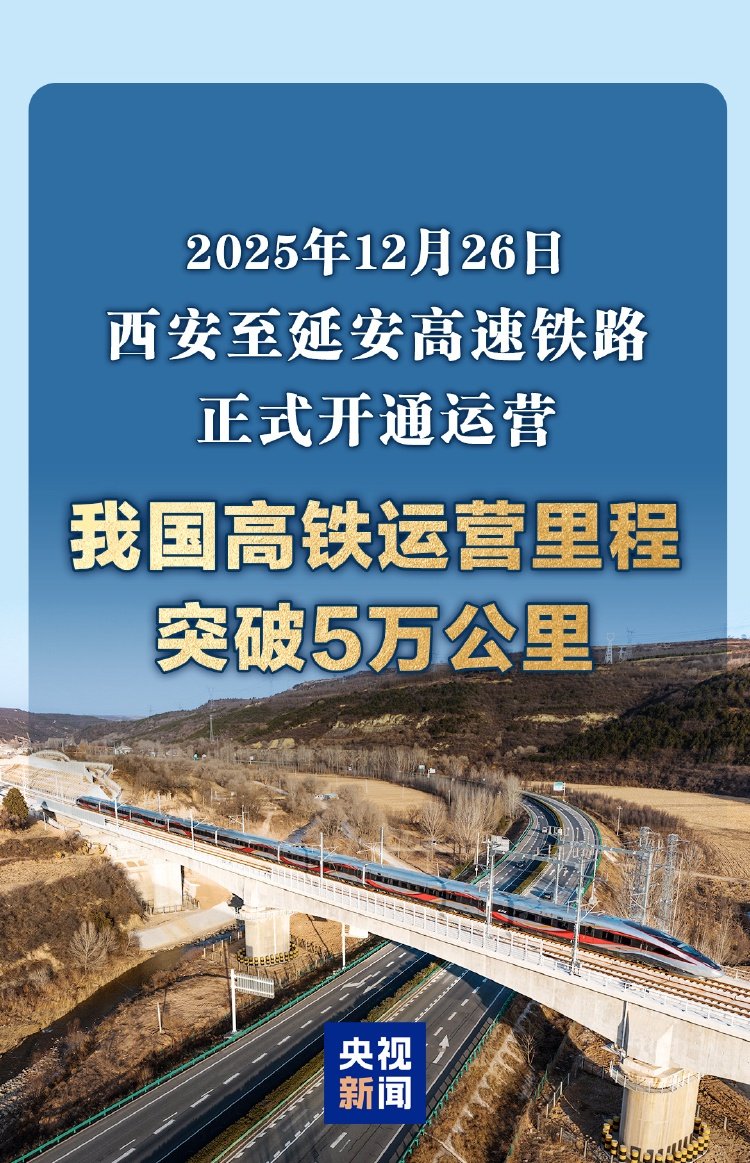
西延高铁开通运营 我国高铁里程突破5万公里
Yang Shi Xin Wen Ke Hu Duan· 2025-12-26 02:06
西延高铁起自陕西省西安市,经渭南市、铜川市,接入延安市延安站,线路全长299公里,设计时速350公 里。 开通运营初期,每日最多开行动车组列车38列,高陵、富平南、铜川、洛川、甘泉北、延安等10座车站投 入运营,西安北至延安站最快68分钟可达,较目前开行的普速铁路旅客列车压缩62分钟。 央视新闻客户端消息,今天上午10时,随着C9309次列车从延安站发车,西安至延安高速铁路正式开通运 营,陕北革命老区迈入高铁时代,我国高铁运营里程突破5万公里。 随着西安至延安高铁开通运营,中国高铁营业里程突破5万公里。半径500公里城市群形成1至2小时交通 圈,实现公交化出行;1000公里跨区域大城市间4小时可达,实现当日往返;2000公里跨区域大城市间8小 时可达,实现朝发夕至。 原标题:西延高铁开通运营 我国高铁里程突破5万公里 编辑:吴思 责编:廖异 ...

京沪高铁20251106
2025-11-07 01:28
Summary of the Conference Call for Beijing-Shanghai High-Speed Railway Industry Overview - The conference call discusses the financial performance and operational updates of the Beijing-Shanghai High-Speed Railway (京沪高铁) and its subsidiary, Jingfu Anhui Company (京福安徽公司) for the third quarter of 2025. Key Financial and Operational Highlights - **Improved Financial Performance**: The financial performance of Beijing-Shanghai High-Speed Railway improved in Q3 2025, attributed to an increase in the total number of trains operated, including cross-border trains, the removal of discounts on benchmark ticket prices, and effective cost control measures that significantly improved gross margins [2][5][10]. - **Profit Growth for Jingfu Anhui**: Jingfu Anhui Company reported profits exceeding 100 million yuan in Q3, primarily by reducing the number of trains operated, which lowered operational costs and enhanced profitability compared to a flat performance in the first half of the year [2][6]. - **Passenger Volume and Revenue**: As of now, the passenger volume handled by Beijing is 44.8 million, a year-on-year decrease of 0.9%. However, cross-border passenger turnover increased by 1.1%. The average ticket revenue per passenger grew by 3%, and the average travel distance increased by 1.1%, indicating a positive contribution from ticket price increases [2][7]. - **Ticket Price Strategy**: Despite a 4.7% decline in overall seat occupancy, the company successfully increased revenue by raising second-class ticket prices, demonstrating effective pricing strategy adjustments without a significant drop in passenger volume [2][8]. Cost Management and Financial Outlook - **Cost Control Measures**: The increase in operating costs was relatively small in Q3 due to optimized operational efficiency and effective cost control measures. Financial expenses decreased due to the repayment of some bank loans by Jingfu Railway, but future financial expenses are expected to stabilize around 313 million yuan [2][10][12]. - **Debt Situation**: Most bank loans have been repaid, with remaining debts primarily consisting of long-term railway construction bonds, which have high interest rates and cannot be repaid early [13]. Future Plans and Market Strategy - **Response to Demand Weakness**: The company has significantly reduced the supply of business class seats, which currently account for about 1% of total traffic, focusing resources on second-class seats due to weak demand in business and first-class segments [9]. - **New Marketing Initiatives**: The company is exploring new marketing strategies, such as special trains for fans, to attract more passengers, although these initiatives have not yet made a significant impact on overall revenue [4]. - **Future Pricing Adjustments**: The company plans to gradually implement differentiated pricing based on market conditions, including daily reporting and vehicle-specific pricing, aiming for price adjustments with the introduction of new equipment [15]. Additional Insights - **Seasonal Revenue Fluctuations**: In October, ticket revenue increased, with northern line revenue growing by 8.5% and cross-line revenue by 4.7%, influenced by seasonal factors and the National Day and Mid-Autumn Festival holidays. However, growth rates have started to decline in early November [3][20]. - **Construction Progress of Jingfu High-Speed Railway**: The southern section of Jingfu High-Speed Railway is still under development, with completion dates uncertain. The northern section is expected to be completed by the end of 2026, which will significantly impact train operations [21]. This summary encapsulates the key points from the conference call, highlighting the financial performance, operational strategies, and future outlook of the Beijing-Shanghai High-Speed Railway and its subsidiary.

中方:愿同印尼一道继续做好雅万高铁高质量运营
Zhong Guo Xin Wen Wang· 2025-10-20 07:40
Core Viewpoint - The Chinese government expresses willingness to collaborate with Indonesia for the high-quality operation of the Jakarta-Bandung High-Speed Railway, emphasizing its positive impact on local economic development and job creation [1]. Group 1: Project Status - The Jakarta-Bandung High-Speed Railway has been in operation for two years, successfully transporting over 11.71 million passengers, with a stable increase in passenger flow [1]. - The project has received recognition and support from various sectors in Indonesia for its contributions to local economic growth [1]. Group 2: Government Collaboration - Both the Chinese and Indonesian governments prioritize the development of the high-speed railway, ensuring close cooperation between relevant departments and enterprises for its safe and stable operation [1]. - The Chinese side highlights the importance of considering public effects and comprehensive benefits, beyond just financial data and economic indicators, when evaluating high-speed rail projects [1].
广深铁路(601333):高铁班列进入收获期,经营利润大幅增长
Changjiang Securities· 2025-09-01 06:16
Investment Rating - The investment rating for the company is "Buy" and is maintained [5]. Core Insights - The company has entered a profit harvest period with significant growth in operating profit, driven by the expansion of high-quality high-speed rail services [3][4]. - In the first half of 2025, the company achieved operating revenue of 13.969 billion yuan, a year-on-year increase of 8.1%, and a net profit attributable to shareholders of 1.109 billion yuan, up 21.55% year-on-year [3][4]. - The company is transitioning from resource provider to operator, enhancing its business model and valuation [4]. Summary by Sections Financial Performance - In Q2 2025, the company reported operating revenue of 7.073 billion yuan, an increase of 11.84% year-on-year, and a net profit of 641 million yuan, a substantial increase of 75.38% year-on-year [3][4]. - The gross profit for the first half of 2025 increased by 5.7% to 1.454 billion yuan, indicating a positive trend in profitability [4]. Operational Changes - The company is actively increasing cross-line train services, which has led to a 37.1% increase in operating revenue despite a decrease in passenger volume compared to 2019 [4]. - The company has integrated its stations and lines with the Guangzhou-Shenzhen-Hong Kong high-speed rail, marking a shift from being a resource provider to an operator [4]. Future Projections - The company expects to see continued profit growth, with projected net profits of 1.44 billion, 1.65 billion, and 1.77 billion yuan for 2025, 2026, and 2027 respectively, corresponding to PE ratios of 15.8, 13.8, and 12.9 [4].