
西延高铁

Search documents
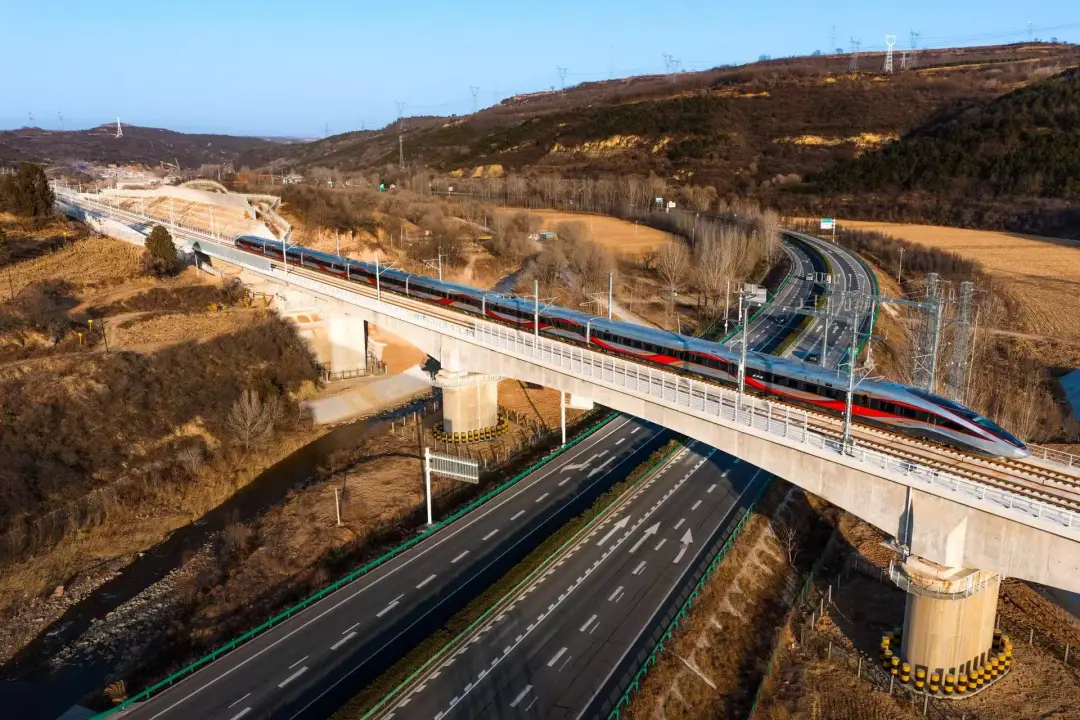
#2026新春走基层# 上车!坐着高铁去延安
Xin Lang Cai Jing· 2026-02-19 02:31
Core Viewpoint - The opening of the Xi'an to Yan'an high-speed railway has significantly improved transportation efficiency, enhancing tourism and local economic activities in Yan'an, a revolutionary area in Shaanxi Province. Group 1: Transportation Impact - The newly opened high-speed railway reduces travel time from Xi'an to Yan'an to approximately 1 hour, compared to previous travel times of up to 14 hours by steam train and 2.5 hours by regular train [2]. - The high-speed railway marks the entry of Yan'an into the "high-speed rail era," facilitating easier access for tourists and residents alike [2][5]. Group 2: Economic and Tourism Growth - The high-speed rail has led to a surge in tourism, with significant increases in visitor numbers at local attractions such as the Yan'an Revolutionary Memorial Museum and various scenic spots [5]. - A promotional campaign between Xi'an and Yan'an offers discounts for residents, resulting in a 38% increase in cross-city tourism spending [5]. Group 3: Agricultural and E-commerce Development - The high-speed railway has improved logistics for local agricultural products, such as apples, significantly reducing transportation time and costs, thus enhancing market access for local farmers [6]. - The rise of e-commerce in Yan'an is supported by the high-speed rail, with local entrepreneurs leveraging the improved logistics to boost sales and expand their businesses [6].

2月2日晚间央视新闻联播要闻集锦
Yang Shi Xin Wen Ke Hu Duan· 2026-02-02 14:24
Group 1 - The core viewpoint emphasizes the historical achievements in wetland ecological protection and restoration in China, guided by Xi Jinping's ecological civilization thought, contributing to the construction of a beautiful China and strengthening ecological security [1][7]. Group 2 - The Central Committee of the Communist Party of China and the State Council approved the "Modern Capital Metropolitan Area Spatial Coordination Plan (2023-2035)" [2][8]. - The 2026 Spring Festival travel season has commenced, with an expected cross-regional population flow exceeding 180 million people [14]. - The "Silk Road Maritime" shipping route has cumulatively handled over 26 million TEUs, serving as China's first international shipping logistics platform for the Belt and Road Initiative, significantly boosting global trade and regional economic cooperation [16].
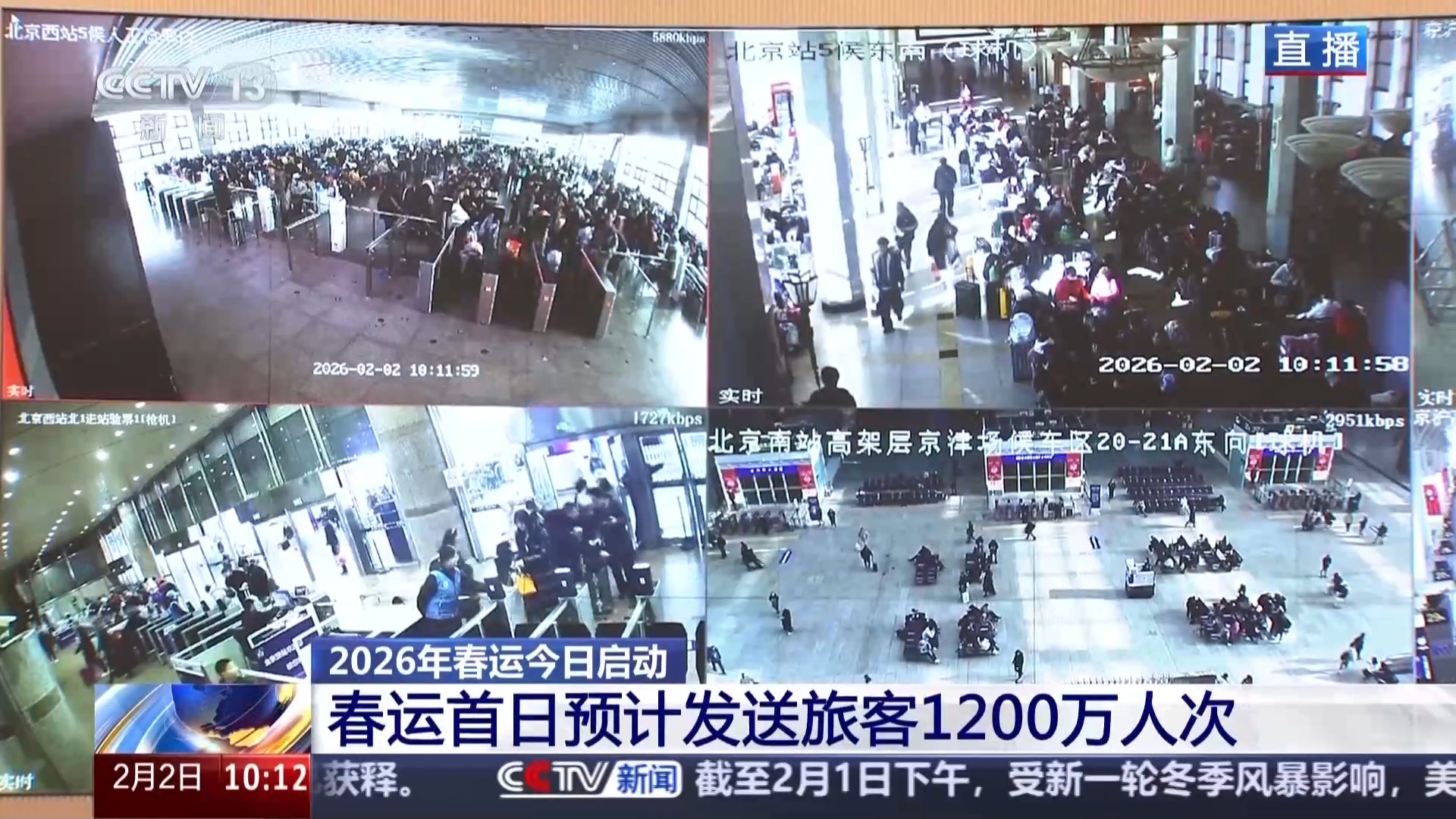
视频丨春运首日铁路预计发送旅客1200万人次
Yang Shi Xin Wen Ke Hu Duan· 2026-02-02 06:05
Core Viewpoint - The Spring Festival travel season is expected to see a significant increase in passenger volume, with the national railway projected to send 540 million passengers from January 7 to March 13, 2026, marking a 5% year-on-year increase in daily average passenger volume to 13.48 million [2][3]. Group 1: Passenger Volume and Trends - On the first day of the Spring Festival travel period, an estimated 12 million passengers are expected to be sent by the national railway [2]. - The travel patterns are characterized by a focus on labor, family visits before the festival, and a mix of student, tourism, and labor flows during and after the festival [3]. Group 2: Capacity Enhancement Measures - To effectively increase overall capacity, new high-speed rail lines and trains will be utilized, including the Guangzhan, Baoyin, and Xiyan high-speed rail lines, along with newly deployed Fuxing bullet trains [5]. - The railway will add over 1,500 direct passenger trains daily across different railway bureaus and will operate over 1,000 night high-speed trains on major routes [7]. Group 3: Targeted Capacity Deployment - In areas with concentrated passenger flow, such as Beijing, Guangzhou, and Shanghai, additional capacity will be deployed to meet travel demands, including temporary trains and expanded services [8]. - Major railway hubs will maintain a reserve of trains and personnel to respond to sudden increases in passenger flow [8]. Group 4: Cultural and Tourism Initiatives - Various railway departments are organizing activities and special trains to enhance the travel experience, such as cultural performances and themed trains that promote local products and tourism [9][11]. - Initiatives like the "Tianjin Travel Time Train" aim to integrate cultural displays and immersive performances into the travel experience, supporting local tourism and economic growth [11].
中国铁路春运启动 预计发送旅客5.4亿人次
Zhong Guo Xin Wen Wang· 2026-02-02 05:26
Core Insights - The 2026 Spring Festival travel season in China is expected to see 540 million passenger trips, averaging 13.48 million trips per day, representing a year-on-year increase of 5.0% [1] Group 1: Passenger Volume and Growth - The national railway is projected to send 540 million passengers during the Spring Festival travel period from February 2 to March 13, 2026, over 40 days [1] - Daily passenger volume is expected to average 13.48 million, with a year-on-year growth of 5.0% [1] Group 2: Operational Enhancements - The railway department will utilize new lines and stations, including the Guangzhan, Baoyin, and Xiyan high-speed railways, along with newly deployed Fuxing bullet trains to enhance capacity [1] - An additional 1,500 direct passenger trains can be added daily across railway bureau groups, with over 1,000 night high-speed trains scheduled on major routes [1] - The overall passenger train capacity is expected to increase by 5.3% compared to the previous year [1] Group 3: Targeted Capacity Adjustments - The railway department will implement temporary passenger trains, double-heading of high-speed trains, and expansion of conventional passenger trains to meet travel demand in key areas [2] - The number of direct train stations from Hong Kong to the mainland has increased to 110, facilitating cross-border travel during the Spring Festival [2]
西延高铁开行“满月”累计发送旅客63万人次
Xi An Ri Bao· 2026-01-28 03:04
Core Insights - The Xi'an to Yan'an high-speed railway (Xi-Yan High-speed Railway) has been operational for one month since its opening on December 26, 2025, with an average of 38 trains running daily and a peak of 48 during holidays, transporting a total of 630,000 passengers [1] - The railway has significantly reduced travel times, with the fastest journeys from Xi'an North to Fuping South, Tongchuan, and Yan'an taking 19, 27, and 68 minutes respectively, compared to reductions of 56, 102, and 62 minutes on conventional trains, leading to a 29.5% year-on-year increase in passenger flow [1] - The railway has enhanced regional connectivity, creating a "one-hour living circle" between Guanzhong and northern Shaanxi, and has stimulated tourism in the area, with a notable increase in visitor numbers during holidays [1] Group 1 - The Xi-Yan High-speed Railway has become a popular travel option, with the direct train from Yan'an to Xi'an achieving a 100% occupancy rate during peak holiday periods [1] - The railway has facilitated a significant increase in passenger traffic, averaging 51,000 daily travelers, and has contributed to a 40% year-on-year increase in arrivals at Yan'an station during the New Year holiday [1] - The railway connects key historical sites, enhancing cultural tourism and promoting local attractions [1] Group 2 - The growing popularity of the Xi-Yan High-speed Railway has led to the introduction of "high-speed rail + tourism" initiatives, offering discounts on tickets and packages to attract more visitors [2] - Enhanced services at Yan'an station include additional security checks, self-service ticket gates, and improved signage, aimed at providing a seamless travel experience [2] - The integration of the Xi-Yan High-speed Railway into the national high-speed rail network has increased the number of daily high-speed trains from 36 to 50, with a peak of 60 during holidays, significantly boosting regional connectivity [2]
西延高铁助力县域经济发展
Yang Shi Wang· 2026-01-14 03:44
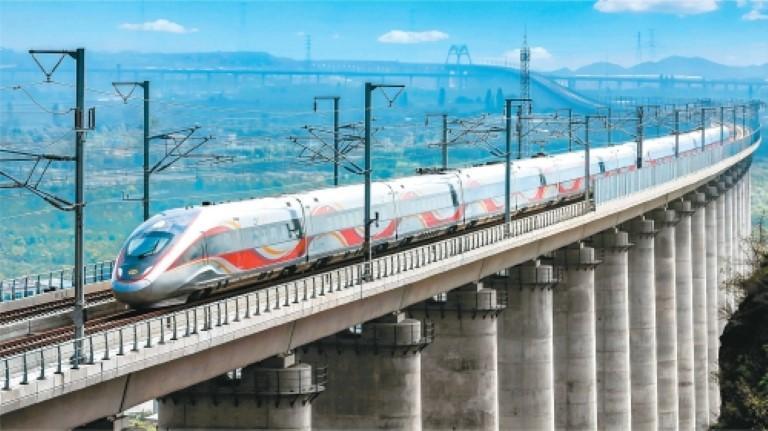
Core Viewpoint - The integration of the Xiyan High-Speed Railway into the national high-speed rail network before the Spring Festival will enhance winter tourism and connect small counties to larger markets [1] Group 1 - The Xiyan High-Speed Railway will transition from C-series trains to G-series trains, indicating a significant upgrade in service [1] - This change is expected to boost tourism in the regions along the railway during the winter season [1] - The railway will facilitate small counties' access to national markets, promoting economic growth [1]
看高清视频、打视频通话……西延高铁如何做到隧道信号也很好→
Ren Min Ri Bao· 2026-01-13 12:48
Core Viewpoint - The Xi'an to Yan'an high-speed railway has achieved full coverage of public 5G signals, even in tunnels, enhancing passenger connectivity and experience during travel [2][6]. Group 1: High-Speed Railway Overview - The Xi'an to Yan'an high-speed railway, the first in the Shaanxi Northern Revolutionary Area, successfully transported 97,000 passengers over the New Year's holiday [2]. - The railway features a significant proportion of tunnels, with over 55% of its length consisting of tunnel sections [2]. Group 2: 5G Signal Coverage - The railway's construction included the simultaneous installation of infrastructure to ensure full public 5G signal coverage, even in tunnels [2]. - The New Yan'an Tunnel, which is 16 kilometers long, has over 80 chambers, with 16 designated for base station installations, ensuring one base station per kilometer [2][3]. Group 3: Technical Innovations - The use of leaky coaxial cables, which have periodic openings in their outer skin, allows for uniform signal radiation throughout the tunnel, creating a continuous "signal corridor" [3]. - The installation of leaky cables is designed to align with the height of train windows, optimizing signal coverage within the train [3]. Group 4: Engineering Challenges and Solutions - The design team faced significant challenges due to the aerodynamic effects created by high-speed trains, which required precise calculations for the installation of leaky cable supports [3][4]. - A new type of mechanical anchor bolt was developed, which has a tensile load capacity of 15 kilonewtons, significantly exceeding the required strength for installation [4]. Group 5: Testing and Implementation - A full-scale simulation communication room was constructed to replicate the typical equipment configuration of the railway, allowing for extensive testing under various extreme conditions [4][5]. - The final installation process involved meticulous steps to ensure precision, including controlling drilling depth and using specialized equipment to prevent contamination [5]. Group 6: Future Applications - The successful implementation of 5G coverage on the Xi'an to Yan'an railway has led to the development of over 190 construction standards, which will be applied to other ongoing projects such as the Xikang and Xishi high-speed railways [6].
从延安通高铁感悟欣欣向荣的中国
Ren Min Ri Bao· 2026-01-12 04:03
Core Viewpoint - The opening of the Xi'an to Yan'an high-speed railway marks the entry of the Shaanxi Northern Revolutionary Area into the "high-speed rail era," contributing to China's high-speed rail network, which now exceeds 50,000 kilometers, the largest and most advanced in the world [1][2]. Group 1: Development Certainty - The historical perspective shows the certainty of China's development through the opening of the Xi'an to Yan'an high-speed railway, which significantly reduces travel time from 14 hours to 2.5 hours and is designed for a speed of 350 kilometers per hour [2][3]. - The establishment of the first version of the "Medium- and Long-Term Railway Network Plan" in 2004 laid the foundation for China's high-speed rail development, leading to a new phase of rapid growth [2]. - China's high-speed rail network has the longest operational mileage, the highest annual growth rate, and the most kilometers under construction globally, demonstrating a systematic and strategic approach to development [2][3]. Group 2: Development Creativity - The construction of the high-speed railway through the challenging terrain of the Loess Plateau showcases China's innovative capabilities in overcoming engineering difficulties [3][4]. - The collaborative efforts of various government departments, enterprises, and research institutions in developing the CR450 train set exemplify the concentration of resources to enhance innovation [5][6]. Group 3: Development Opportunities - The high-speed railway to Yan'an creates new pathways for development, enhancing the market for local agricultural products and boosting tourism, with an expected annual visitor count of over 50 million in Yan'an [8][9]. - The railway facilitates regional collaboration, integrating Yan'an into the "one-hour economic circle" of Xi'an, thus improving logistics and attracting high-end talent [8][9]. - The ongoing development of major projects during the 14th Five-Year Plan period is expected to lead to sustained growth in disposable income in revolutionary areas, surpassing the national average [9].
【省发展改革委】陕西区域协同发展气象新
Shan Xi Ri Bao· 2026-01-11 22:47
Core Insights - The opening of the Xi'an Metro Line 15 and the Xiyan High-speed Railway marks significant advancements in transportation infrastructure in Shaanxi, enhancing connectivity and improving the quality of life for residents [1][2]. Transportation Development - The Xi'an Metro Line 15, referred to as a "livelihood line," is expected to reshape the transportation landscape in southern Xi'an, with nearly 100,000 passengers on its first day of operation [1]. - The Xiyan High-speed Railway connects Yan'an to the Guanzhong region, facilitating a one-hour commuting circle and promoting regional collaboration [2]. Regional Coordination and Urban-Rural Integration - Shaanxi is focusing on regional coordinated development and urban-rural integration as essential strategies for high-quality growth [3]. - The provincial government is enhancing the regional coordination mechanism, promoting innovation in Guanzhong, energy transformation in northern Shaanxi, and ecological upgrades in southern Shaanxi [4]. Economic Transformation in Northern Shaanxi - The Yulin Energy Revolution Innovation Demonstration Zone is leading the transformation with two major projects aimed at advancing the coal chemical industry towards high-end, diversified, and low-carbon development [5]. - Yulin has been approved to establish a national cold chain logistics base, further supporting its economic transformation [5]. County-Level Economic Growth - County-level economic policies are shifting from "low support" to "strong support," with 30 counties now exceeding an economic scale of 20 billion yuan, doubling the number from the previous five-year plan [6]. - The expected output value of leading industries in counties is projected to surpass 1.5 trillion yuan, indicating significant growth in local economies [6]. Strategic Development Goals - The provincial government aims to optimize the regional economic layout by implementing a strategy that emphasizes dual-polar growth, multi-point support, and coordinated development across three regions [6][7]. - The focus will be on enhancing the leading roles of Xi'an and Yulin, fostering a balanced urban-rural development model, and leveraging experiences from poverty alleviation initiatives to promote comprehensive rural revitalization [6][7].
新场景点燃新需求 “情绪价值”成增长密码——元旦假期消费市场盘点
Xin Hua She· 2026-01-03 12:56
Group 1: Travel and Transportation - Approximately 590 million trips were made during the New Year holiday, averaging about 198 million trips per day [2] - The opening of the Xi'an to Yan'an high-speed railway reduced travel time to about 1 hour, contributing to a 165% increase in daily visitors to the Hukou Waterfall scenic area [2] - Didi's ride-hailing demand surged by 31% year-on-year during the holiday, with peak demand exceeding 189,000 requests per minute on New Year's Eve [2][3] Group 2: Tourism and Cultural Experiences - The emphasis on "experience" and "ceremony" in cultural tourism was highlighted, with a 125% year-on-year increase in searches related to New Year travel [4] - Popular destinations for ice and snow tourism accounted for 40% of the top 20 domestic flight routes during the holiday [6] - The trend of "emotional experience" in consumer behavior reflects a shift from material satisfaction to more personalized and diverse demands in cultural tourism [4] Group 3: Consumer Spending and Retail - The introduction of the "National Subsidy" program led to a significant increase in consumer spending on home appliances, with foot traffic in stores rising by 110% during the holiday [7] - The "China Shopping" trend gained momentum, with foreign tourists increasingly participating in shopping experiences across various cities [8] - The Ministry of Commerce emphasized the importance of ensuring market supply and stable prices during the holiday season, with plans for promotional activities to boost consumption [8]
