
鸡蛋供应与需求

Search documents
10月鸡蛋实际供应压力或依然较大 蛋价重心仍将下移
Xin Hua Cai Jing· 2025-10-11 07:18
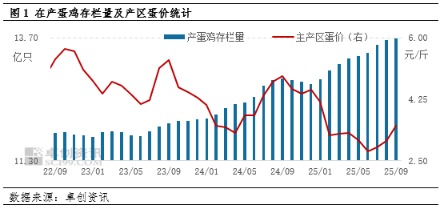
Group 1 - The core viewpoint indicates that the domestic laying hen inventory continues to rise, leading to a downward trend in egg prices due to supply pressure [1][2] - In September, the national laying hen inventory reached approximately 1.368 billion, with a month-on-month increase of 0.22% and a year-on-year increase of 6.05%, contributing to significant supply pressure [2][4] - The average price of eggs in major production areas was 3.49 yuan per jin, reflecting a month-on-month increase of 14.05% but a year-on-year decrease of 28.92% [2] Group 2 - The number of new laying hens in September was high, with around 90 million chicks added, despite a month-on-month decrease of 4.27% [4] - The profit per kilogram of eggs in September was 0.26 yuan, which is a month-on-month increase of 0.45 yuan, but the increase in the number of hens slaughtered was less than expected [4][7] - In October, the laying hen inventory is expected to decrease slightly to around 1.367 billion, but actual inventory may differ due to uncertainties in the slaughter of hens [5][8] Group 3 - October is traditionally a low-demand season for eggs, which may lead to a further decline in egg prices and potential losses for farmers, prompting them to slaughter hens earlier [8] - The expected decrease in the laying hen inventory in October may be more significant than theoretical estimates, potentially dropping to around 1.36 billion [8]

鸡蛋周报:天气压制现货反弹,盘面重回区间震荡-20250623
Zhong Yuan Qi Huo· 2025-06-23 11:06
1. Report Industry Investment Rating - Not provided in the content 2. Core Viewpoints of the Report - The current contradiction is the co - existence of high supply and seasonal weather factors, leading to low spot prices. However, the market is approaching a cycle and seasonal strength - weakness conversion point, and a stage of spot - futures linked rebound is imminent [3]. - The futures has started a cycle conversion and bottomed out, while the spot is still restricted by weather and short - term supply - demand pressure, but the seasonal peak season is coming [6][13]. - The overall cost is oscillating with a small decline, and the breeding profit has fallen into a deep loss. The negative feedback of production capacity caused by profit loss is gradually taking effect [3][30][31]. - The market competition is intensifying, with bears and bulls having different views. The basis is expected to strengthen, and short - term reverse arbitrage is the main strategy [34][36][39] 3. Summary by Relevant Catalogs Futures Review - Last week, the egg futures showed a strong performance, mainly breaking through and rising, and continued to trade at a premium to the spot. The sentiment brought by the stable and rising spot was greater than the actual support. The futures has started a cycle conversion and bottomed out [6]. Spot Review - Last week, the egg spot continued a strong rebound, with the sales areas driving the production areas to rise. The restocking in sales areas and food factories led to the price rebound. However, the continuous rain in southern sales areas restricted the rebound height of the spot price, and downstream restocking was relatively cautious. But the seasonal peak season is coming, and demand support is about to start, while the energy efficiency of the supply side will further decrease [13]. Supply - **New Capacity**: From June to August 2025, the newly opened production corresponds to the replenishment volume from February to April 2025, which remains at a high level, and the new volume is higher than the historical average [18]. - **Eliminated Capacity**: From June to August 2025, the normal eliminated capacity corresponds to the replenishment volume from October 2023 to January 2024, and the available eliminated capacity is relatively neutral [18]. - **Laying Hens Inventory**: The inventory remains at a high level, the new capacity is increasing steadily, the new replenishment has slowed down, and the available eliminated capacity this month has decreased steadily. The data shows that the backward production capacity has started the active elimination stage, but relatively slowly, and the overall supply pressure still exists [18]. Elimination - The backward production capacity is being removed, but has not entered the acceleration phase. The price of eliminated chickens is 4.51 yuan/jin, down 0.1 yuan/jin, and may be approaching the bottom - rebound period; the elimination volume has continued to rise and is approaching the peak; the elimination age is 502 days, down 2 days, and the downward trend of age is obvious [21]. Other Supply - Related Indicators - **Egg - producing Egg Rate**: It is 90.34%. As the temperature rises, the egg - producing rate continues to decline, but the decline rate this year is relatively slow. In July, high - temperature will cause the energy efficiency to drop by about 4%, and potential positive factors are emerging [23]. - **Seasonality**: It is in the transition period from the off - season to the peak season, and a certain turnaround is expected to occur in mid - June [25]. - **Production Area**: Currently, the production areas are actively selling. With the increasing high temperature, new chickens are constantly starting to lay eggs [25]. - **Consumption Area**: The restocking has ended, the overall demand is average, and the weather factors are suppressing the egg price [25]. - **Substitute Products**: Vegetable prices are about to enter a seasonally strong stage, which will support the egg price; pork prices continue to weaken, and the substitution effect on eggs is not obvious; other meat prices are strengthening [27]. Cost & Profit - **Cost**: Corn prices are running at a high level, and the spot price of soybean meal is falling steadily. The overall cost is oscillating. Currently, the feed cost is about 2.5 yuan/jin, and the comprehensive breeding cost is about 2.8 yuan/jin [30]. - **Profit**: The breeding profit has fallen below the feed cost, and the whole industry has entered a deep - loss period, running at a low level, waiting for a seasonal bottom - rebound. The negative feedback of production capacity caused by profit loss is gradually taking effect, and attention should be paid to the elimination of backward production capacity [31]. Capital and Market Indicators - **Capital**: The capital is at a high level, and the market competition is intensifying. Bears believe that the production capacity is high and there is still room for decline due to seasonal suppression, while bulls believe that the valuation is low and it is time to go long due to the upcoming seasonal shift from weak to strong [34]. - **Basis**: The basis is negative, and the overall market is trading at a premium. The expectation is positive. Currently, the basis is running at a low level, waiting for the strengthening trend of the basis brought by the peak season. The rhythm may slow down, but the trend will not change, and the support brought by the strengthening basis is approaching [36]. - **Spread**: The falling spot price is suppressing the near - month contracts, and short - term reverse arbitrage is the main strategy [39].
5月供应端或同比继续增加 鸡蛋期货走势承压运行
Jin Tou Wang· 2025-05-19 08:29
Core Viewpoint - The main trend in egg futures is a downward movement, with the primary contract experiencing a decline of 1.14% to 2853.00 yuan, indicating ongoing pressure on egg prices due to high supply and cautious demand [1] Group 1: Market Analysis - Jiangsu Futures indicates that short-term production capacity has not been cleared, leading to pressure on egg prices. Despite potential support from increased downstream purchasing as the Dragon Boat Festival approaches, high supply levels and adverse weather conditions in southern regions are likely to limit demand [2] - Ruida Futures notes that the overall decline in egg prices is slowing, with strong corn prices providing cost support. However, high levels of egg-laying hen stocks and substantial new production pressure may restrict price increases, leading to a cautious market outlook [3] - Southwest Futures suggests that while supply may continue to increase year-on-year, pre-festival stocking could provide some support. The firm recommends considering short-selling after potential price rebounds [4]