黄金价值

Search documents
恒定不灭的黄金:神秘的天外来客,俘虏了古今人类(之四)
Sou Hu Cai Jing· 2025-12-17 05:45
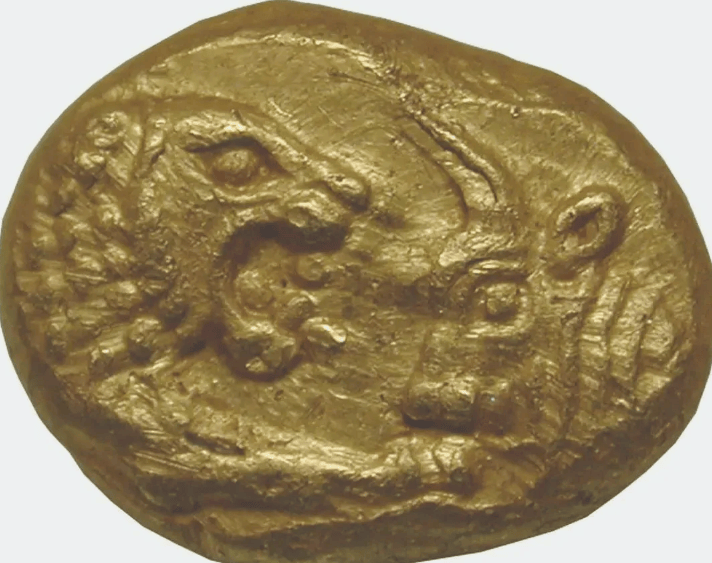
Group 1: Historical Significance of Gold Artifacts - The Sanxingdui gold artifacts represent the peak of early precious metal craftsmanship in ancient China, with over 2000 grams of gold used in various items such as gold staffs and masks [1] - The earliest known coins were minted in Lydia around the 6th century BC, made from natural gold-silver alloys, leading to significant wealth for the Lydians [2] - The oldest known Chinese coins, known as Yingyuan, were used during the Warring States period and had a gold content of over 90%, primarily used for significant transactions and gifts [3] Group 2: The Golden Age of the Western Han Dynasty - The largest quantity of gold artifacts found in China comes from the Western Han tomb of the Marquis of Haihun, with 478 pieces totaling 115 kilograms, marking the "Golden Age" of the Western Han [4] - The purity of the gold artifacts from this period is exceptionally high, reaching 99%, with various forms serving both currency and ceremonial purposes [4] Group 3: Modern Gold Utilization and Value - Colombia is renowned for its historical gold production, with the Bogotá Gold Museum housing over 30,000 ancient gold artifacts [11] - Modern smartphones contain gold in various components, with an iPhone containing approximately 0.034 grams of gold, valued at about 13.3 yuan [11] - Historically, the total market value of all gold mined is around $30 trillion, with annual supply and demand stable at approximately 4,500 tons [12][13]

地球可能存在4亿亿吨黄金,人均超500万吨,为何挖金矿却很难?
Sou Hu Cai Jing· 2025-07-14 03:30
Core Insights - The article discusses the historical context of gold mining in the United States during the gold rush, highlighting that 99.99% of prospectors returned empty-handed despite the allure of wealth [1] - It emphasizes the vast amount of gold estimated to be within the Earth, approximately 400 trillion tons, yet the difficulty of extraction due to its deep burial [3] - The article explains the natural processes that lead to the formation of gold deposits, including volcanic activity and geological movements [5][7][8] Group 1: Gold Formation and Sources - Gold is primarily formed through volcanic eruptions, which bring rare elements to the surface, leading to the creation of gold-rich ores [5] - Natural gold deposits are a significant source of gold, formed through geological processes that have allowed some gold to remain exposed at the surface [8] - The Rand goldfields in South Africa are highlighted as a major source, containing over 50% of the world's gold reserves, supplying 600 to 700 tons annually [10] Group 2: Gold's Value and Consumption - Despite increasing global gold supply, its value remains stable, and it is recognized not only as a store of value but also as a luxury consumable [12][15] - Gold is used in various applications, including medical treatments and food decoration, although its recovery after use is often inefficient [14][15] - The article warns that as surface gold deposits diminish, the potential for exploiting deeper reserves may arise, leading to ethical and environmental concerns [20] Group 3: Cosmic Perspective on Gold - Gold is formed in stars through nuclear fusion and is released into the universe during supernova explosions, eventually contributing to the formation of planets [18] - The article discusses the implications of attempting to mine gold from the Earth's core, suggesting that it could destabilize the planet's mass and gravitational integrity [17][20]