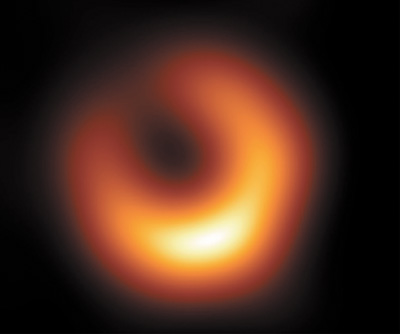
黑洞研究

Search documents
依托“天关”卫星 黑洞研究又有新发现
Xin Lang Cai Jing· 2026-02-10 09:48
Core Insights - The "Tian Guan" satellite (Einstein Probe Satellite) has captured an unprecedented high-energy cosmic explosion, differing significantly in brightness variation, radiation rhythm, and spectral characteristics from any known explosions [1] Group 1: Scientific Discovery - The explosion observed by the "Tian Guan" satellite is hypothesized to be the process of a medium-mass black hole tearing apart a white dwarf star [1] - The findings related to this cosmic event have been published in the academic journal "Science Bulletin" [1]
三张“甜甜圈”照片 揭示黑洞研究新发现
Huan Qiu Wang Zi Xun· 2025-10-12 10:54
Core Insights - The Event Horizon Telescope has discovered new changes in the mysterious celestial body known as a black hole, revealing significant advancements in understanding its magnetic field variations [3]. Group 1: Observational Data - Observations were made in 2017, 2018, and 2021, showing a progression in the magnetic field of the black hole [3]. - In 2017, the magnetic field exhibited a unidirectional spiral pattern, while in 2018 it remained relatively stable [3]. - By 2021, the magnetic field had completely reversed, indicating dynamic changes in the surrounding environment of the black hole [3]. Group 2: Scientific Implications - The evolution of polarization reflects the turbulent magnetic field around the black hole, which is crucial for understanding how matter falls into the black hole and how energy is released outward [3].
人类首次看见的黑洞有了新照片
Ren Min Ri Bao· 2025-09-17 22:22
Group 1 - The Event Horizon Telescope collaboration has released new images and research findings regarding the supermassive black hole at the center of the M87 galaxy, revealing the evolution of polarized radiation over time [1] - The M87 galaxy is approximately 55 million light-years away from Earth, and its central black hole has a mass over 6 billion times that of the Sun [1] - The analysis of images from 2017, 2018, and 2021 shows a significant change in the magnetic field distribution around the M87 black hole, indicating a continuous evolutionary state of the black hole and its surrounding environment [1] Group 2 - Powerful jets, like those from the M87 black hole, play a crucial role in galaxy evolution by regulating star formation and energy distribution on a large scale [2] - These jets produce a wide range of electromagnetic radiation, including gamma rays and neutrinos, providing a unique "laboratory" for studying the formation mechanisms of extreme cosmic phenomena [2] - The ongoing improvements in the observational capabilities of the Event Horizon Telescope deepen the understanding of the physical properties of black holes [2]
【新华社】人类首次“看见”的黑洞,“身份照”又上新!
Xin Hua She· 2025-09-17 00:44
Core Insights - The Event Horizon Telescope (EHT) collaboration has released new images and research findings of the supermassive black hole at the center of the M87 galaxy, published in the journal "Astronomy & Astrophysics" [2][4]. Group 1: Black Hole Characteristics - The M87 black hole is located 55 million light-years from Earth and has a mass approximately 6.5 billion times that of the Sun [4]. - The first image of the black hole was captured in 2017 and published in 2019, with subsequent observations in 2018 and 2021 [4]. Group 2: Research Findings - The latest findings reveal the evolution of polarized radiation around the M87 black hole over time, with significant changes in magnetic field distribution observed between 2017 and 2021 [4]. - The magnetic field direction changed from counterclockwise in 2017 to clockwise in 2021, indicating a continuous evolutionary state of the black hole and its surrounding environment [4]. Group 3: Implications for Astrophysics - The powerful jets associated with supermassive black holes like M87 play a crucial role in galaxy evolution by regulating star formation and energy distribution on a large scale [5]. - The new discoveries provide essential insights into the mechanisms behind extreme cosmic phenomena, contributing to the understanding of the universe [5]. Group 4: Technological Advancements - The EHT collaboration has enhanced observational capabilities by adding two new telescopes in 2021, significantly improving sensitivity and image clarity [5]. - Upgrades to existing telescopes have further enhanced data quality, facilitating ongoing research in astrophysics [5].

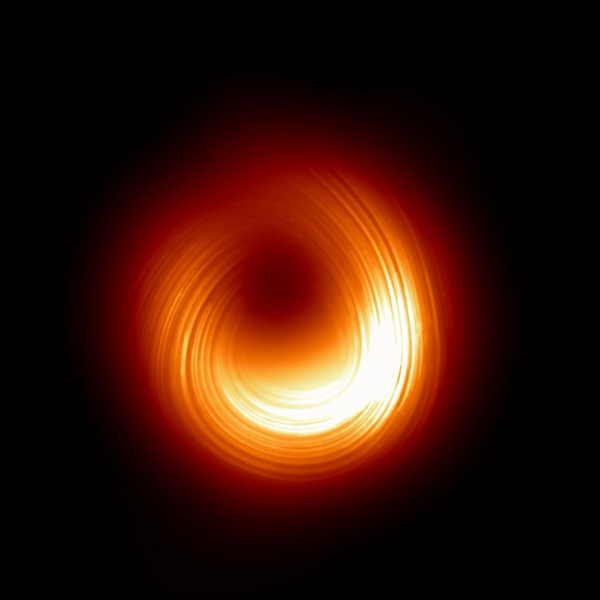
人类首次“看见”的黑洞,“身份照”又上新!
Qi Lu Wan Bao· 2025-09-16 13:25
Core Insights - The Event Horizon Telescope (EHT) collaboration released new images and research findings of the supermassive black hole at the center of the M87 galaxy, published in the journal Astronomy & Astrophysics [2] Group 1: Research Findings - The M87 black hole is located 55 million light-years from Earth and has a mass approximately 6.5 billion times that of the Sun, with the first image captured in 2017 and released in 2019 [2] - The latest image is based on observational data from 2017, 2018, and 2021, revealing the evolution of polarized radiation around the black hole over time and the first signs of extended radiation connecting the black hole's ring structure to the base of its jets [2][4] - Analysis of the three images indicates a change in the magnetic field distribution around the black hole, with a counterclockwise direction in 2017, consistent in 2018, and a clockwise reversal in 2021, suggesting ongoing evolution in the black hole's environment [4] Group 2: Implications for Astrophysics - The significant change in polarization direction may result from the interplay between internal magnetic structures and external effects, reflecting a turbulent environment around the black hole [4] - The powerful jets associated with M87 play a crucial role in galaxy evolution by regulating star formation and energy distribution on a large scale, producing electromagnetic radiation that aids in understanding extreme cosmic phenomena [4] Group 3: Technological Advancements - The EHT collaboration enhanced its observational capabilities in 2021 by adding two telescopes in Arizona and France, improving sensitivity and image clarity, along with upgrades to existing telescopes [5]
人类首图黑洞最新研究:为破解宇宙极端现象谜题提供关键拼图
Zhong Guo Xin Wen Wang· 2025-09-16 08:25
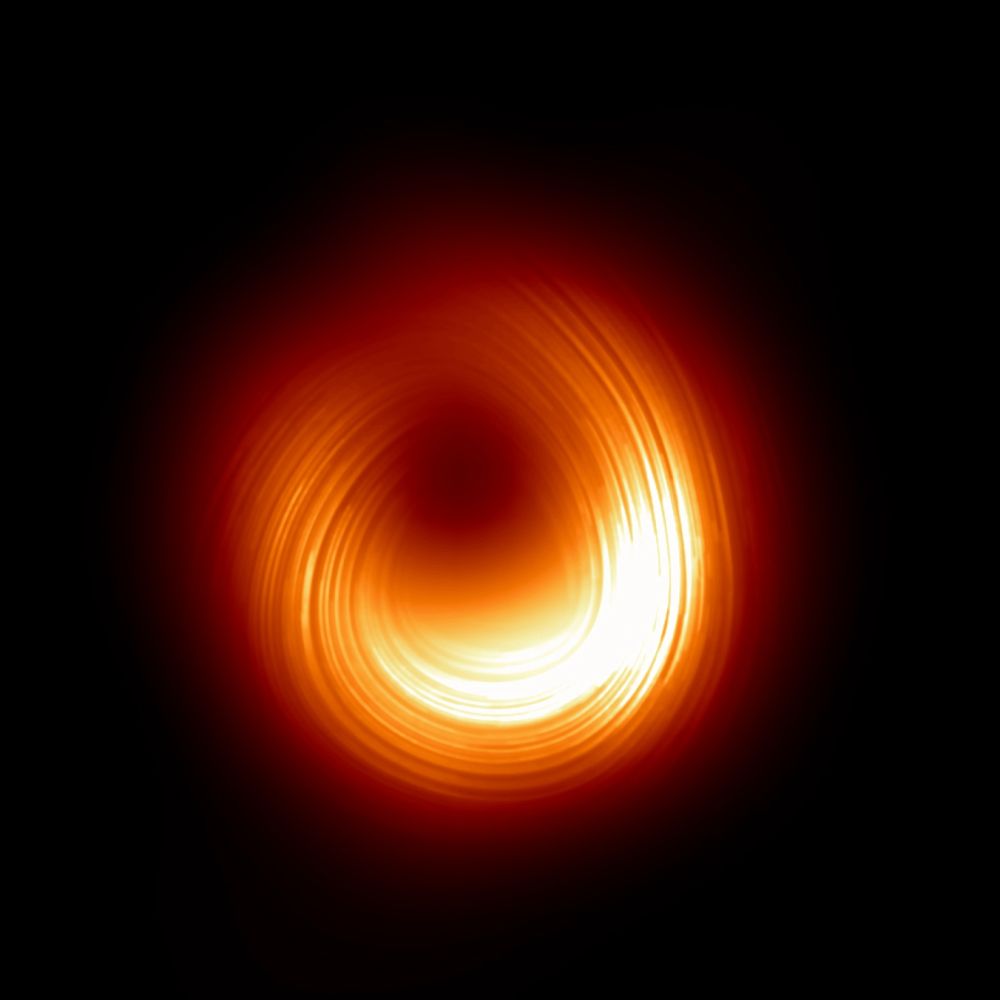
Core Insights - The latest research on the M87* black hole provides crucial insights into the extreme phenomena of the universe, revealing evolving polarization patterns and detecting 230 GHz radiation [1][2]. Group 1: Research Findings - The Event Horizon Telescope (EHT) collaboration has released new images showing the dynamic environment around the M87* black hole, highlighting unexpected changes in polarization direction over time [2][5]. - Observations from 2017 to 2021 indicate a significant flip in the polarization direction of the black hole's magnetic field, suggesting a complex and dynamic environment influenced by both internal magnetic structures and external effects [5][6]. - The research demonstrates that the size of the black hole's ring structure remained consistent over four years, confirming predictions made by Einstein's general relativity, while the polarization patterns exhibited significant changes [3][6]. Group 2: Technological Advancements - The addition of new telescopes, such as the Kitt Peak Observatory and the Northern Extended Millimeter Array (NOEMA), has significantly enhanced the sensitivity and imaging clarity of the EHT, allowing for the first successful constraints on the radiation direction of relativistic jets near the black hole [7]. - Upgrades to existing telescopes, including the Greenland Telescope and the James Clerk Maxwell Telescope (JCMT), have further improved data quality, enabling the detection of weak polarization signals [7]. Group 3: Implications for Astrophysics - The findings contribute to understanding how powerful jets from black holes influence star formation and energy distribution on a large scale, providing a unique laboratory for studying the mechanisms behind extreme cosmic phenomena [8]. - The EHT's evolution into a mature observatory not only captures unprecedented images of black holes but also deepens the understanding of black hole physics, showcasing its significant scientific potential [8].

银河系中心黑洞转速或正接近极限
Ke Ji Ri Bao· 2025-06-17 00:51
Group 1 - The core finding of the research indicates that the black hole at the center of the Milky Way may be spinning at a speed close to the theoretical limit [1][2] - The study utilized artificial intelligence to analyze millions of simulated data files, enhancing the precision of uncertainty quantification and achieving unprecedented accuracy in comparing observational data with theoretical models [2] - The research revealed that the radiation around the black hole primarily originates from extremely hot electrons in the accretion disk, rather than the previously theorized jets [1][2] Group 2 - The high-throughput computing technology employed in this research is likened to a symphony orchestra of thousands of computers, efficiently processing vast amounts of data [1] - This technology is currently supporting hundreds of global research projects across various fields, including neutrino detection and antibiotic resistance [1] - The study challenges long-standing theories regarding black hole behavior and provides new insights into the dynamics of accretion disks [1][2]
黑洞是如何“长”大的(瞰前沿)
Ren Min Ri Bao· 2025-04-11 21:51
Core Insights - The discovery of evidence showing the impact of supermassive black holes on the formation and evolution of host galaxies has been recognized as one of the "Top Ten Scientific Advances in China" for 2024 [8] - Black holes continue to be a hot topic in the scientific community, with significant public interest stemming from their mysterious nature and the technological advancements that allow for their study [9][10] Group 1: Black Hole Types and Formation - Black holes are categorized into three types based on mass: stellar black holes (a few to tens of solar masses), supermassive black holes (millions of solar masses), and intermediate black holes [10] - Stellar black holes form from the collapse of massive stars after supernova explosions, while supermassive black holes may grow from intermediate black holes through mergers or accretion of surrounding gas [15][16] - The existence of intermediate black holes remains uncertain, often referred to as the "missing link" in black hole research [14] Group 2: Detection and Research Methods - Various methods have been developed to detect black holes, including X-ray detection, gravitational wave observation, and gravitational lensing techniques [13] - Recent advancements include the discovery of GaiaBH3, the largest known stellar black hole in the Milky Way, and the identification of a small black hole (G3425) that fills a gap in the black hole mass distribution [13] Group 3: Technological Impact and Applications - Research on black holes has led to technological advancements that impact everyday life, such as the development of WiFi technology and laser interferometry used in earthquake warning systems and medical imaging [10] - The study of black holes not only addresses cosmic mysteries but also symbolizes humanity's quest for knowledge and technological progress [11]