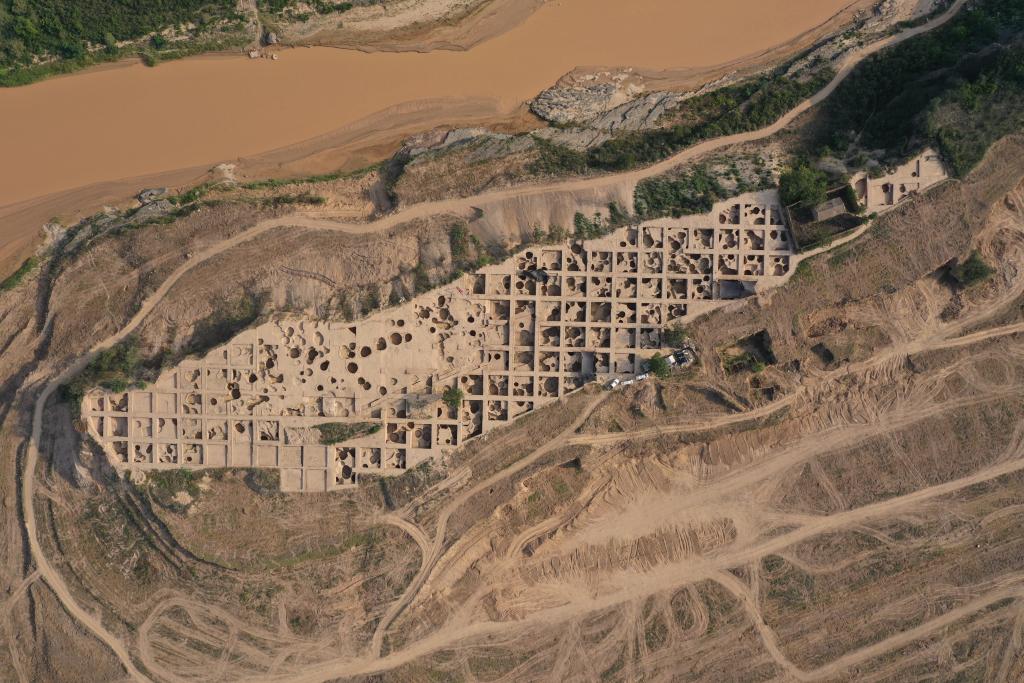
龙山文化早期

Search documents
古代粮库长啥样?陕西罗家河遗址考古发掘成果公布
Yang Shi Wang· 2025-12-14 19:44
Core Insights - The archaeological findings at the Luojiahe site in Shaanxi reveal a large storage site dating back approximately 4,800 to 4,200 years, associated with the early Longshan culture [1][2] Group 1: Archaeological Findings - The Luojiahe site covers an area of about 50,000 square meters, with an excavation area of approximately 14,200 square meters, uncovering 1,068 various relics from the Miao Digo II cultural period, including pits, storage cellars, house sites, and pottery kilns [2] - A total of 17 grain storage cellars were identified, with the largest having a diameter of 4.42 meters and a depth of 3.8 meters, indicating significant storage capacity [3][10] - The excavation yielded over 1,000 artifacts, including pottery, stone tools, and jade items, with 1,003 items already restored and categorized [5] Group 2: Storage and Agricultural Practices - The storage methods included various techniques such as storing with ears of grain, threshing, and shelling, with evidence of woven straw artifacts resembling those used for bundling crops [3][4] - The total volume of the identified storage cellars is approximately 390 cubic meters, estimated to hold around 300 tons of millet, indicating the site's role as a significant grain storage facility [10] Group 3: Cultural and Environmental Insights - The site is interpreted as a specialized settlement focused on storage, providing crucial evidence for understanding early civilization and state origins in the Guanzhong region [9] - The discovery of animal bones from 18 species, including aquatic and domesticated animals, suggests a diverse ecosystem and a climate that was likely warmer and more humid than today [11]
陕西咸阳发现龙山文化早期大型仓储遗址
Xin Hua She· 2025-12-03 23:07
Core Insights - Archaeological findings at the Luojiahe site in Shaanxi Province reveal multiple granary pits, indicating significant agricultural storage practices during the early Longshan period, approximately 4800 to 4200 years ago [2][4] Group 1: Archaeological Discoveries - The Luojiahe site has uncovered 17 granary pits, characterized by circular or oval shapes, with well-constructed walls and intentionally leveled bottoms, suggesting advanced construction techniques [2] - Four of the granary pits contained carbonized grains such as millet and broomcorn, along with stalk remnants, indicating their use for grain storage [4] - The total volume of the 17 granary pits is approximately 390 cubic meters, estimated to hold around 300 tons of millet [4] Group 2: Cultural Significance - The concentration of granary pits at the Luojiahe site exceeds the food consumption capacity of the local population, suggesting it served as a specialized storage base for a larger central settlement in the Jinghe River basin [4] - The findings provide important physical evidence for exploring the origins of early civilization and state formation in the Guanzhong region [4]