101计划

Search documents
“101计划”了解一下!江苏9所高校榜上有名,其中8所“双一流”
Xin Lang Cai Jing· 2026-01-17 12:35
Core Insights - The "101 Plan" in the field of intelligent manufacturing has officially launched at Huazhong University of Science and Technology, coordinated by the Ministry of Education and involving 16 universities, research institutes, and enterprises nationwide [1][2] - The "101 Plan" aims to address talent cultivation issues by focusing on core elements such as curriculum, textbooks, faculty, and practical projects, initially starting in the computer science field and expanding to other disciplines [2] - As of now, the plan has extended to nearly 80 "Double First-Class" universities across various fields, including statistics, traditional Chinese medicine, and intelligent manufacturing, with a goal to develop 14 core courses in intelligent manufacturing [2][3][4] Summary by Category - **Plan Overview** - The "101 Plan" was initiated in 2021 to reform undergraduate education in computer science and has since expanded to include multiple disciplines [2] - The plan's core tasks include building high-quality core courses, textbooks, teaching teams, and practical projects [2] - **Field Expansion** - The plan has been broadened to include foundational disciplines such as mathematics, physics, chemistry, and more, with a second batch set to launch in fields like integrated circuits and artificial intelligence [2] - The intelligent manufacturing sector is one of the latest areas to be included, with plans to establish 14 core courses [3] - **Participation and Impact** - Nearly 80 top-tier universities are participating in the "101 Plan," with specific universities in Jiangsu province being recognized for their contributions [4] - The computer science sector has already seen significant achievements, including the development of 12 core courses and 31 textbooks, benefiting over 20,000 students [2]
图灵奖获得者霍普克罗夫特:中国重视人才培养将推动人工智能发展
Xin Hua She· 2025-12-19 15:51
Group 1 - The core viewpoint of the articles highlights China's significant investment in higher education and its ample reserve of technological talent, which are seen as advantages for accelerating the development of artificial intelligence in the country [1][2] - John Hopcroft, a Turing Award winner, emphasizes that Chinese students are fortunate to be in a country that prioritizes AI education, showcasing the substantial resources allocated to talent cultivation [1] - The "101 Plan," proposed by Hopcroft, is a pilot program initiated by the Ministry of Education aimed at reforming undergraduate education in computer science and expanding to other foundational disciplines, including AI by 2024 [1] Group 2 - Hopcroft notes that while Chinese universities gather a large number of top talents with strong problem-solving skills, there is a need to focus more on developing students' soft skills, such as creativity and foresight [2] - He encourages young individuals aspiring to work in AI to pursue their passions, stating that genuine love for their field is crucial for success [2] - Hopcroft advises parents to provide their children with enough time and freedom to explore their interests and realize their life values [2]
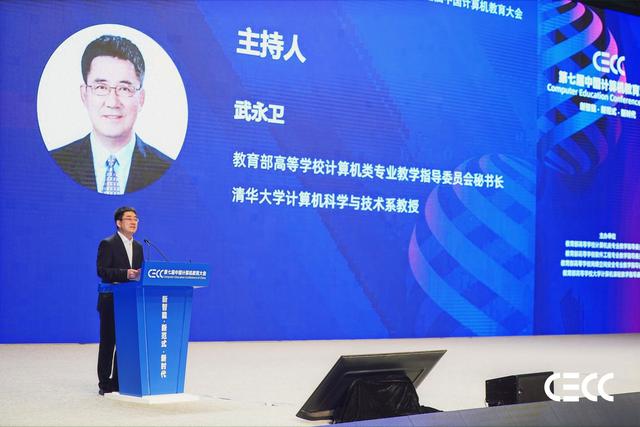
第七届中国计算机教育大会(CECC)在厦门召开
Huan Qiu Wang· 2025-12-02 09:15
Core Viewpoint - The 7th China Computer Education Conference (CECC) emphasizes the transformation of computer education in the context of rapid AI development, aiming to enhance talent cultivation and drive innovation in education [1]. Group 1: Conference Overview - The conference, themed "New Intelligence, New Paradigm, New Era," took place at the Xiamen International Conference Center, gathering over a hundred experts from academia, education, and industry [1]. - The event is co-hosted by various educational committees and universities, with support from major companies like Huawei and Alibaba Cloud [1]. Group 2: Keynotes and Presentations - Wu Yongwei, the conference chair, highlighted the importance of aligning talent cultivation with national development and fostering innovative talents through policy innovation [4][9]. - Zhao Qinpeng, a member of the conference guiding committee, stressed the need to break traditional paradigms and create a new educational ecosystem to nurture innovative talents [6]. - John Hopcroft, a Turing Award winner, presented on the "101 Plan," advocating for reforms in curriculum and teaching to improve the quality of foundational discipline talent cultivation [11]. - He You, a vice president of the Chinese Academy of Artificial Intelligence, discussed the applications of AI in education and the challenges it faces, such as model bias and misuse [12]. Group 3: Thematic Forums and Discussions - The conference will feature 12 thematic sub-forums covering topics like high-quality talent cultivation, AI education, and the integration of industry and education [14]. - The event aims to foster collaboration between universities and leading companies to enhance the cultivation of top-tier talents in computer science [14]. Group 4: Awards and Recognition - The 2025 Education Ministry-Huawei "Intelligent Base" awards recognized 20 outstanding teachers and 6 exemplary textbooks, highlighting the commitment to excellence in computer education [15]. - Since its inception in 2019, the CECC has attracted over 20,000 participants, establishing itself as a vital platform for the integration of computer education and industry [15].