3D芯片堆叠技术

Search documents
三星、美光、英特尔分食英伟达大单:三星代工LPU,美光量产HBM4
Hua Er Jie Jian Wen· 2026-03-17 06:10
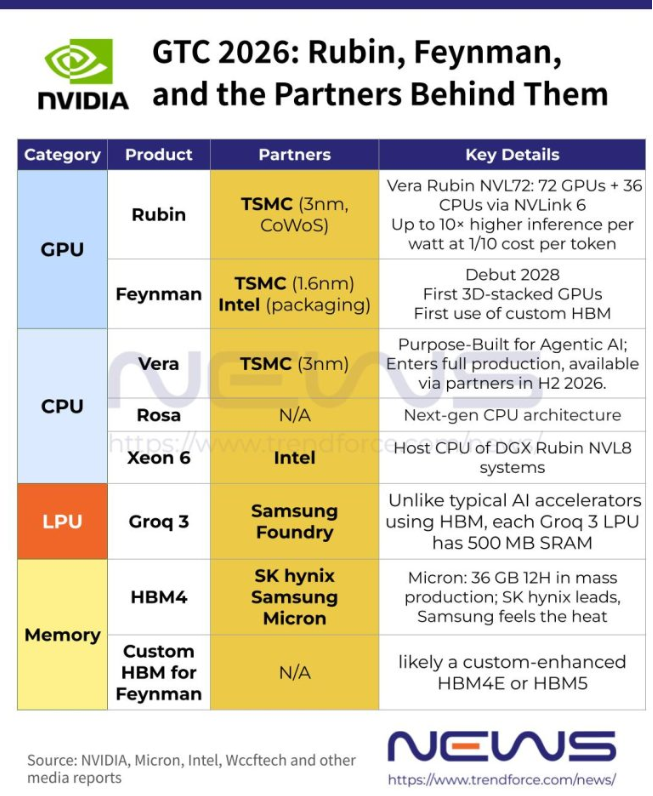
Core Insights - The Nvidia GTC 2026 conference marks a significant reshaping of the supply chain dynamics, particularly with the introduction of the next-generation AI platform, Vera Rubin, and the roles of major chip manufacturers like Samsung, Micron, and Intel [1] Group 1: Nvidia's Product Developments - Nvidia's CEO Jensen Huang confirmed that the Groq 3 LPU will be manufactured by Samsung, continuing a prior agreement before Nvidia's acquisition of Groq for $20 billion [3] - The Groq 3 LPU is designed for high-speed inference and will be integrated into the Vera Rubin platform, expected to ship in the second half of 2026 [3] - The Vera Rubin platform will utilize TSMC's 3nm technology, featuring 72 GPUs and 36 CPUs, promising up to 10 times higher inference per watt at one-tenth the cost per token [2] Group 2: Memory and Supply Chain Dynamics - Micron announced that its 36GB 12-layer HBM4 has entered mass production in Q1 2026, with a pin speed exceeding 11 Gb/s and a bandwidth of over 2.8 TB/s, representing a 2.3 times improvement over HBM3E [4] - Micron's production ramp-up is expected to reduce supplier concentration in the HBM market, increasing pressure on existing suppliers like SK Hynix and Samsung [4] - Samsung's role has expanded from being an HBM supplier to also include logic chip manufacturing for Nvidia, enhancing its strategic position within the supply chain [3] Group 3: Intel's Strategic Collaborations - Intel confirmed that its Xeon 6 processors will support Nvidia's DGX Rubin NVL8 systems, offering a 2.3 times increase in memory bandwidth compared to the previous generation [5] - Intel is expected to collaborate with Nvidia on wafer-level packaging for the upcoming Feynman GPU, which will utilize TSMC's 1.6nm process technology [5] - The Feynman platform will introduce 3D chip stacking technology and custom HBM, differentiating Nvidia's AI data center offerings [5]