A股市场回调

Search documents
ETF周评|近五百亿资金趁大跌抄底,哪些ETF成了香饽饽
Sou Hu Cai Jing· 2025-11-24 10:44
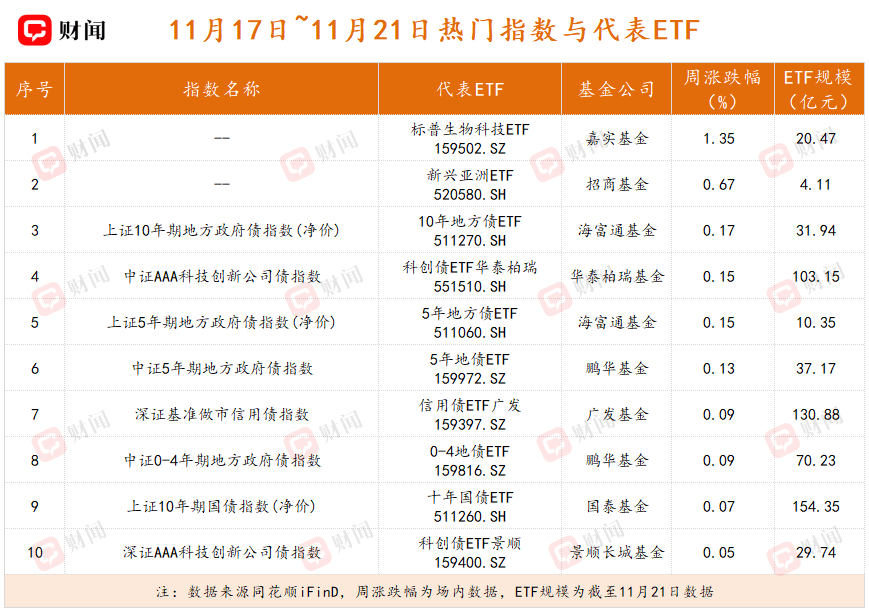
Market Overview - The A-share market experienced significant adjustments from November 17 to November 21, with the Shanghai Composite Index falling below 4000 points and a cumulative decline of 3.9% [1] - The Shenzhen market showed even weaker performance, with the Shenzhen Component Index down 5.13% and the ChiNext Index down 6.15% [2] - The Hong Kong market also faced pressure, with the Hang Seng Index dropping over 5% during the same period [2] ETF Performance - All stock-type ETFs in the market saw declines, particularly those related to new energy sectors like photovoltaic and lithium batteries, with 23 ETFs dropping over 10% [3] - The leading ETFs in decline were the Sci-Tech Innovation New Energy ETF (588960.SH) and the Sci-Tech New Energy ETF (588830.SH), with weekly declines of 13.44% and 13.17%, respectively [3] - Only 52 ETFs managed to rise, with the S&P Biotechnology ETF (159502.SZ) being the sole ETF to increase by more than 1%, up 1.35% [4] Fund Flows - The overall market saw a net inflow of 981.24 billion yuan into ETFs, with stock-type ETFs attracting the most significant inflow of 494.70 billion yuan [6] - On November 21, despite the market downturn, stock-type ETFs received a substantial net inflow of 357.95 billion yuan, with total trading volume reaching 1558.48 billion yuan, a 40.89% increase from the previous week [6] - Major contributors to the inflow included the CSI 300 ETF (510300.SH) and the CSI 500 ETF (510500.SH), each with net inflows exceeding 30 billion yuan [6] Sector-Specific Trends - Industry and thematic ETFs experienced notable outflows, with the Bank ETF (512800.SH) seeing a net outflow of 13.56 billion yuan, the only ETF with outflows exceeding 10 billion yuan [7] - Other cyclical ETFs, such as the Chemical ETF (159870.SH) and Coal ETF (515220.SH), also faced significant outflows of 9.64 billion yuan and 9.26 billion yuan, respectively [7] ETF Size Changes - Despite the inflow into broad-based index ETFs, the market volatility led to a reduction in the sizes of major ETFs, with the CSI 300 ETF and the CSI 500 ETF both shrinking by over 100 billion yuan [11] - As of November 21, the sizes of the two ETFs were reported at 2901.18 billion yuan and 4117.08 billion yuan, respectively [11] Top Performing ETFs - The top 10 ETFs by net inflow included the CSI 500 ETF (510500.SH) with an inflow of 57.78 billion yuan, followed by the Hua Bao Tian Yi ETF (511990.SH) with 51.79 billion yuan [9] - Other notable ETFs in the top inflow list included the ChiNext ETF (159915.SZ) and the CSI 300 ETF (510300.SH), with inflows of 46.78 billion yuan and 44.62 billion yuan, respectively [9] Bottom Performing ETFs - The Bank ETF (512800.SH) led the outflows with a decrease of 13.56 billion yuan, followed by the Chemical ETF (159870.SH) and Coal ETF (515220.SH) with outflows of 9.64 billion yuan and 9.26 billion yuan [10] - Other ETFs experiencing significant outflows included the 5G Communication ETF (515050.SH) and Financial Technology ETF (159851.SZ) [10]