ETF资金流向

Search documents
负债行为跟踪:两融先降后升,ETF流出可控
ZHONGTAI SECURITIES· 2026-03-08 09:02
1. Report Industry Investment Rating - Not provided in the content 2. Core View of the Report - This week, the global risk - averse sentiment has increased, and global risk assets have declined in resonance. The A - share market has also fallen but shows stronger resilience. The short - term decline does not mean the end of the bull market, and the "Spring Rally" is currently in the third stage [4][13] 3. Summary by Relevant Catalogs 3.1 Market Overview - **Global Market**: Affected by the US - Iran conflict, global stock markets generally declined this week, with South Korean and European stock markets experiencing significant drops. US, Japanese, and German government bond yields rose significantly, while Chinese bond yields slightly declined by 0.7bp. Global commodities saw precious metals fall, and crude oil and natural gas prices rise significantly. The US dollar index rose, and most other currencies depreciated [16] - **A - share Market**: Except for the dividend index, most broad - based indices fell this week, with the Science and Technology Innovation 50 leading the decline at - 4.9%. The trading volume of broad - based indices decreased, with the daily average trading volume of Wande A - share dropping from over 3 trillion on Monday and Tuesday to below 2.5 trillion from Wednesday to Friday. The weekly average trading volume of Wande A - share increased from 2.4 trillion to 2.6 trillion [22][25] 3.2 Industry Performance - **Industry Trends**: This week, the media sector led the decline at - 6.38%, while the top five rising industries were petroleum and petrochemicals (9.06%), coal (7.11%), public utilities (5.77%), agriculture, forestry, animal husbandry and fishery (4.23%), and banks (1.64%) [32] - **Technology Sector**: Since February, sectors such as optical communication, high - frequency PCB, high - speed copper connection, solid - state batteries, and liquid cooling have had excess returns. Since March, only optical modules, optical communication, and controllable nuclear fusion have had certain excess returns. From Wednesday to Friday, sectors such as storage, robots, and commercial aerospace rose with reduced trading volume [33][36] 3.3 Fund Flows - **ETF Funds**: The outflow speed of representative broad - based ETFs has changed little. From January 14th to the end of January, the average daily net outflow of CSI 300 ETF was over 14 billion, and since February, it has slowed to about 1 billion. Since February, the average daily net outflow of SSE 50 ETF has been less than 1 billion, compared with over 5 billion previously. The outflows of SSE Composite, Science and Technology Innovation 50, and CSI 1000 ETFs have slowed down compared with last week, while those of CSI 300, SSE 50, and CSI 500 ETFs have slightly accelerated [40][43] - **Leveraged Funds**: The proportion of margin trading turnover has decreased from 10.08% to 9.23%, and the margin trading balance has decreased from 2.67 trillion to 2.65 trillion. However, there were improvement signals on Thursday. Most industries have de - leveraged, but transportation, petroleum and petrochemicals, coal, food and beverages, textile and apparel, and non - ferrous metals have increased leverage. Stocks of all market - cap gradients have de - leveraged, with large - cap stocks having a larger de - leveraging amplitude. Hot stocks in transportation, petroleum and petrochemicals, non - ferrous metals, and storage have mostly increased leverage [44][52][56] - **Quantitative Funds**: Since March, the excess return of CSI 500 quantitative index enhancement has continued to rise, with a median of 1.5%, while that of CSI 1000 quantitative index enhancement has fallen to - 0.01% [67] - **Main Funds**: From Monday to Wednesday, the main funds in CSI 300, ChiNext, and the Science and Technology Innovation Board had net outflows, with a large outflow on Tuesday. On Thursday, the main funds turned into net inflows, and on Friday, there was a slight net outflow. Overall, the sentiment of the main funds improved after Thursday [74][78] - **North - bound Funds**: This week, the total trading volume of north - bound funds has increased, with the average daily trading volume rising from 323.8 billion to 344.3 billion, and the proportion of A - share trading volume dropping from 13.3% to 13.0%, but still remaining at a relatively high level above 13%. The median of the weekly performance of the top 50 heavy - holding stocks of north - bound funds has risen from - 0.35% to 0.79%, indicating a possible net inflow of north - bound funds [12][82][86] - **South - bound Funds**: This week, the average daily trading volume of south - bound funds has increased from 224.4 billion to 230.6 billion, and the proportion has risen from 47.8% to 52.8%. The average daily net purchase amount has decreased from 460 million to - 140 million. The inflow of south - bound funds into the electronics, communication, computer, medicine, and commerce and retail industries has decreased, while the inflow into the banking, media, and non - bank sectors has increased [90][92][93]
ETF资金流向视角下的行业轮动配置
Huafu Securities· 2026-03-04 13:27
Quantitative Models and Construction Methods 1. Model Name: Industry Allocation Model Based on ETF Fund Flows - **Model Construction Idea**: The model leverages ETF fund flow data to identify industry rotation opportunities. It incorporates short-term fund inflows/outflows, style-adjusted holding levels, marginal changes in holdings, and the divergence between ETF and active equity fund holdings to construct an industry allocation strategy[3][69][72] - **Model Construction Process**: 1. **Short-term Fund Flows**: Calculate the first-order difference of weekly ETF holdings to identify industries with significant inflows or outflows[40][44] 2. **Style-Adjusted Holdings**: Adjust industry holdings based on market style (e.g., large-cap vs. small-cap, growth vs. value) using a single-sided HP filter and factor momentum to determine style trends[49][50][57] 3. **Marginal Changes in Holdings**: Analyze the marginal changes in ETF holdings by ranking industries into five groups based on their monthly holding changes[22][25] 4. **Divergence with Active Equity Funds**: Compare ETF holdings with active equity fund holdings to identify industries with higher or lower relative allocations. Use regression-based methods to estimate active fund holdings when real data is unavailable[27][28][31] 5. **Final Strategy**: Combine the above factors equally, select the top six industries, and rebalance the portfolio bi-weekly[72] - **Model Evaluation**: The model effectively captures industry rotation opportunities by integrating multiple dimensions of ETF fund flow data and market style trends[72] --- Model Backtesting Results 1. Industry Allocation Model Based on ETF Fund Flows - **Annualized Return**: 15.57% - **Excess Annualized Return**: 7.56% (compared to equal-weighted industry benchmark) - **Information Ratio (IR)**: 0.93 - **Maximum Drawdown**: 8.30% - **Monthly Excess Win Rate**: 64% - **Payoff Ratio**: 1.38x[72] --- Quantitative Factors and Construction Methods 1. Factor Name: Short-term Fund Flows - **Factor Construction Idea**: Identify industries with significant short-term fund inflows or outflows to capture immediate price impacts[40][44] - **Factor Construction Process**: 1. Calculate the first-order difference of weekly ETF holdings 2. Rank industries based on the magnitude of fund flow changes[40][44] - **Factor Evaluation**: Demonstrates strong monotonicity in short-term returns, with industries experiencing inflows showing higher returns[44] 2. Factor Name: Style-Adjusted Holdings - **Factor Construction Idea**: Adjust industry holdings based on prevailing market styles (e.g., large-cap vs. small-cap, growth vs. value)[46][49] - **Factor Construction Process**: 1. Use a single-sided HP filter to smooth market style data (e.g., CSI 300/CSI 1000 index ratios) 2. Define factor momentum as the difference between the current value and the average of the previous two periods 3. Classify industries into five groups based on their adjusted holdings[49][50][57] - **Factor Evaluation**: Captures the relationship between industry holdings and market style trends, effectively identifying style-driven opportunities[47][57] 3. Factor Name: Marginal Changes in Holdings - **Factor Construction Idea**: Analyze the marginal changes in ETF holdings to identify industries with increasing or decreasing allocations[22][25] - **Factor Construction Process**: 1. Calculate the monthly difference in ETF holdings for each industry 2. Rank industries into five groups based on the magnitude of changes[22][25] - **Factor Evaluation**: Demonstrates a strong correlation with growth and value style trends, providing insights into industry rotation opportunities[47] 4. Factor Name: Divergence with Active Equity Fund Holdings - **Factor Construction Idea**: Compare ETF holdings with active equity fund holdings to identify industries with higher or lower relative allocations[27][28] - **Factor Construction Process**: 1. Use regression-based methods to estimate active fund holdings when real data is unavailable 2. Calculate the difference between ETF and active fund holdings and rank industries into three groups based on the magnitude of divergence[27][28][31] - **Factor Evaluation**: Highlights the pricing power of ETF flows relative to active funds, especially post-2021[31][65] --- Factor Backtesting Results 1. Short-term Fund Flows - **Absolute Return**: 6.17% (highest group) - **Annualized Volatility**: 21.22% - **Sharpe Ratio**: 0.29 - **Maximum Drawdown**: -37.61%[42] 2. Style-Adjusted Holdings - **Annualized Return**: 9.66% - **Excess Annualized Return**: 5.82% - **Information Ratio (IR)**: 0.75 - **Maximum Drawdown**: -29.11%[55] 3. Marginal Changes in Holdings - **Annualized Return**: 7.80% (highest group) - **Excess Annualized Return**: 6.91% - **Information Ratio (IR)**: 1.13 - **Maximum Drawdown**: -16.10%[71] 4. Divergence with Active Equity Fund Holdings - **Annualized Return**: 14.01% - **Excess Annualized Return**: 6.11% - **Information Ratio (IR)**: 0.76 - **Maximum Drawdown**: -28.80%[64][65]
港股科技类ETF资金“逆势”流入
HTSC· 2026-02-09 00:35
Investment Rating - The report indicates a positive investment sentiment towards the technology sector ETFs, highlighting a "contrarian" inflow of funds despite a downturn in the underlying stock prices [1][6]. Core Insights - The technology sector ETFs in Hong Kong experienced a net inflow of 173.59 billion, with specific inflows of 112.76 billion for the Hang Seng Technology Index ETFs and 28.12 billion for the Hang Seng Internet Technology Index ETFs, both exceeding 5% of their respective total ETF sizes [1][6]. - Historical data suggests that when the Hang Seng Technology Index and the Hang Seng Internet Technology Index see a weekly decline of over 5% alongside a net inflow of over 500 million, there is a high probability of a rebound in short-term returns [9][11]. - The Hang Seng Internet Technology Index, which includes only internet-related companies, shows a sharper focus in the technology sub-sector, making it a potential area for continued investor interest [6][12]. Summary by Sections ETF Fund Flows - The technology sector led the net inflows among various ETF categories, with significant contributions from medical, financial, consumer, and high-end manufacturing sectors [2][15]. - The total net inflow for the technology sector ETFs was 173.59 billion, while other sectors saw lower inflows, indicating a strong preference for technology investments during the reporting period [15]. ETF Trading Activity - The top five ETFs by trading volume included those tracking the Hang Seng Technology and Internet Technology indices, with trading volumes of 989.65 billion and 234.63 billion respectively [3][16]. - The report highlights that the trading activity in these ETFs reflects investor confidence despite the overall market downturn [3][19]. ETF Issuance - In the past two weeks, three new Hong Kong ETFs were established, focusing on diverse themes including biotechnology, dividends, and technology, with a total fundraising of 20.79 billion [4][21]. - The report notes the increasing variety in ETF offerings, which may cater to different investor interests and market conditions [4][22]. ETF Financing - The report indicates that the Huatai Baichuan Hang Seng Technology ETF had a financing buy-in amount exceeding 50 billion, showcasing strong investor engagement [2][20]. - Other ETFs, such as the E Fund Hang Seng Technology ETF and the Huaxia Hang Seng Internet Technology ETF, also reported significant financing activities, indicating robust market participation [20][19].
资金流向逆转 新发ETF纷纷上市
Shang Hai Zheng Quan Bao· 2026-02-08 17:31
Group 1 - The reversal of significant net outflows from stock ETFs occurred, with a net inflow of 6.965 billion yuan on February 3, marking the first net inflow since January 14 [1] - From February 3 to 6, multiple broad-based ETFs saw substantial net inflows, including 2.549 billion yuan into the Huaxia Science and Technology Innovation 50 ETF and 1.763 billion yuan into the Huaxia CSI A500 ETF [1] - Conversely, resource-themed ETFs experienced notable outflows, with the Huaxia Nonferrous Metals ETF seeing a net outflow of 4.364 billion yuan [1] Group 2 - A total of 10 new ETFs were launched from February 2 to 6, with an additional 6 ETFs set to list between February 9 and 11, contributing to market liquidity [2] - Significant investments in newly launched ETFs were made by entities such as China Shipbuilding Group, which purchased 100 million yuan worth of shares in the Fortune CSI Selected Shipbuilding Industry ETF [2] - The ETF market is expected to continue expanding, with numerous new products being reported by fund companies, including the Hang Seng A-share Power Grid Equipment ETF [2]
近90亿!抄底资金来了
Zhong Guo Ji Jin Bao· 2026-02-06 06:37
Core Viewpoint - The stock ETF market has shown significant resilience amid recent market volatility, with a net inflow of nearly 90 billion yuan on February 5, indicating strong investor interest despite broader market declines [1][2]. Group 1: Market Performance - On February 5, the A-share market opened lower due to declines in overseas technology stocks and precious metals, but the stock ETF market experienced a net inflow of 88.99 billion yuan [2]. - The total scale of all stock ETFs (including cross-border ETFs) reached 3.9 trillion yuan as of February 5 [2]. - The net inflow for A-share stock ETFs specifically was 34.95 billion yuan [1]. Group 2: ETF Inflows and Outflows - The leading inflows were observed in Hong Kong stock ETFs and thematic industry ETFs, with net inflows of 53.2 billion yuan and 19.47 billion yuan, respectively [2]. - Conversely, bond ETFs experienced a net outflow of 1.87 billion yuan [2]. - Notably, ETFs tracking the Hang Seng Technology Index saw a net inflow of 29.72 billion yuan, while those tracking the CSI 500 Index had a net outflow of 31.39 billion yuan [2]. Group 3: Fund Company Performance - Major fund companies such as Huaxia, Huatai-PB, and E Fund saw net inflows of 31.8 billion yuan, 28.5 billion yuan, and 28.2 billion yuan, respectively [2]. - In contrast, Southern and Jiashi funds experienced net outflows of 28.5 billion yuan and 3.8 billion yuan [2]. Group 4: Specific ETF Performance - E Fund's ETFs reached a total scale of 651.95 billion yuan, with significant inflows in various ETFs, including 9.2 billion yuan for the China Internet ETF and 3.6 billion yuan for the Hang Seng Technology ETF [3]. - Huaxia Fund's A500 ETF and Hang Seng Technology Index ETF also saw substantial inflows of 11.99 billion yuan and 6.5 billion yuan, respectively [3]. Group 5: Market Outlook - The market is expected to continue its oscillating pattern, with risks that have been accelerating in the short term, particularly in cyclical sectors like metals [5]. - Despite recent adjustments in the technology sector, the overall fundamental outlook remains robust, suggesting limited downside potential [5]. - Consumer sectors may present opportunities for recovery, especially with upcoming events like the Spring Festival and the National People's Congress [5].
复盘贵金属巨震
Di Yi Cai Jing Zi Xun· 2026-02-03 00:56
Core Viewpoint - The precious metals market experienced significant volatility following a panic sell-off, with silver showing over 8% fluctuation and platinum and palladium futures rebounding nearly 10% from early lows. Analysts are divided on the market outlook, with many believing the current downturn is temporary, but cautioning that bottom-fishing may require patience [2][3]. Group 1: Market Performance - After a drop of over 5%, COMEX futures for February delivery recovered to $4,700, following an 11% plunge last Friday, marking the worst single-day performance since 1980. Gold futures hit a high of $5,626.80 per ounce but have since fallen 17% from that peak [3]. - UBS commodity analyst Giovanni Staunovo predicts gold prices will exceed $6,200 per ounce later this year, while JPMorgan forecasts a year-end price of $6,300 per ounce. Deutsche Bank maintains a $6,000 per ounce prediction based on sustained investor demand [3][5]. Group 2: Market Dynamics - The sell-off was exacerbated by the appointment of Jerome Powell as the next Federal Reserve Chair, which led to a rebound in the dollar index, increasing the cost of precious metals and triggering initial sell-offs. The crowded trades in gold and silver, particularly silver, led to a significant number of investors simultaneously exiting positions, amplifying the decline due to liquidity issues [3][4]. - Analysts warn that the current high volatility may persist, with risks of further sell-offs remaining elevated due to the extreme concentration of positions in the market [4]. Group 3: Liquidity Concerns - The recent sell-off resulted in an evaporation of $8 trillion in market value for gold and silver, highlighting the liquidity risks when large amounts of capital attempt to exit the same asset class simultaneously. This situation has raised questions about the perceived safety of these assets [6][7]. - The market's response to the sell-off indicates that liquidity, rather than fundamental value, drives asset prices during periods of stress. The assumption that holding quality assets guarantees safety is being challenged [7][8]. Group 4: Future Outlook - The true "safe signal" for the market will not be a price rebound but a decrease in volatility. Without a reduction in volatility, liquidity will remain fragile, and while physical buying may slow price declines, it cannot prevent significant fluctuations caused by forced repositioning [8].


ETF规模速报 | 黄金ETF净流入超30亿元,沪深300ETF易方达净流出超285亿元
Sou Hu Cai Jing· 2026-01-29 01:25
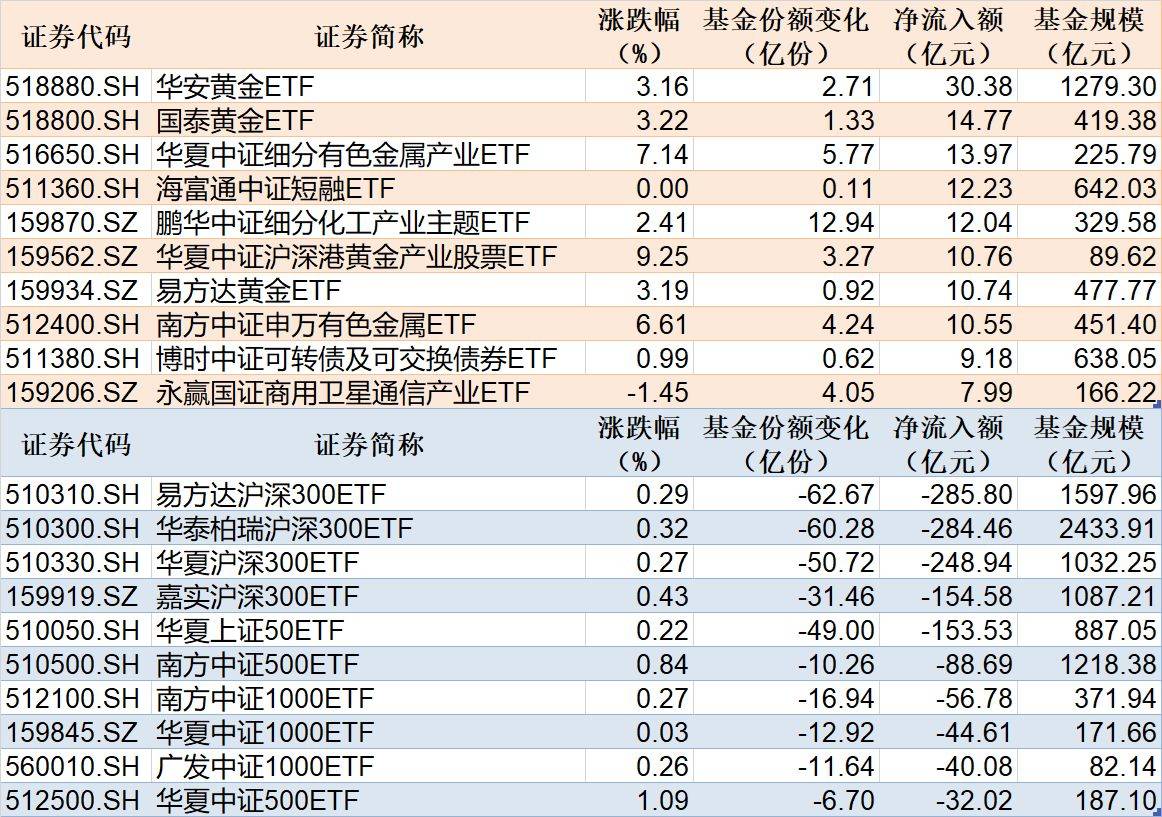
Market Overview - The Shanghai Composite Index and Shenzhen Component Index experienced a pullback after an initial rise, while the ChiNext Index opened high but fell over 1% during the day [1] - Resource stocks led the market, with precious metals, oil and gas, and electrolytic aluminum sectors showing significant gains, while the pharmaceutical and photovoltaic sectors faced the largest declines [1] ETF Fund Flows - On January 28, the Huaan Gold ETF saw an increase of 271 million shares with a net inflow of 3.038 billion yuan, while the Guotai Gold ETF increased by 133 million shares with a net inflow of 1.477 billion yuan [1] - The Huaxia CSI Subdivided Nonferrous Metals Industry ETF increased by 577 million shares with a net inflow of 1.397 billion yuan [1] Notable ETF Performance - The top-performing ETFs by net inflow for the month include: - Southern CSI Shenwan Nonferrous Metals ETF with a net inflow of 15.529 billion yuan [4] - Penghua CSI Subdivided Chemical Industry Theme ETF with a net inflow of 13.183 billion yuan [4] - Huaxia CSI Subdivided Nonferrous Metals Industry ETF with a net inflow of 12.211 billion yuan [4] - The total market ETF shares reached 32,657.17 billion shares, with a total scale of 55,523.97 billion yuan as of January 28 [4]
行业主题ETF开年吸金逾2200亿元,已超去年全年流入额三成
Sou Hu Cai Jing· 2026-01-28 05:45
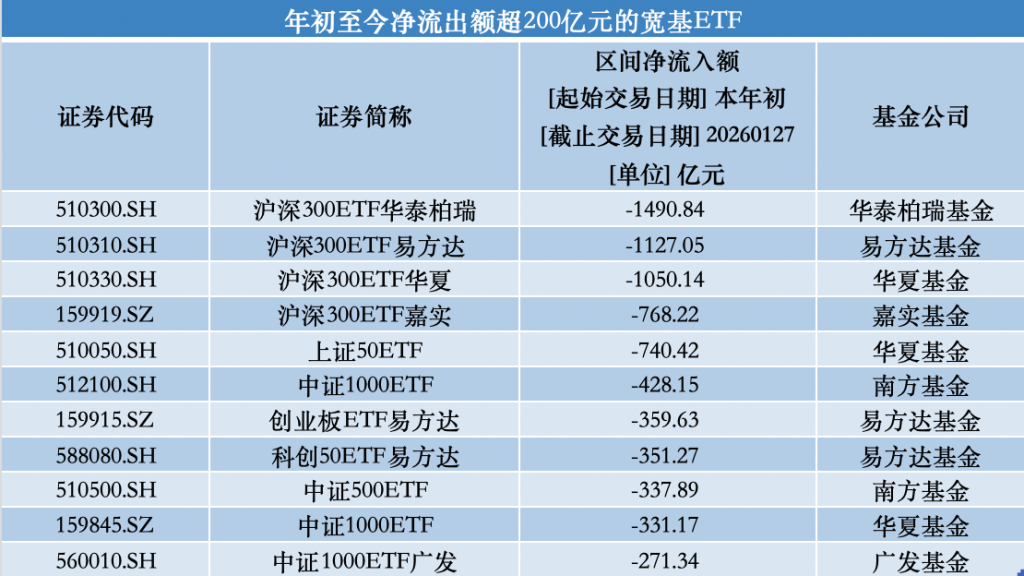
Core Insights - The A-share stock ETF market has shown a clear divergence since the beginning of 2026, with significant net outflows from core broad-based products like the CSI 300 ETF, totaling 795.76 billion yuan, while sector-specific thematic ETFs in industries such as non-ferrous metals, electric grid equipment, and chemicals have attracted substantial inflows [1][2] Market Trends - As of January 27, 2026, the total net outflow for stock ETFs (including cross-border ETFs) reached 597.45 billion yuan since the start of the year, with broad-based ETFs being the primary source of this outflow [2] - The net outflow for large-scale index ETFs (including cross-border ETFs) has reached 795.76 billion yuan as of January 27, 2026 [2] - On January 27 alone, major CSI 300 ETFs experienced significant single-day net outflows, with Huatai-PB CSI 300 ETF and E Fund CSI 300 ETF seeing outflows of 14.065 billion yuan and 11.924 billion yuan, respectively [2] Sector Performance - The thematic ETFs have seen a cumulative net inflow of 227.18 billion yuan, which is nearly one-third of the total net inflow for such products in 2025, which was 738.54 billion yuan [1][5] - The top-performing sector ETFs include the Southern Non-Ferrous Metals ETF, which led with a net inflow of 14.474 billion yuan, followed by the Huaxia Electric Grid Equipment ETF and Penghua Chemical ETF with inflows of 12.740 billion yuan and 11.980 billion yuan, respectively [7][9] Investment Insights - Analysts suggest that the current market conditions may lead to a slow bull market driven by bank wealth management and insurance funds, rather than the previous bull market led by public funds [4] - The non-ferrous metals sector is expected to perform well due to anticipated price increases driven by interest rate cuts and high exposure to new growth areas such as energy storage and AI infrastructure [6][10] - The chemical sector is viewed as undervalued, with potential for recovery as PPI is expected to turn positive in the second half of 2026, particularly in the petrochemical chain [8]
再创天量成交!国家队最新持仓出炉
Ge Long Hui· 2026-01-23 08:33
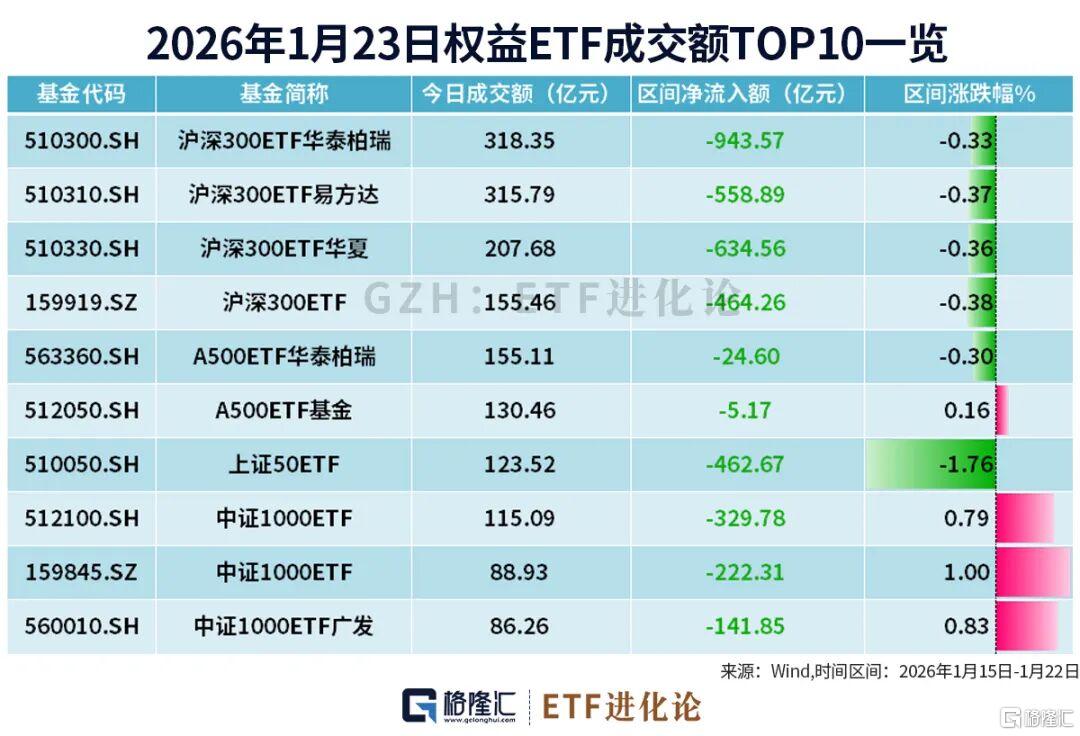
Group 1 - The core point of the news highlights a significant surge in trading volumes for multiple Hu-Shen 300 ETFs, with two ETFs surpassing a transaction volume of 30 billion yuan, indicating heightened market activity [1][2] - The Hu-Shen 300 ETF from Huatai-PineBridge reached a transaction volume of 31.8 billion yuan, marking a new high since October 8, 2024, while the ETF from E Fund reached 31.5 billion yuan, also a record since its listing [1][2] - The report indicates that the total market value of ETFs held by the Central Huijin Investment and Central Huijin Asset Management companies exceeded 1.53 trillion yuan, reflecting an increase of 245.8 billion yuan compared to the previous year [8] Group 2 - The data shows that the Hu-Shen 300 ETF from Huatai-PineBridge had a holding market value of 169.49 billion yuan in Q4 2025, with no change in the number of shares held [3] - The Central Huijin Asset Management held 12 ETFs with a market value of 697 billion yuan in Q4 2025, also maintaining the same number of shares [5] - The report notes that since January 15, large funds have been selling off broad-based ETFs, with a net outflow of 77 billion yuan in a single day, totaling a net outflow of 534.6 billion yuan since the beginning of the year [11] Group 3 - The top 30 ETFs by net outflow since the beginning of 2026 include the Hu-Shen 300 ETF from Huatai-PineBridge, which saw a net outflow of 97.27 billion yuan, and the Hu-Shen 300 ETF from E Fund with a net outflow of 57.53 billion yuan [16] - Industry-specific ETFs have experienced a net inflow of 126.2 billion yuan, with sectors such as fine chemicals, semiconductor materials and equipment, non-ferrous metals, and electric grid equipment being the most attractive, drawing in 15.17 billion yuan, 14.41 billion yuan, 12.04 billion yuan, and 11.74 billion yuan respectively [18][19] - The report indicates that two ETFs, the Southern Non-Ferrous Metals ETF and the Huatai Electric Grid Equipment ETF, have each seen net inflows exceeding 10 billion yuan, with inflows of 12 billion yuan and 11.7 billion yuan respectively [21][22]