
AI与制造业融合

Search documents
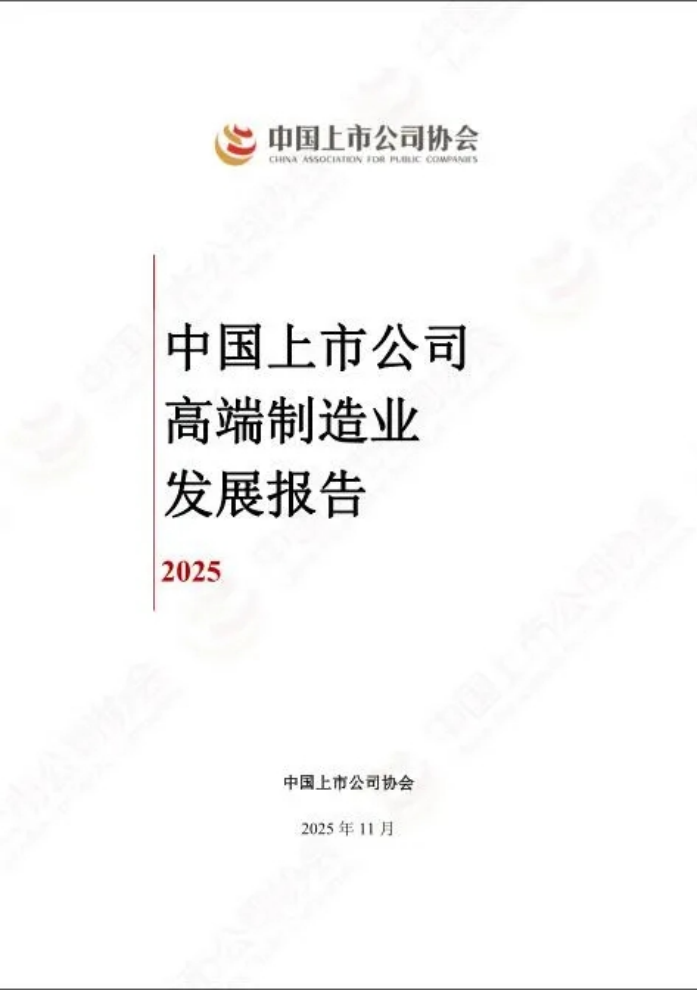
报告丨中国上市公司高端制造业发展报告
Xin Lang Cai Jing· 2025-12-08 01:33
Industry Overview - As of the end of 2024, the number of high-end manufacturing listed companies in A-shares reached 2,503, accounting for 46.50% of the total A-share companies, with a compound annual growth rate (CAGR) of 10.80% over the past five years [2][19] - The total asset scale reached 27.24 trillion yuan, and total revenue was 15.41 trillion yuan, with CAGRs of 13.98% and 13.27% respectively, indicating strong expansion capabilities [2][19] - Private enterprises accounted for 71.87% of the industry, while state-owned enterprises, though only 17.58% in number, contributed 34.31% of the revenue [2][19] - The industry is primarily concentrated in southeastern coastal provinces such as Guangdong, Jiangsu, and Zhejiang [2][19] - The tax contribution of the industry in 2024 was 253.9 billion yuan, with an employee count of 10.35 million and an average salary of 189,500 yuan, reflecting stable employment and income growth [2][19] Core Development Metrics - In 2024, total R&D expenditure was 934.12 billion yuan, with a CAGR of 18.51%, and R&D spending accounted for 6.06% of revenue [3][20] - The number of R&D personnel reached 1.8464 million, with a CAGR of 12.07%, achieving multiple technological breakthroughs in sectors like power equipment, semiconductors, and passenger vehicles [3][20] - The total market capitalization was 32.47 trillion yuan, with a CAGR of 3.91% [3][20] - The total scale of IPOs and refinancing was 115.54 billion yuan, showing a decline due to regulatory policy adjustments, although financing activity remained high in mechanical manufacturing and electronics [3][20] - Overseas revenue reached 4.3113 trillion yuan, with a CAGR of 19.81%, accounting for 27.98% of total revenue [3][20] Key Industry Characteristics - The mechanical manufacturing, electronics, power equipment, and passenger vehicles and parts sectors contributed 73.78% of the total assets and major revenue of the high-end manufacturing industry [4][20] - The medical industry led with a net profit margin of 13.19% and a return on assets of 5.03% [4][20] - The semiconductor industry benefited from the growth in AI and new energy vehicle demand, with a price-to-earnings ratio of 118.09 [4][20] - The aerospace and defense sector saw steady market capitalization growth driven by defense construction demand, with R&D investment accounting for 6.75% [4][20] - The power equipment sector faced a 66.43% decline in net profit due to overcapacity, while the pharmaceutical industry experienced a continuous decline in market capitalization due to policy adjustments, despite a high R&D investment ratio of 11.65% [4][20] Industry Trends and Policies - The government has introduced policies such as the "New National Nine Articles" and "Science and Technology Innovation Sixteen Articles" to support technological innovation, promoting equipment upgrades and the replacement of consumer goods [5][21] - The integration of AI and manufacturing has been widely applied in R&D design, production, and intelligent scheduling, leading to new business models [5][21] - New demands for computing power and smart terminals are emerging, with companies like SANY Heavy Industry and GAC Group leading practical implementations [5][21] - Efforts to revise the "Anti-Unfair Competition Law" and promote industry self-regulation have effectively addressed issues of low-price competition and disorderly expansion, guiding resources towards innovation [5][21] - The focus is on intelligent, green, and integrated development, with an emphasis on nurturing emerging industries such as low-altitude economy and humanoid robots, while tackling critical technology challenges in integrated circuits and industrial mother machines [5][21] Challenges and Future Outlook - Some industries are facing issues of overcapacity and profit fluctuations, with core technology bottlenecks persisting [6][22] - International market competition and geopolitical risks have intensified [6][22] - The future strategy includes increasing R&D investment, deepening industrial cluster development, and advancing international strategic layouts, aiming to transition from a "manufacturing giant" to a "manufacturing power" [6][22]

智造未来可期 第二十五届工博会23日开幕
Guo Ji Jin Rong Bao· 2025-09-12 12:53
Core Points - The 25th China International Industry Fair (CIIF) will be held from September 23 to 27 at the National Exhibition and Convention Center in Shanghai, with a theme of "Industrial New Quality, Intelligent Manufacturing Without Boundaries" and an exhibition area of 300,000 square meters, expected to set historical records in scale and international participation [1][3] Group 1: Exhibition Highlights - The fair will showcase high-end, intelligent, and green technologies, serving as a core display window for industrial achievements during the 14th Five-Year Plan period [3] - Key exhibits include the C919 large passenger aircraft and the domestically produced cruise ship "Aida·Magic City," along with 1,500 projects aimed at enhancing industrial capabilities and 80 advanced manufacturing clusters from various countries [3] - Innovations in AI and manufacturing will be highlighted, such as a machine tool achieving the world's first "zero human experience" for autonomous processing paths and a domestic oral surgery robot utilizing AI for safer procedures [3] Group 2: International Participation - The event will attract nearly 3,000 exhibitors from 28 countries and regions, with international exhibitor space reaching new heights [4] - The Saudi exhibition group will present achievements related to industrial transformation and smart manufacturing as part of Saudi Arabia's Vision 2030 [4] - The fair will focus on cutting-edge fields such as superconductors, atomic-level manufacturing, brain-computer interfaces, and quantum technology, showcasing future industry results [4] Group 3: Special Exhibitions and Events - The exhibition will feature a framework of "1+3+9+10," including one high-profile opening ceremony, three major special exhibitions, nine industry-themed exhibitions, and ten key industry summits [4] - The "National New Industrialization and '14th Five-Year' Major Industrial Achievements Exhibition" will cover approximately 2,000 square meters, divided into three main areas: achievements, advanced manufacturing clusters, and industrial innovation [4][5] Group 4: Product Launches - The fair will see the debut of nearly 300 global firsts and around 200 China firsts, including advanced robotics and industrial control technologies [7] - Notable exhibits include ABB's compact collaborative robot PoWa, which boasts an industrial-grade speed of 5.8 meters per second, and a heavy-duty robot with a 5,000-kilogram load capacity from domestic company ChaiFu [7] Group 5: Visitor Engagement - The fair has received appointment requests from professional buyers from 102 countries and regions, with overseas visitor numbers doubling compared to the previous year, marking a historical high [8] - A "China Manufacturing Experience Day" will be introduced, inviting international representatives for interactive discussions on various themes [8]


