
AI与自动化

Search documents
康龙化成(300759) - 2026年03月31日投资者关系活动记录表附件之演示文稿(英文版)
2026-04-01 09:00
Group 1: Financial Performance - Revenue reached RMB 14,095 million, with a year-over-year growth of 14.8% [14] - Non-IFRS net profit was RMB 1,816 million, reflecting a year-over-year growth of 13.0% [14] - Net profit declined to RMB 1,664 million, a year-over-year decrease of 7.2% [14] - Revenue from the top 20 multinational corporations (MNCs) grew by 29.4% [14] Group 2: Customer and Market Expansion - Over 950 new customers acquired, totaling over 3,300 active customers, including all top 20 MNCs [15] - Revenue from China entities grew by 15.0%, while overseas subsidiaries saw a growth of 13.8% [21] - New purchase orders (POs) increased by 14% year-over-year [14] Group 3: Operational Highlights - 28 R&D and manufacturing facilities across China, the UK, the US, and Singapore [15] - 887 drug discovery projects currently in progress [16] - 1,397 clinical research organization (CRO) projects, including 125 in Phase III [16] Group 4: Future Outlook - Expected revenue growth of 12-18% year-over-year in 2026 [45] - Continued development of an end-to-end, fully integrated services platform [45] - Focus on advancing the contract development and manufacturing organization (CDMO) business model and integrating AI and automation [45] Group 5: ESG and Sustainability - Achieved an MSCI ESG rating of AA and recognized as a low-risk company by Sustainalytics [23] - Joined the United Nations Global Compact (UNGC) and received the EcoVadis Silver Prize [24]

跨境电商无货源新玩法:自养号采购技术如何提升效率与成功率?
Sou Hu Cai Jing· 2026-02-06 05:46
Group 1: Core Concept - The essence of the no-inventory model is "zero inventory sales," where sellers integrate domestic supply chain resources to forward overseas orders directly to suppliers or use transit warehouses for repackaging and delivery to end buyers [3] - The no-inventory model addresses three major pain points in traditional cross-border e-commerce: it eliminates inventory risk, reduces startup costs by 80%, and allows for rapid product testing with an iteration cycle of just 7 days [3] Group 2: Self-Cultivated Account Procurement Technology - The core of self-cultivated account technology is to simulate real user behavior to avoid platform risk control detection for bulk purchasing accounts, structured in a three-layer protective system: hardware isolation, network environment, and browser fingerprint management [4] - The technology enhances procurement efficiency and account survival rates, achieving a daily average of 200 orders with a 40% higher success rate compared to third-party purchasing, while reducing labor costs by 60% [14] Group 3: Practical Process of Self-Cultivated Account Procurement - The procurement process involves three stages: registration, nurturing, and purchasing, with a focus on building a credible identity and gradually increasing account trustworthiness [7][8] - During the nurturing phase, accounts are required to complete small orders to enhance their weight score by 60%, which increases the approval rate for larger orders by 45% [9] Group 4: Risk Control and Compliance Operations - A dual approach to risk control includes real-time monitoring and anomaly handling, with measures such as enabling two-factor authentication and using password management tools [15] - The establishment of a policy monitoring center allows for dynamic adjustments to operational strategies in response to platform rule changes, ensuring compliance and reducing the risk of account bans [16] Group 5: Industry Trends and Future Outlook - The no-inventory model is being reshaped by AI and automation, which can quickly identify potential bestsellers and optimize procurement orders [17] - As platform regulations tighten, sellers must focus on compliance and operational precision, with a trend towards localizing supply chains and transitioning to a mixed model of "no inventory + overseas warehouses" [18] - Sellers are advised to quickly test over 100 SKUs to identify 3-5 bestsellers and establish long-term partnerships with quality suppliers to reduce procurement costs [19]


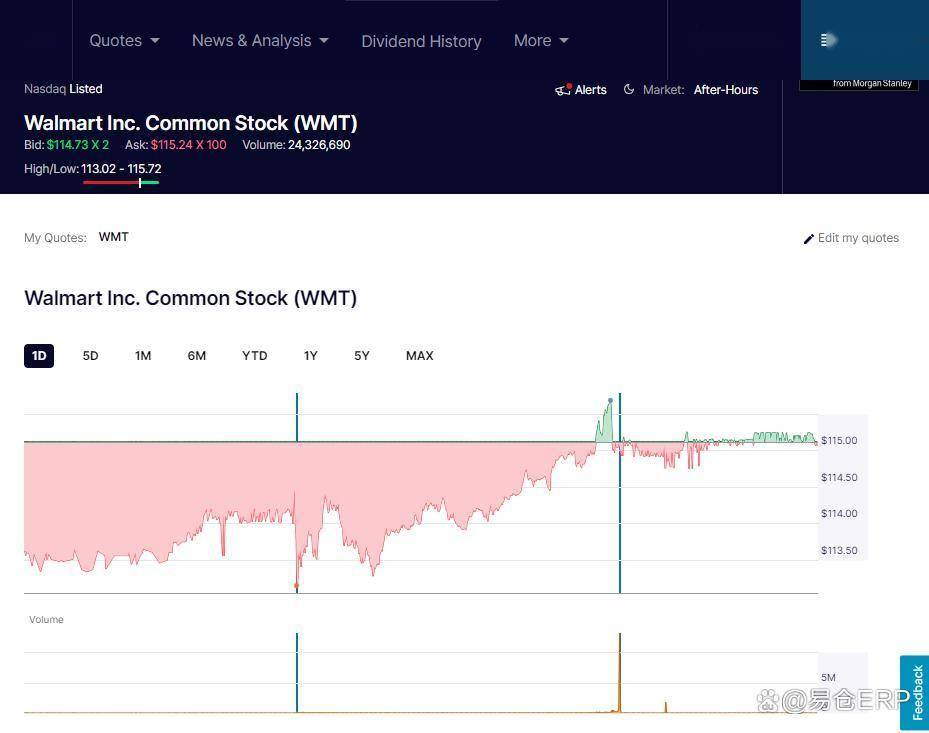
沃尔玛突然“搬家”!跑纳斯达克上市去了
Sou Hu Cai Jing· 2025-12-11 03:37
Core Viewpoint - Walmart's transition to Nasdaq marks a significant strategic shift, positioning itself as a technology-driven retail leader, competing with Amazon, rather than just a traditional discount retailer [2][5]. Group 1: Stock Market Transition - Walmart officially moved its stock trading to Nasdaq on December 9, 2025, ending over 50 years on the New York Stock Exchange, with a market capitalization of nearly $900 billion [1]. - The stock symbol remains "WMT," and this transition is noted as the largest in U.S. stock market history [1]. Group 2: Financial Performance - In Q3 of fiscal year 2026, Walmart reported total revenue of $179.5 billion and operating profit of $7.2 billion, indicating steady growth in both revenue and profit [2]. Group 3: Technological Integration - Over 60% of goods are transported through automated centers, and over 40% of new codes are generated by AI, highlighting Walmart's focus on technology in retail [2]. - The management has placed AI and automation at the core of its strategy, leading to rapid iterations in infrastructure and tools [4]. Group 4: Seller Implications - Sellers will face increased requirements for real-time, accurate inventory synchronization to participate in services like "two-hour delivery" and "in-store pickup" [7]. - The need for efficient cross-border e-commerce ERP systems is emphasized, as they are essential for managing inventory and optimizing sales opportunities on Walmart's platform [4][7]. Group 5: Competitive Landscape - The shift to Nasdaq is expected to elevate the overall competitive landscape of the platform, with a focus on operational efficiency rather than just price and product competition [7]. - Sellers who can leverage automation and intelligent inventory management will gain a competitive edge, aligning with Walmart's strategic direction [7].

Phreesia(PHR) - 2025 Q4 - Earnings Call Transcript
2025-03-13 03:41
Financial Data and Key Metrics Changes - Q4 revenue was $109.7 million, up 15% year over year [5] - Q4 adjusted EBITDA was $16.4 million, up from $19.9 million year over year, with an adjusted EBITDA margin of 15% [5] - Average healthcare services clients reached $4,341, an increase of $104 from the prior quarter and $379 from the prior year [5] Business Line Data and Key Metrics Changes - Strong growth was noted in network solutions, with management indicating that underlying market conditions for 2026 are expected to be similar to 2025 [10] - Total revenue per AhSE metric grew by 5% year over year, and 7% when excluding the clearinghouse impact, but was flat sequentially [16] Market Data and Key Metrics Changes - Management acknowledged that calendar factors, such as business days and holidays, significantly impacted Q4 performance [17] - The company is closely monitoring macroeconomic factors, including consumer confidence and Medicaid changes, but has not seen significant impacts on business yet [46] Company Strategy and Development Direction - The company aims to leverage AI and automation to improve internal productivity and enhance network solutions [19] - Management emphasized the importance of capital allocation for durable growth, balancing organic and inorganic opportunities [48] Management's Comments on Operating Environment and Future Outlook - Management expressed confidence in maintaining financial outlook and visibility in network solutions, indicating no changes since previous assessments [42] - The company is positioned to benefit from larger entrants in the market, with improved close rates noted [26] Other Important Information - The company celebrated its 20th anniversary, reflecting on its mission to make care easier every day [4] - Management highlighted the value of new products like appointment readiness and patient bill pay, which are expected to enhance client engagement and revenue [32][33] Q&A Session Summary Question: Comments on gross margin expansion and expense leverage - Management noted that mix is a significant driver of gross margin improvements, with payment processing associated with lower margins [9] Question: Market conditions for network solutions in 2026 - Management indicated that conditions are expected to be similar to 2025 [10] Question: Insights on postscript engagement product - Management described the product as impression-based, similar to other offerings [13] Question: Impact of calendar on revenue per AhSE metric - Management acknowledged that calendar factors and external events like the LA fires affected Q4 performance [17] Question: Progress on leveraging AI and automation - Management shared positive feedback on AI applications used internally, indicating valuable results [19] Question: Critical mass for new products in pharma customer base - Management stated that products are designed with scale in mind and are often ready for market upon announcement [24] Question: Competitive dynamics in the market - Management noted improved close rates and a beneficial impact from larger market entrants [26] Question: Update on patient bill pay rollout - Management expressed excitement about the product's value and its potential to generate additional revenue [33] Question: Capital deployment priorities for fiscal 2026 - Management reiterated a consistent approach to capital allocation focused on durable growth [48]
