AI智能预警

Search documents
一码通查强监管 数字赋能优服务 ----塔城地区食品生产经营主体扫码入企改革实践
Zhong Guo Shi Pin Wang· 2025-11-28 04:45
Core Insights - The article discusses the implementation of a digital reform initiative called "Scan into Enterprise" in the Tacheng region, aimed at enhancing food safety regulation by addressing issues such as arbitrary, repetitive, and multi-agency inspections [1][2]. Group 1: Digital Reform Implementation - The "Scan into Enterprise" reform is a key measure for optimizing the business environment and improving regulatory efficiency, included in the 2025 work plan of the Tacheng regional committee [1]. - The initiative has provided exclusive QR codes to 17,000 food production and operation entities, facilitating comprehensive inspections and establishing a digital safety barrier for food security [1][2]. - A total of 10 million yuan has been allocated for system development and upgrades, with a dedicated task force formed to ensure effective implementation [1]. Group 2: Enhanced Regulatory Efficiency - A specialized management model called "one code, two databases, three lists" has been developed, which includes an electronic ID QR code for food businesses that contains licensing and risk information [2]. - The integration of inspection processes across seven departments has led to a significant increase in inspection efficiency, with the average number of inspections per day per inspector rising from 3 to 9 [2]. - The error rates in inspections have decreased significantly, with the omission rate dropping from 18% to 3.2% and the error rate from 12% to 2.1%, resulting in a 46% improvement in issue detection accuracy [2]. Group 3: Service Optimization for Enterprises - A dual governance mechanism has been established, allowing enterprises to view inspector qualifications and inspection lists in real-time, enhancing transparency and responsiveness [2]. - The regulatory approach has been adjusted to provide leniency for compliant businesses, with measures such as "no penalty for first-time violations" and "exemptions for minor infractions" being implemented [2]. - The frequency of inspections for businesses has been reduced to an average of 5-6 times per year, with the rate of repeated inspections falling below 5%, thereby improving the legal business environment [2]. Group 4: Future Directions - The Tacheng market supervision bureau plans to further enhance the "Scan into Enterprise" reform by optimizing the smart regulatory platform and expanding applications such as blockchain traceability and AI intelligent warning systems [3].
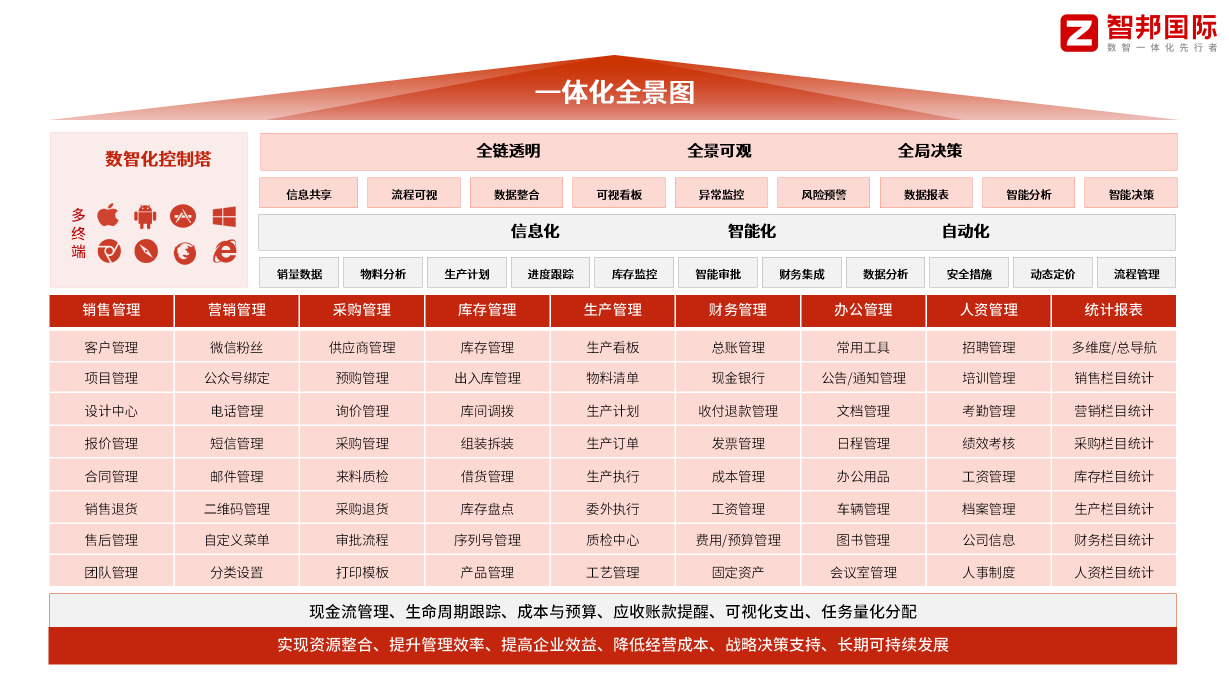
智邦国际机械行业ERP:全生命周期+AI智能预警,企业增长难题迎刃而解
Zhong Guo Chan Ye Jing Ji Xin Xi Wang· 2025-05-14 03:06
Core Viewpoint - The mechanical industry in China is facing unprecedented opportunities and challenges in the context of the Industrial 4.0 era, necessitating a deep integration of digital intelligence with enterprise management to overcome traditional management inefficiencies and achieve high-quality development [1]. Group 1: Industry Challenges and Opportunities - The mechanical manufacturing sector is experiencing intensified market competition, revealing shortcomings in traditional management models such as low efficiency, lack of transparency in production processes, and difficulties in cost control [1]. - The integration of emerging technologies like AI, big data, blockchain, and IoT with digital transformation is essential for mechanical manufacturing enterprises to enhance efficiency and business growth [1]. Group 2: ERP Market Dynamics - Many mechanical manufacturing companies are adopting ERP systems to connect various departments and integrate internal and external resources, but the current ERP market is saturated with products that are often single-functional and rigid in management processes [2]. - The "one-size-fits-all" approach of many ERP solutions does not align with the specific characteristics of the mechanical industry, leading to inefficiencies in operations [2]. Group 3: Company Profile and Product Offering - Founded in 2003, the company has focused on the ERP field, aiming to provide the best management services and has developed a comprehensive product matrix based on the "integrated enterprise management" philosophy [3]. - The new generation of "integrated ERP" specifically designed for the mechanical industry offers comprehensive lifecycle management and AI-driven predictive capabilities to enhance quality and address growth challenges [3][5]. Group 4: Integrated ERP Features - The new generation "integrated ERP" covers the entire lifecycle of a product, from design and procurement to manufacturing, quality control, and after-sales service, ensuring transparency and traceability in production processes [5]. - The platform enables real-time tracking of production progress and market trend analysis to optimize material storage and improve resource utilization [5]. Group 5: AI and Predictive Capabilities - The AI predictive warning technology embedded in the new generation "integrated ERP" allows for real-time data analysis and monitoring, triggering alerts for anomalies and providing actionable recommendations to management [6]. - This intelligent warning mechanism helps enterprises identify and resolve operational issues promptly, supporting data-driven decision-making [6]. Group 6: Globalization and Multi-language Support - The new generation "integrated ERP" supports multiple languages and global operations, facilitating international collaboration and management across different regions [8]. - The platform is accessible on various devices, enhancing operational efficiency and responsiveness for enterprise personnel regardless of their location [8].