AI自进化

Search documents
人类研究员首次全线落败——AI架构、数据、算法三战获科学发现级突破
机器之心· 2026-03-29 02:54
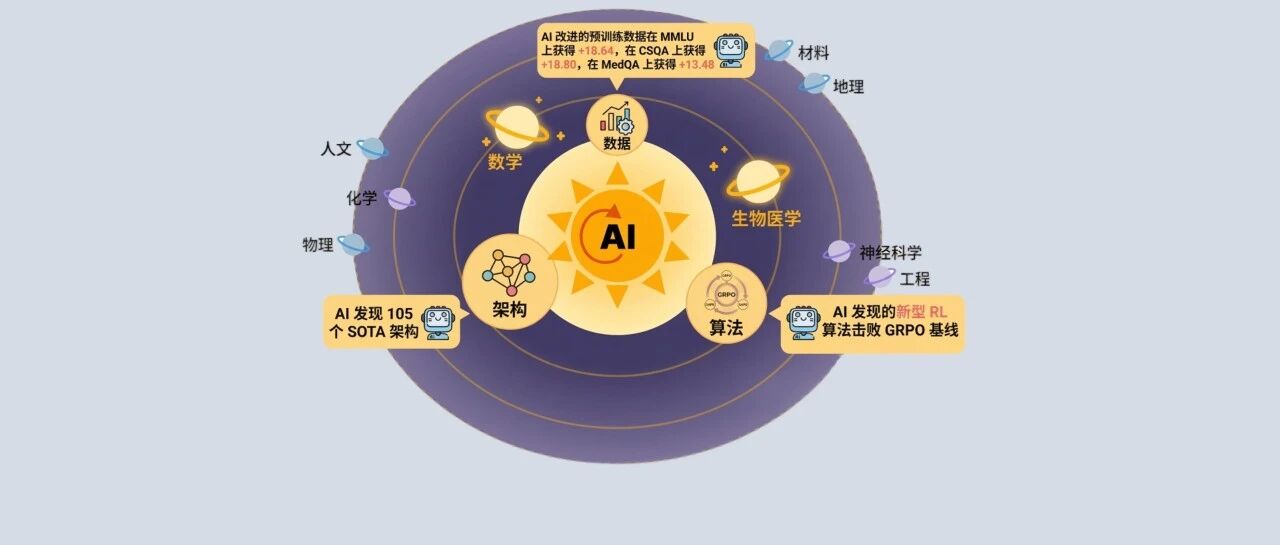
Core Insights - The development of AI has entered a critical phase where the competition is centered around the acceleration of AI's self-evolution [2][3] - DeepMind's mission emphasizes that intelligence is the key to unlocking significant breakthroughs across various fields, and achieving true self-evolution in AI is essential for this [2] - The ASI-Evolve framework from the GAIR team demonstrates that AI can independently complete the research cycle without human intervention, marking a significant advancement in AI capabilities [5][6] Group 1: Breakthroughs in AI Research - ASI-Evolve has achieved scientific-level breakthroughs in three core areas: architecture, data, and algorithms, driving advancements in mathematics, biomedicine, and physics [5][6] - AI has successfully optimized its own model architecture, discovering over 105 new architectures that outperform the human-designed DeltaNet by nearly three times in performance [13] - In data pre-processing, AI has autonomously designed data cleaning strategies, resulting in significant performance improvements across various benchmarks, including an 18.64-point increase in MMLU [17][18] Group 2: Algorithm Innovations - ASI-Evolve has not only fine-tuned hyperparameters but has also invented new reinforcement learning algorithms, achieving consistent improvements across multiple tasks compared to the GRPO baseline [20][21] - The AI-designed algorithms have shown enhancements in mathematical and coding tasks, with notable score increases such as +12.5 points on AMC32 and +11.67 points on AIME24 [20][21] Group 3: Efficiency and Application - The ASI-Evolve framework incorporates a closed-loop system of learning, designing, experimenting, and analyzing, which significantly enhances research efficiency [22][24] - In real-world applications, AI-optimized architectures have demonstrated practical value in drug discovery tasks, achieving higher AUROC and F1 scores compared to traditional methods [31][37] - The framework's ability to autonomously research and optimize not only improves AI performance but also indicates a shift in the research paradigm, allowing humans to focus on defining problems rather than executing solutions [36]

敢和刘慈欣叫板的AI诞生了
量子位· 2025-09-20 10:51
Core Viewpoint - The hope for breaking through the ceiling of human civilization may lie in AI, as suggested by Liu Cixin, who believes that AI could help advance civilization beyond its current limitations [13][15]. Group 1: AI's Role in Society - AI is no longer just a tool but is emerging as a participant in discussions about the future, showcasing its capabilities in understanding and expressing opinions [7][9]. - The dialogue at the 2025 Science Fiction Nebula Carnival highlighted the interaction between carbon-based and silicon-based intelligences, marking a significant moment in the evolution of AI's role in society [8][6]. Group 2: AI in Mobile Technology - The mobile phone industry is rapidly integrating AI, with devices becoming the primary platform for AI applications due to their proximity to users and advanced capabilities [21][22]. - AI is evolving from being a simple voice assistant to a core component of user experience, embedded deeply within mobile operating systems [24][25]. Group 3: Self-Evolving AI - The concept of "self-evolving" AI is gaining traction, where devices learn and adapt to user behavior over time, enhancing personalization and user experience [30][31]. - The industry is shifting focus from mere functionality to behavioral evolution, aiming for AI that continuously learns from real-world usage [32][33]. Group 4: Future of AI Devices - The upcoming Honor Magic8 is expected to embody these advancements, featuring dynamic resource allocation based on user interaction, thus enhancing its performance over time [51][52]. - The integration of AI capabilities into the operating system is anticipated to allow for more intuitive interactions, where the device can predict user needs and assist proactively [56][57]. Group 5: Market Trends and Expectations - IDC forecasts that by 2025, global shipments of generative AI phones will reach 370 million units, accounting for nearly 30% of total shipments, indicating a significant shift in consumer expectations towards smarter devices [38][41]. - The evolution of AI in mobile technology is not just about enhancing existing features but also about redefining the relationship between users and their devices, positioning AI as a digital companion rather than just a tool [45][67].