
AI通识教育

Search documents
破解中小学AI教育“五无”:科企入校成效显著,西部教材、教师缺口明显
Xin Lang Cai Jing· 2025-12-20 08:46
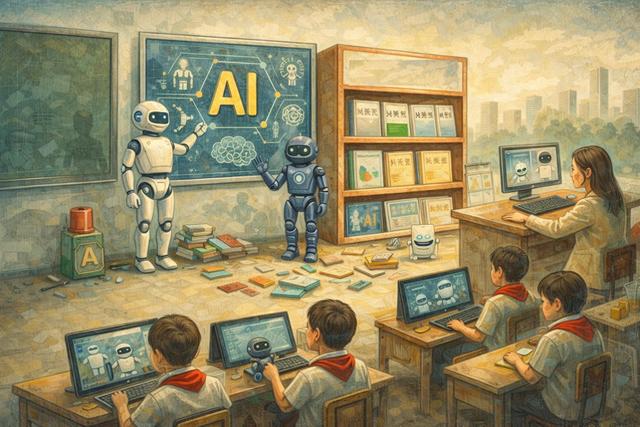
Core Insights - The implementation of AI education in primary and secondary schools is set to officially begin in certain provinces by September 2025, driven by various policies and guidelines from the Ministry of Education [3][6] - There is a significant disparity in the understanding and application of AI among teachers in less developed regions compared to more developed areas, highlighting a need for improved training and resources [4][5] Group 1: Current State of AI Education - As of now, many teachers in less developed regions have limited exposure to AI tools, with only about 30% having used AI in their work, indicating a gap in familiarity and application [3][4] - In Shanghai, over 6,000 teachers have utilized AI for lesson preparation, and more than 15,000 have incorporated AI tools into their teaching, showcasing a more advanced integration of AI in education [3] Group 2: Challenges in AI Education Implementation - The "Five Nos" concerns raised by experts include the lack of fixed class hours, standardized textbooks, professional teachers, smart devices, and evaluation standards, which hinder the effective rollout of AI education [2][4] - Many existing AI educational materials are outdated or overly focused on promoting specific technology products, lacking the necessary breadth and depth for comprehensive education [5][6] Group 3: Role of Technology Companies - Technology companies are increasingly recognized for their role in providing comprehensive AI education solutions, with firms like iFlytek and DJI leading initiatives in various provinces [4][5] - These companies are leveraging cloud technology to create virtual labs, making AI education more accessible to schools with limited resources [4] Group 4: Future Directions - There is a growing demand for national standardized textbooks and more training opportunities for teachers to enhance the quality of AI education [5][6] - Concerns have been raised about the potential commercialization of AI education, with some regions focusing excessively on competitions and certifications, which may detract from the core educational objectives [6]

Sora爆火背后:AI通识教育已经刻不容缓 | 小白商业观
Jing Ji Guan Cha Bao· 2025-10-11 08:21
Core Insights - OpenAI's AI short video application Sora, based on Sora2 technology, has gained significant traction, achieving approximately 627,000 downloads on iOS in its first week, surpassing ChatGPT's initial downloads of 606,000 in early 2023 [2] - Sora allows content creators to generate virtual videos by simply inputting a prompt, eliminating the need for traditional video shooting and uploading, which may lead to an overwhelming presence of AI-generated content online [2] - The emergence of Sora raises concerns about the authenticity of content on short video platforms, as it blurs the line between reality and algorithmically generated "hyperreality," challenging societal perceptions and trust in information [3] Industry Implications - The rise of AI-generated content necessitates urgent discussions on AI governance, emphasizing the need for proactive ethical frameworks that ensure safety, transparency, and accountability throughout the content creation process [4] - Effective AI compliance requires the development of reliable content tracing and digital watermarking technologies, alongside ethical design principles that guide content generation and dissemination [4] - AI literacy education is crucial for society to navigate the challenges posed by AI-generated content, fostering critical thinking and media literacy to discern potential risks and ethical considerations [5] Future Considerations - A well-informed society on AI can better identify and resist misinformation while holding technology companies accountable for compliance, creating a positive governance cycle [5] - The integration of AI literacy and compliance frameworks is essential to responsibly harness AI technology, ensuring a future rich in creativity and possibilities [5]
Sora爆火背后:AI通识教育已经刻不容缓
Jing Ji Guan Cha Wang· 2025-10-11 08:17
Core Insights - The launch of OpenAI's AI short video application Sora, based on Sora2 technology, has gained significant traction, achieving approximately 627,000 downloads on iOS in its first week, surpassing the initial downloads of ChatGPT [1] - Sora allows content creators to generate virtual videos through simple prompts, indicating a shift towards AI-generated content flooding the internet [1] - The emergence of Sora raises concerns about the authenticity of content, as AI-generated videos may blur the lines between reality and simulation, challenging societal perceptions of truth [2] Industry Implications - The rise of AI-generated content necessitates urgent discussions on AI governance, emphasizing the need for proactive ethical frameworks in model training, data usage, and content generation [3] - Effective AI compliance requires the integration of safety, transparency, and accountability mechanisms throughout the content creation process, including reliable content tracing and digital watermarking [3] - The rapid growth of AI-generated content outpaces existing regulatory frameworks, highlighting the importance of enhancing public understanding of AI technologies through AI literacy education [3][4] Social Considerations - AI literacy education aims to cultivate critical thinking and media literacy in the public, enabling individuals to understand AI-generated content, recognize its limitations, and identify potential risks [4] - A society well-versed in AI literacy can better discern and resist misinformation while holding technology companies accountable for compliance, creating a positive governance cycle [4] - The ongoing cognitive revolution driven by AI underscores the necessity of building robust frameworks to responsibly harness AI technology for a more imaginative and possible future [4]