AI for Math

Search documents
这个情人节,AI深吻Math!国产RL系统多维突破300年亲吻数难题
机器之心· 2026-02-14 07:32
Core Viewpoint - The article discusses the breakthrough achieved by the PackingStar reinforcement learning system in solving the Kissing Number Problem, showcasing a significant advancement in both mathematical understanding and AI application in high-dimensional geometry [2][3][4]. Group 1: Breakthrough Achievements - PackingStar has set new records in multiple dimensions, including 25-31 dimensions, and has broken records for the kissing numbers in 12, 14, 17, 20, and 21 dimensions, as well as discovering over 6000 new structures [15][21]. - The system's approach involved transforming high-dimensional geometric problems into a cosine matrix filling problem, allowing for a systematic search and generation of new geometric configurations [12][25]. Group 2: Methodology and Collaboration - The breakthrough was achieved through a multi-agent reinforcement learning architecture, where two agents collaborated: one for filling the matrix and the other for pruning suboptimal structures [6][9][11]. - This collaborative approach mirrors the dynamics of a partnership, where one agent explores boldly while the other refines and optimizes the results [8][30]. Group 3: AI and Mathematical Integration - PackingStar represents a shift in the AI for Math paradigm, demonstrating that AI can not only solve problems but also actively construct new geometric possibilities in high-dimensional spaces [26][27]. - The project emphasizes the importance of human-AI collaboration, where human intuition and mathematical insight guide the AI's exploration and construction processes [32][41]. Group 4: Engineering and Computational Efficiency - The engineering team optimized the underlying operators, significantly enhancing computational efficiency and enabling large-scale operations, which resulted in a 2-3 times increase in search efficiency and saved over 100,000 GPU hours [36][37]. - This optimization is crucial for sustaining mathematical exploration and ensuring that the system can tackle increasingly complex problems [36][37].

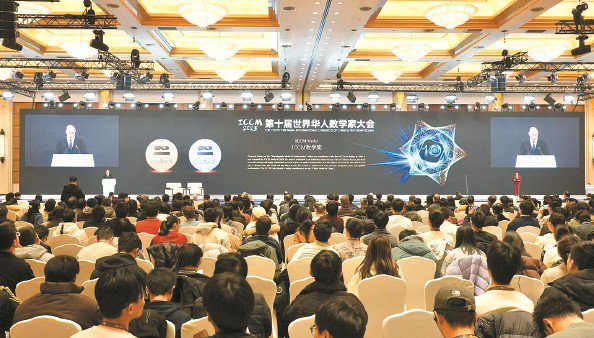
“科学之母”数学的热点何在
Xin Lang Cai Jing· 2026-01-07 06:53
Group 1 - The main focus of current mathematical research includes areas such as analysis/probability, algebra/number theory, and geometry/topology, with a significant emphasis on Partial Differential Equations (PDE) [3] - PDE research addresses systems described by multi-variable functions or vector fields that adhere to physical laws, with many classical problems being answered while numerous unsolved issues remain [3][4] - The famous Millennium Prize Problems include the Navier-Stokes existence and smoothness problem and the construction of Yang-Mills quantum field theory, both of which are significant unsolved problems in mathematics [4] Group 2 - The relationship between mathematics and contemporary technologies like AI and quantum technology is highlighted, with potential breakthroughs in quantum computing possibly leading to significant advancements in algorithms and computational power [5] - Two research directions in the intersection of mathematics and AI are identified: "Math for AI," which focuses on the mathematical foundations of AI technologies, and "AI for Math," which explores how AI can assist in mathematical research [5][6] - Recent advancements in "AI for Math" include using AI to find approximate solutions to PDEs, conducting mathematical experiments, and automating mathematical proofs, with AI models showing capabilities in writing proofs and formalizing them [5][6][7] Group 3 - The impact of AI on foundational mathematics is currently limited, primarily addressing specific problems rather than generating original proofs, but future developments in AI may change the landscape of mathematical research [7] - The importance of mathematical literacy for contemporary youth is emphasized, focusing on skills such as logic, statistics, analysis, and structuring, which are essential for navigating an increasingly complex information environment [8][9]