PackingStar强化学习系统

Search documents
AI与数学“双向奔赴” 中国团队突破亲吻数问题
Zhong Guo Qing Nian Bao· 2026-02-27 01:27
Core Insights - The research team from Shanghai Institute of Science and Intelligence, Peking University, and Fudan University has made significant breakthroughs in the classical mathematical problem of kissing numbers, utilizing the PackingStar reinforcement learning system to explore complex high-dimensional spaces beyond human intuition [1][2] Group 1: Breakthroughs in Kissing Numbers - The team has achieved new best-known kissing number structures in dimensions 25-31, and has broken long-standing records in dimensions 14, 17, 12, 20, and 21 [1] - The PackingStar system transforms high-dimensional packing problems into multi-agent game learning on cosine matrices, allowing for a unified approach to complex geometric issues [3] Group 2: Applications and Implications - Kissing number problems are not just abstract geometric challenges; they are central to discrete geometry and coding theory, with applications in satellite communication, quantum coding, and data compression [2] - The advancements in this area could lead to improved signal distribution methods in engineering, highlighting the practical significance of the research [2] Group 3: Research Methodology and Efficiency - The research has resulted in a 2-3 times increase in search efficiency and saved over 100,000 GPU hours, showcasing the computational potential of the AI model [3] - The methods developed through the PackingStar project have become a reusable interdisciplinary computational paradigm, enabling systematic exploration of previously deemed "intractable" scientific problems [3] Group 4: Team and Institutional Support - The project is led by young researchers, including AIMath researcher Ma Chengdong, who aims to tackle more niche and high-risk problems after achieving existing academic results [3][5] - The Shanghai Institute of Science and Intelligence promotes an inclusive environment for young researchers, encouraging independent exploration without hierarchical constraints [5]
AI与数学“双向奔赴”,中国团队突破亲吻数问题
Xin Lang Cai Jing· 2026-02-15 10:37
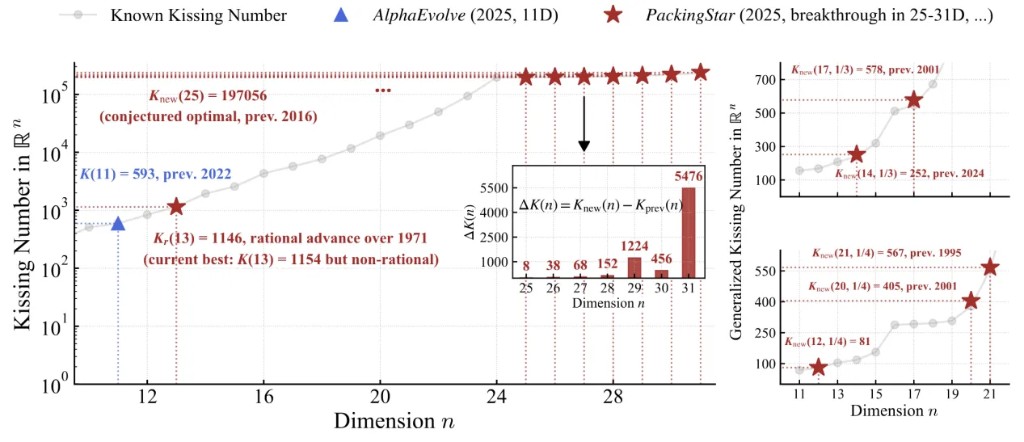
Core Viewpoint - A breakthrough in the kissing number problem has been achieved by a collaborative research team from the Shanghai Institute of Science and Intelligence, Peking University, and Fudan University, utilizing the PackingStar reinforcement learning system to explore complex high-dimensional spaces and surpass previous human-known optimal structures [1][4]. Group 1: Research Breakthroughs - The research team has broken the known optimal kissing number structures in dimensions 25-31, as well as the long-standing values for 14 and 17 dimensions for "two-ball kissing numbers," and 12, 20, and 21 dimensions for "three-ball kissing numbers" [1]. - The PackingStar system has transformed the complex high-dimensional geometric problem into an algebraic problem compatible with GPU parallel logic, significantly enhancing the computational potential of AI models [4][6]. Group 2: AI and Mathematics Integration - The research represents a bidirectional attempt between AI and mathematics, with AI advancements lowering the barriers for researchers to tackle complex problems [2]. - Previous attempts to use AI in the kissing number problem, such as DeepMind's AlphaEvolve, resulted in limited breakthroughs, highlighting the unique approach of the PackingStar system in achieving substantial improvements [3][4]. Group 3: Future Plans and Applications - The research team plans to improve the system further, expand to the entire space of sphere packing problems, explore applications in graph theory, and collaborate with more mathematicians [8]. - The results from the PackingStar project have led to a 2-3 times increase in search efficiency and saved over 100,000 GPU hours, establishing a reusable interdisciplinary intelligent computing paradigm [6].


人工智能助力 中国团队攻克经典数学难题
Ke Ji Ri Bao· 2026-02-14 23:37
Core Insights - The Shanghai Institute of Intelligent Science (SIIS) has achieved a breakthrough in the kissing number problem, marking a significant advancement in mathematical research through the collaboration of AI and human researchers [1][5]. Group 1: Breakthrough Details - The PackingStar reinforcement learning system, developed in collaboration with Peking University and Fudan University, has set new records for kissing numbers across multiple dimensions, including 12, 13, 14, 17, 20, 21, and 25 to 31 [1]. - This achievement represents a systematic breakthrough in high-dimensional combinatorial geometry and coding theory, validating a new human-AI collaborative research approach [1][5]. Group 2: Historical Context - The kissing number problem, first proposed by Newton and Gregory in 1694, has a long history, with significant developments occurring only sporadically over the past 300 years [1][2]. - The problem is linked to various mathematical branches and has practical applications in satellite communication, quantum coding, and data compression [1]. Group 3: Methodological Innovations - The breakthrough has led to a methodological transformation in the research of the kissing number problem, moving from traditional symmetric constructions to discovering asymmetric configurations that maintain multi-dimensional records [5]. - The PackingStar project has redefined the problem by converting high-dimensional geometric challenges into algebraic computations, facilitating cross-dimensional migration paths [5]. Group 4: Engineering Support - The research is supported by a robust engineering framework, with the SIIS focusing on dismantling scientific goals through an open platform and leveraging engineering capabilities to mitigate exploration uncertainties [5]. - The project has optimized GPU computing processes and established an automatic checkpoint mechanism, significantly enhancing search speeds and saving over 100,000 GPU hours [5].
这个情人节,AI深吻Math!国产RL系统多维突破300年亲吻数难题
机器之心· 2026-02-14 07:32
Core Viewpoint - The article discusses the breakthrough achieved by the PackingStar reinforcement learning system in solving the Kissing Number Problem, showcasing a significant advancement in both mathematical understanding and AI application in high-dimensional geometry [2][3][4]. Group 1: Breakthrough Achievements - PackingStar has set new records in multiple dimensions, including 25-31 dimensions, and has broken records for the kissing numbers in 12, 14, 17, 20, and 21 dimensions, as well as discovering over 6000 new structures [15][21]. - The system's approach involved transforming high-dimensional geometric problems into a cosine matrix filling problem, allowing for a systematic search and generation of new geometric configurations [12][25]. Group 2: Methodology and Collaboration - The breakthrough was achieved through a multi-agent reinforcement learning architecture, where two agents collaborated: one for filling the matrix and the other for pruning suboptimal structures [6][9][11]. - This collaborative approach mirrors the dynamics of a partnership, where one agent explores boldly while the other refines and optimizes the results [8][30]. Group 3: AI and Mathematical Integration - PackingStar represents a shift in the AI for Math paradigm, demonstrating that AI can not only solve problems but also actively construct new geometric possibilities in high-dimensional spaces [26][27]. - The project emphasizes the importance of human-AI collaboration, where human intuition and mathematical insight guide the AI's exploration and construction processes [32][41]. Group 4: Engineering and Computational Efficiency - The engineering team optimized the underlying operators, significantly enhancing computational efficiency and enabling large-scale operations, which resulted in a 2-3 times increase in search efficiency and saved over 100,000 GPU hours [36][37]. - This optimization is crucial for sustaining mathematical exploration and ensuring that the system can tackle increasingly complex problems [36][37].
当一道世界级数学难题在上海与AI相遇
Xin Lang Cai Jing· 2026-02-13 21:46
Core Insights - The article discusses a significant breakthrough in solving the "kissing number problem," a mathematical challenge that has persisted for over 300 years, achieved through the collaboration of AI and researchers from Shanghai, Peking University, and Fudan University [3][4]. Group 1: Kissing Number Problem - The kissing number problem involves determining the maximum number of identical spheres that can touch another identical sphere in N-dimensional space, with historical debates dating back to Isaac Newton and David Gregory [4]. - Recent advancements have been made in high-dimensional spaces, particularly by Marina Viazovska, who received the Fields Medal for her work on the 8-dimensional and 24-dimensional cases [4]. Group 2: AI's Role in Research - The research team utilized AI to tackle the kissing number problem, with the belief that AI could enhance mathematical problem-solving capabilities, despite skepticism from some mathematicians [6][7]. - The development of the PackingStar reinforcement learning system led to the discovery of new optimal packing structures in dimensions 25-31 and over 6000 new solutions in various dimensions [8]. Group 3: Collaborative Research Environment - The collaborative environment in Shanghai allows young researchers to lead projects based on innovative ideas, emphasizing the importance of interdisciplinary teamwork in solving complex scientific problems [10]. - The integration of AI in mathematical research represents a paradigm shift, where AI acts as a partner in scientific exploration, potentially accelerating the pace of discovery [8][10].