Advanced Driver Assistance Systems (ADAS)

Search documents
What Does Mobileye's New DMS Deal Mean for Auto Safety?
ZACKS· 2026-03-24 14:31
Core Insights - Mobileye Global Inc. (MBLY) has secured a deal with a major U.S. automaker to integrate its Driver Monitoring System (DMS) into vehicles powered by the EyeQ6L chip, with production set to commence in 2027, expanding an existing ADAS program to cover millions of vehicles across various models and years [1][10] Group 1: Technology and Integration - Mobileye's in-cabin sensing solution combines DMS and Occupant Monitoring System (OMS) on a single chip, enhancing the functionality of ADAS by integrating interior monitoring with external road awareness [2] - The new agreement builds on previous partnerships, highlighting the growing demand from automakers for unified systems that combine driver monitoring, occupant safety, and advanced driving features, thereby reducing hardware complexity and costs [3] - The platform is designed to comply with upcoming Euro NCAP 2026 requirements and is being developed with future standards in mind, including the anticipated 2029 protocol, which aims for more comprehensive engagement detection beyond simple eye tracking [6] Group 2: Safety and Engagement - As hands-free driving becomes more prevalent, ensuring driver engagement is critical for safety; Mobileye's system links driver gaze with real-time road data from ADAS cameras to detect distractions and recognize attentive drivers, aiming to reduce unnecessary alerts and improve intervention accuracy [5] - The integration of DMS addresses the need for context-aware monitoring on a single ADAS chip and ECU platform, which is essential for scaling advanced features without adding extra hardware or integration challenges [4]



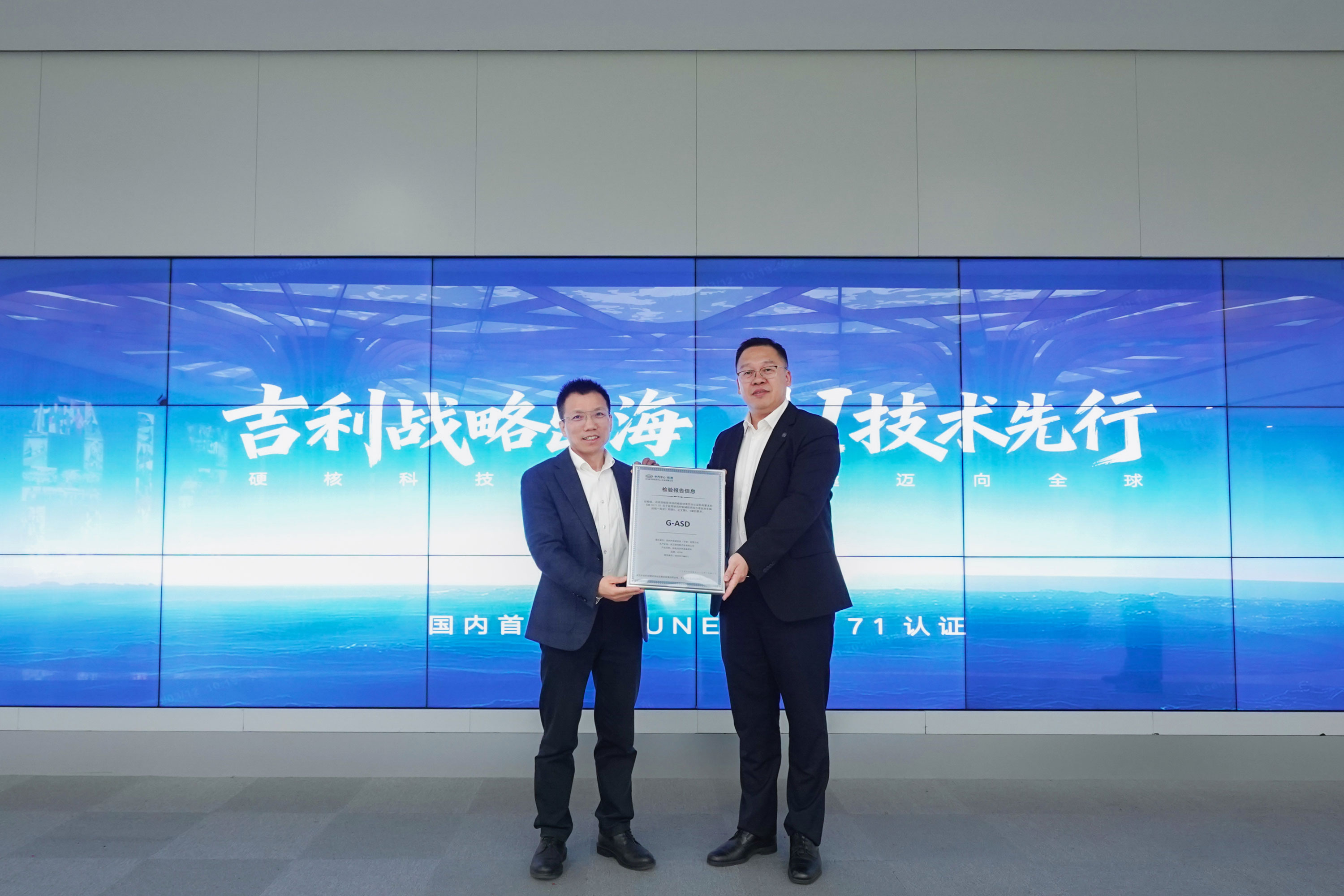
Geely’s G-ASD Secures UN R171 Certification, Spearheading ADAS Global Expansion
Globenewswire· 2026-03-18 13:18
Core Viewpoint - Geely Auto Group's G-ASD has achieved UN R171 certification, marking a significant milestone as the first Chinese ADAS to receive European regulatory approval, which facilitates its entry into the European market [1][4]. Group 1: Certification and Regulatory Impact - The UN R171 certification is one of the most stringent ADAS certifications globally, requiring high standards for hazard recognition, system redundancy, and continuous driver monitoring [3]. - The certification allows vehicles equipped with G-ASD to be sold across all UNECE member states without needing individual country certifications, acting as a regulatory "passport" [4]. Group 2: Technological Advancements - The G-ASD system is powered by dual NVIDIA Orin-X chips and supports assisted driving at speeds up to 150 km/h on European highways, featuring automated highway interchanges, smart navigation, autonomous overtaking, and dynamic speed regulation [6]. - Geely has developed a pioneering testing framework in collaboration with CATARC to meet the UN R171 standards, showcasing China's leadership in smart automotive technology [3][4]. Group 3: Market Strategy and Future Plans - The first vehicle featuring the certified G-ASD system is expected to hit European roads in June 2026, positioning Geely to launch the world's first mass-produced ADAS under this new framework [6]. - Geely plans to leverage its first-mover advantage to expand this technology across its global portfolio, including brands like ZEEKR, Lynk & Co, and Lotus [6].

Lotus Tech Becomes the Second Automaker to Obtain UN R171 Certification Globally, Advancing ADAS Compliance
Globenewswire· 2026-03-13 11:00
Core Insights - Lotus Technology Inc. has achieved UN R171.01 certification, becoming the second global automaker to do so, which enhances its position in the intelligent and luxury mobility sector [1][4][9] Group 1: Certification and Compliance - The UN R171 regulation, effective since September 2024, is the first globally harmonized technical regulation for Level 2 Driver Control Assistance Systems, establishing standardized requirements for automakers [3] - The LOTUS Eletre is the first and only China-built model certified under UN R171.01, equipped with the Highway Navigation Pilot (HNP) function [4][9] - Certification involves both closed-course validation and real-road assessments to ensure safety limits are maintained while allowing driver control [3] Group 2: Product Development and Features - The LOTUS Eletre's HNP function will be rolled out in Europe via over-the-air updates starting June 2026 [2][9] - The intelligent parking and ADAS suite, LOTUS For Me (Eletre X in Europe), is planned to pursue UN R171 certification in the future [5] Group 3: Strategic Focus and Future Plans - The company emphasizes a "Safety First, Compliance Priority, Consistent Experience" approach to enhance ADAS capabilities [6] - Lotus Tech is committed to delivering safer and smarter mobility experiences through rigorous R&D and adherence to global standards [5]

indie Semiconductor(INDI) - 2025 Q4 - Earnings Call Transcript
2026-02-19 23:02
Financial Data and Key Metrics Changes - The company reported Q4 revenue of $58 million, exceeding the midpoint of the outlook by $1 million, representing an 8% sequential growth and flat compared to the prior year period [5][15] - Full year revenue reached $217.4 million, with non-GAAP operating loss of $10.1 million, an improvement from $11.3 million in the previous quarter and $14.2 million a year ago [15] - The company exited the quarter with total cash and cash equivalents of $155.7 million, a decrease of $15.5 million from the third quarter [16] Business Line Data and Key Metrics Changes - The radar business is gaining traction with a Tier 1 partner, with initial shipments starting in December and expected demand exceeding 50 million units annually [9][10] - The vision portfolio is seeing momentum with design wins for image signal processor SoCs, including the IND880, and new design wins in e-mirror and camera mirror systems [10][11] - The company secured a design win with a leading electric vehicle manufacturer in China for a camera mirror system, expected to ramp in mid-2026 [11] Market Data and Key Metrics Changes - The automotive industry is transitioning towards standardization of ADAS features, creating opportunities for the company to leverage its technology investments [5][6] - The humanoid robotics market is transitioning from research to real-life applications, presenting new opportunities for the company [6][7] - The company is also gaining traction in the quantum communications and sensing market, with significant bookings for LXM lasers [12] Company Strategy and Development Direction - The company aims to capitalize on the structural transformation in the automotive market by focusing on software-defined intelligence and scalable sensor technology [5][6] - Plans to expand activities in humanoid robotics and enhance radar and vision technologies to maintain competitive advantages [8][10] - The company is actively managing supply chain constraints and expanding production capabilities to meet growing demand [9][13] Management's Comments on Operating Environment and Future Outlook - Management expressed optimism about the future, expecting revenue from core business to grow by 20% sequentially in Q1 2026, despite a decline in revenue from Wuxi due to reduced EV subsidies [18][19] - The company anticipates a steady ramp in radar revenue through 2026 and beyond, with increasing visibility on design wins and OEM traction [20][41] - Management acknowledged ongoing supply chain constraints but is confident in their ability to manage through 2026 [37][38] Other Important Information - The company is in the process of selling its equity interest in Wuxi Indie Micro for approximately $135 million, with the transaction expected to close by late 2026 [17] - Non-GAAP operating expenses for Q1 2026 are expected to be $37 million, relatively flat compared to Q4 2025 [18] Q&A Session Summary Question: What was the Wuxi revenue for Q4? - The revenue was around $29.7 million [23] Question: What are the reasons for the sequential decline in revenue? - The decline is primarily due to the upcoming Chinese New Year shutdown and reduced EV subsidies [24] Question: What is expected for the ramp in Q2? - A recovery is expected in Q2, although the business is in the process of being sold [25] Question: Can you provide an update on radar program ramp? - The company has made significant progress and expects strong traction with OEMs [26] Question: What impact do supply chain constraints have in Q1? - There was a trailing impact into Q1, with some demand still questionable due to supply issues [27] Question: Any updates on design wins and traction for core business? - The company is performing well across all regions, with exposure to OEMs in Europe, Asia, and India [33] Question: What is the size of the opportunity in robotics and quantum space? - The robotics market is expected to grow significantly, while quantum traction is also increasing, with a projected tripling of optical product shipments [35][36] Question: What is the timeline for resolving supply chain constraints? - The tightness is driven by AI demand, and while improvements are being made, full resolution may not occur until 2027 [37][38] Question: What are the expected radar revenues for 2026? - Radar revenue is expected to remain in the $30 million-$50 million range, with strong momentum from newer OEMs [41]

indie Semiconductor(INDI) - 2025 Q4 - Earnings Call Transcript
2026-02-19 23:00
Financial Data and Key Metrics Changes - The company reported Q4 revenue of $58 million, exceeding the midpoint of the outlook by $1 million, representing an 8% sequential growth and flat compared to the prior year period [4][12] - Full year revenue reached $217.4 million, with non-GAAP operating loss of $10.1 million, an improvement from $11.3 million in the previous quarter and $14.2 million a year ago [12][13] - The company exited the quarter with total cash and cash equivalents of $155.7 million, a decrease of $15.5 million from the third quarter [13] Business Line Data and Key Metrics Changes - The radar business is gaining traction with a Tier 1 partner, who launched their Gen 8 77 GHz radar solution, leading to initial shipments and expected demand exceeding 50 million units annually [6][7] - The vision portfolio is seeing momentum with design wins for image signal processor SoCs, including the IND880, and new design wins in e-mirror and camera mirror systems [8][9] - The company secured a design win with a leading electric vehicle manufacturer in China for a camera mirror system, expected to ramp in mid-2026 [9] Market Data and Key Metrics Changes - The automotive industry is transitioning towards standardization of ADAS features, creating a significant opportunity for the company to leverage its technology investments [4][5] - The humanoid robotics market is transitioning from research to real-life applications, presenting new opportunities for the company [5] - The company is also gaining traction in the quantum communications and sensing markets, with significant bookings for LXM lasers [10] Company Strategy and Development Direction - The company aims to capitalize on the structural transformation in the automotive market by focusing on ADAS and automated driving technologies [4][5] - Plans to expand activities in humanoid robotics and enhance production capabilities to meet growing demand [6][7] - The company is defining next-generation radar platforms to deliver competitive advantages in performance and cost [7] Management's Comments on Operating Environment and Future Outlook - Management expressed optimism about the automotive market's transition and the company's positioning to drive growth through 2026 and beyond [17] - The company anticipates a decline in first-quarter revenue from Wuxi due to reduced EV subsidies and expects core business revenue to grow by 20% sequentially [15][16] - Management acknowledged ongoing supply chain constraints but is focused on expanding the supply base to mitigate risks [11][34] Other Important Information - The company is in the process of selling its equity interest in Wuxi Indie Micro for approximately $135 million, with the transaction subject to regulatory approval [14] - The Qi 2.0 wireless charging platform production with Ford is on track for the first half of 2026, with further adoption expected [10][11] Q&A Session Summary Question: What was the Wuxi revenue for Q4? - The revenue was around $29.7 million [19] Question: What are the reasons for the sequential decline in revenue? - The decline is primarily due to the upcoming Chinese New Year shutdown and reduced EV subsidies [21] Question: What is expected for the ramp in Q2? - A recovery is expected in Q2, although the company is in the process of selling that business [22] Question: Can you provide updates on radar program ramp expectations? - The company has made significant progress and expects strong traction with OEMs [23] Question: What impact do supply chain constraints have in Q1? - There was a trailing impact into Q1, with some demand still uncertain due to supply issues [24] Question: Any updates on design wins and traction for core business? - The company is performing well across all regions, with exposure to OEMs in Europe, Asia, and India [30] Question: What is the size of the opportunity within robotics and quantum space? - The robotics market is showing significant activity, and quantum applications are expected to see increased momentum [32][33] Question: What is the timeline for resolving supply chain constraints? - The tightness is driven by AI demand, and the company is expanding its supply base to mitigate risks [34][35] Question: What are the expected radar revenues for 2026? - Radar revenue is expected to remain in the $30 million-$50 million range, with strong momentum anticipated [39] Question: What percentage of core business remains in China? - The percentage is now in the 25%-30% range, but it is slightly lower than before [41]
Mahindra Selects Mobileye’s (MBLY) EyeQ6 ADAS for Future Vehicle Lineup
Yahoo Finance· 2026-02-19 00:43
Group 1: Company Overview - Mobileye Global Inc. (NASDAQ:MBLY) is recognized as a promising single-digit stock by analysts, with a strong position entering 2026 due to new program wins and partnership expansions [1] - The company develops and deploys advanced driver assistance systems (ADAS) and autonomous driving technologies across various regions including the US, Europe, and China [5] Group 2: Recent Developments - Mahindra & Mahindra Ltd. has selected Mobileye's SuperVision and Surround ADAS platforms for at least six future vehicle models, with production expected to start in 2027, positioning Mobileye as a Tier 1 supplier [2] - The SuperVision system will utilize 11 cameras and optional radars powered by two EyeQ6H chips for advanced driving capabilities, while the Surround ADAS system will employ five cameras and multiple radars for hands-off highway driving [3] Group 3: Market Context - India is the third-largest automotive market globally, experiencing increased ADAS adoption driven by consumer demand and new regulatory standards like the Bharat New Car Assessment Program, which supports Mobileye's growth in this key market [4]
Valeo to invest €200m in India under Elevate 2028 plan
Yahoo Finance· 2026-02-18 19:13
Investment Plans - Valeo plans to invest more than €200 million ($236.8 million) in India to expand its electrification, advanced driver assistance systems (ADAS), and artificial intelligence (AI) engineering activities under its Elevate 2028 strategy [1] - The company aims to triple its local revenue to about €700 million by 2028 [1] Electrification Initiatives - Valeo has started operations at a new facility in Pune dedicated to e-axle lines for a Mahindra & Mahindra electric vehicle project, with total orders approaching $1 billion [2] - The company will supply electric powertrain systems for Mahindra's 'Born Electric' passenger platform and on-board charger combo units for electric utility vehicles [2] Strategic Importance of India - Valeo's CEO, Christophe Périllat, emphasized that India is a key pillar of the company's global growth and innovation roadmap, highlighting the remarkable transformation in the Indian automotive sector driven by electrification and sustainable mobility [3] - Valeo has formed a collaboration with Atul Greentech and Honda Power Pack Energy India targeting electric three-wheelers, combining battery technology and compact powertrains [3] R&D and Manufacturing Expansion - Valeo is increasing the scope of its Chennai R&D center for software development, AI-enabled engineering, and validation for global electrification and ADAS projects [4] - New camera production lines at the Sanand plant in Gujarat are scheduled to begin by mid-2026, enhancing the manufacturing capabilities for ultrasonic sensors [4] Partnerships and Workforce - Valeo is collaborating with French tech group 2CRSi to develop liquid-cooling solutions for edge data centers in India, including systems for outdoor and 5G infrastructure [5] - The Chennai Group Technical Centre and a satellite site in Bangalore employ over 3,300 engineers, with expanded in-house laboratory testing and validation capacity [5]
Needham Analysts Stay Bullish On Mobileye Global (MBLY)
Yahoo Finance· 2026-02-15 13:58
Group 1 - Mobileye Global Inc. is recognized as one of the top 12 mid-cap AI stocks to buy according to hedge funds, with a Buy rating and a price target of $16, indicating a potential 65% increase in stock value [1] - The company has secured an agreement with Mahindra & Mahindra to provide advanced driver assistance systems (ADAS), which will utilize the EyeQ6 High system-on-chip and multiple cameras for enhanced safety features, with production expected to start in 2027 [3] - Mobileye develops computer vision and machine learning technologies specifically for ADAS and autonomous driving solutions, and is headquartered in Jerusalem, Israel [4] Group 2 - The partnership with Mahindra positions Mobileye as a Tier 1 supplier across all of Mahindra's programs, which is expected to positively impact the company's operations in India [3]
Can Qualcomm's Snapdragon Ride Flex for Hyundai Work Wonders?
ZACKS· 2026-01-09 17:25
Core Insights - Qualcomm and Hyundai Mobis have signed a comprehensive agreement to co-develop next-generation solutions for Software-Defined Vehicles (SDVs) and Advanced Driver Assistance Systems (ADAS) [1] - The partnership aims to leverage Qualcomm's Snapdragon Ride Flex SoC to create integrated automotive solutions that cater to emerging markets and enhance Qualcomm's position in the global automotive supply chain [1][8] Qualcomm's Technological Advancements - The Snapdragon Ride Flex SoC is designed to support ADAS and autonomous driving, featuring high-performance AI processing, real-time sensor fusion, and advanced safety features [2] - This chip enables efficient handling of complex driving and parking tasks while reducing power consumption and system complexity [2] - Qualcomm and Hyundai Mobis plan to develop advanced driving and parking solutions that consolidate multiple vehicle functions onto a single chip, aiming to lower costs and improve efficiency for automakers [2][8] Future Development Plans - The two companies intend to combine their software and chip technologies to create a scalable, high-performance SDV architecture that is efficient, stable, and capable of over-the-air upgrades [3] - Qualcomm has also strengthened its partnership with Google to advance AI-powered vehicle technologies and has collaborated with Garmin to launch the Nexus automotive compute platform [4] Competitive Landscape - Qualcomm faces competition from NXP Semiconductors and NVIDIA, with NVIDIA expanding its DRIVE platform for Level 4 self-driving vehicles and introducing AI technologies to enhance decision-making in complex driving scenarios [5] - NXP is enhancing its CoreRide platform and acquiring TTTech Auto to improve automotive software functions, while also introducing S32N7 processors to support AI features and reduce costs for automakers [6] Financial Performance - Qualcomm shares have increased by 15.9% over the past year, compared to the industry's growth of 39.5% [7] - Earnings estimates for 2025 have risen by 0.3% to $12.15, while estimates for 2026 have decreased by 1% to $12.58 [9] - The company's shares currently trade at a price/earnings ratio of 14.82, which is lower than the industry average of 33.24 [10]



Hyundai Mobis and Qualcomm Sign Comprehensive Agreement to Collaborate on SDV architecture for ADAS
Prnewswire· 2026-01-07 18:00
Core Insights - Hyundai Mobis and Qualcomm Technologies Inc. have signed a comprehensive agreement to co-develop next-generation solutions for Software-Defined Vehicles (SDV) and Advanced Driver Assistance Systems (ADAS) at CES 2026 [1][6] Group 1: Collaboration Details - The MOU signing was attended by key executives from both companies, indicating a high-level commitment to the partnership [2] - The collaboration aims to develop integrated solutions tailored for emerging markets, leveraging Hyundai Mobis's expertise in system integration and sensor fusion alongside Qualcomm's leadership in system-on-chip (SoC) technology [3] Group 2: Focus Areas - The initial focus will be on co-developing advanced driving and parking solutions based on Qualcomm's Snapdragon Ride Flex SoC, targeting fast-growing markets like India where ADAS adoption is increasing [4] - Future SDV applications will involve creating integrated solutions that combine Hyundai Mobis's standardized software platform with Qualcomm's Snapdragon automotive technologies to enhance performance, efficiency, and stability [4] Group 3: Strategic Initiatives - Hyundai Mobis hosted a private exhibition booth at CES 2026 to showcase its strategy of expanding into new business areas, including robotics, SDV solutions, and semiconductors, with over 200 representatives from major customers visiting for discussions [5]