B2B模式

Search documents
2025年商城系统代码解析与类型详解
Sou Hu Cai Jing· 2025-11-27 05:40
Core Insights - The article discusses the definition and functionality of e-commerce platform code, emphasizing its role in product display, order processing, user management, and payment interfaces [2][3] - It analyzes different types of e-commerce systems, including traditional monolithic architecture and modern microservices architecture, highlighting their suitability for various business scales and needs [2][3][4] - Practical suggestions are provided to enhance the efficiency of building e-commerce systems, ensuring they meet future development needs and market changes [4][5] E-commerce System Code Structure - E-commerce system code typically consists of front-end and back-end components, with front-end technologies like HTML, CSS, and JavaScript frameworks such as Vue or React, and back-end languages like Java, Python, or PHP [2][3] - The implementation principle utilizes the MVC (Model-View-Controller) architecture, which enhances system maintainability and facilitates future functionality expansion [2][3] Types of E-commerce Systems - The article categorizes e-commerce systems into traditional monolithic systems, suitable for small businesses, and microservices architecture, which is preferred by larger enterprises due to its scalability [3][4] - Different industry applications exhibit unique advantages, such as B2C models for retailers and B2B models for manufacturers and wholesalers, necessitating an understanding of specific requirements for effective operation [3][4] Choosing the Right E-commerce System - Companies should clarify their business needs, considering factors like business scale and model, to select the most suitable e-commerce system [4][5] - Lightweight systems like mall4j or JavaShop are recommended for startups or small businesses, while systems supporting microservices architecture, like Xianbao Mall, are better for high concurrency and traffic [3][4] Enhancing System Development Efficiency - To improve the efficiency of building e-commerce systems, companies should choose appropriate open-source frameworks and technology stacks, leveraging established frameworks to save time and costs [4][5] - Utilizing automation tools for environment configuration and deployment, such as Docker and CI/CD tools, can simplify deployment processes and enhance project maintainability [4][5] - Emphasizing modular design and agile methodologies can facilitate future functionality expansion and ensure the final system meets expected user experience requirements [4][5]


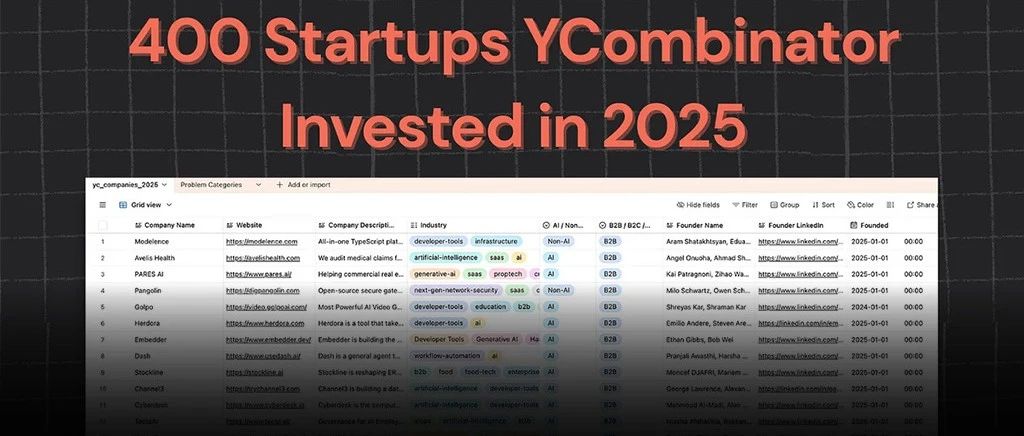
YC 2025 407 家创企复盘:B2B 模式占主导,AI 编程过度饱和,最大的机会还没人注意到
Founder Park· 2025-08-01 11:11
Core Insights - For AI entrepreneurs, identifying a precise entrepreneurial direction is more crucial than merely focusing on technology [2] - The analysis of over 400 startups in YC 2025 reveals that many AI entrepreneurs are competing in saturated markets, particularly in developer tools, with 94 companies in this space [2][18] - There are significant opportunities in underexplored sectors such as government technology, insurance, and construction, which have substantial market sizes but minimal AI startup presence [4][79] Market Saturation and Opportunities - The AI programming market is oversaturated, with a recommendation to focus on AI solutions that can fully automate high-salary jobs rather than just assist [22][18] - The B2B model dominates the YC ecosystem, accounting for nearly 90% of startups, reflecting a trend towards enterprise-level solutions [9][13] - Specific sectors like healthcare and finance show strong demand for AI solutions, particularly in automating administrative tasks and compliance [34][36] Emerging AI Agent Market - Approximately 34% of the companies in YC are developing AI Agent products or services, indicating a growing trend in this area [47] - Vertical specialization in AI Agents is proving to be more effective than general capabilities, with a focus on industry-specific knowledge [51][60] - The market is expanding into physical automation, with a notable increase in companies developing robotic and physical agents [59] Strategic Positioning - Companies are encouraged to adopt three main positioning strategies: vertical specialization, workflow specialization, and customer segment focus [60][62] - The value of market positioning is emphasized over technical capabilities, suggesting that deep industry understanding is more critical for success [67][68] - Successful AI companies should prioritize hiring industry experts rather than solely AI engineers to enhance their market relevance [68] Blue Ocean Opportunities - Six significant blue ocean opportunities have been identified, including government AI compliance, insurance AI underwriting, construction AI scheduling, agriculture AI inventory, restaurant AI quality control, and real estate AI documentation [79][80] - These sectors present minimal competition but substantial market potential, indicating a ripe environment for new AI solutions [79][80]