人工智能开发

Search documents
SpaceX为负债累累的xAI提供救命稻草
Xin Lang Cai Jing· 2026-02-10 12:44
Core Insights - SpaceX is considered Elon Musk's most successful venture, transforming the aerospace industry and creating a multi-billion dollar enterprise with few competitors [1] - xAI Holdings, in contrast, is burdened with billions in debt and faces regulatory scrutiny, relying heavily on contracts and investments from Musk's other businesses [1][2] - The merger between xAI and SpaceX is seen as a potential rescue operation rather than a straightforward merger, with implications for Wall Street investors [2] Company Overview - xAI was established in 2023 with a mission to "understand the true nature of the universe," but lacks the influence and strategy of competitors like OpenAI and Anthropic [2][3] - The company has generated minimal revenue, with $107 million reported in the last three months of the previous year, while incurring monthly expenses of nearly $1 billion [4] Financial Situation - xAI has accumulated $5 billion in debt within less than two years, raising concerns among creditors about its profitability and funding needs [5] - The company is heavily reliant on debt financing compared to peers like OpenAI and Anthropic, which have not engaged in traditional capital markets [5] Strategic Relationships - SpaceX and Tesla have invested a total of $2 billion in xAI, which has helped boost its valuation to $250 billion [3] - The merger may allow for refinancing of approximately $18 billion in debt at lower interest rates, providing critical financial relief [5] Future Prospects - The benefits of the merger for SpaceX remain unclear, with analysts suggesting that xAI shareholders may gain more than SpaceX stakeholders [6] - There are ongoing tests to integrate xAI's Grok chatbot into SpaceX's workflows, indicating a small-scale initial implementation [6]
企业AI如何开发:告别“作坊式”定制,步入平台化、智能体驱动的规模化时代
Sou Hu Cai Jing· 2025-12-16 01:12
Core Insights - The development cycle for AI tools in manufacturing has significantly shortened, moving from months to weeks or even days, indicating a rapid evolution in AI application [1] - By 2027, over 70% of new intelligent terminals and applications are expected to be widely adopted in China, as outlined in the government's "Artificial Intelligence+" action plan [1] - A survey by IBM predicts that by the end of 2026, 70% of enterprises will deploy AI agents capable of independent action [1] Industry Trends - The penetration rate of AI applications in Chinese enterprises reached 42.3% by the end of 2024, with over 60% year-on-year growth in manufacturing and finance sectors [3] - The transition to AI is being driven by strong policy support at both national and local levels, including financial incentives for AI model development [3] - Traditional AI development faces challenges such as long development cycles (6-12 months), high technical barriers, and complex maintenance costs [3] Solutions and Innovations - The industry is shifting from custom development to platform-based, low-code, and modular approaches to AI development [3] - Platforms like "Yuan Zhi Qi" allow developers to create AI applications through visual modules, significantly reducing development time from an average of 100 person-weeks to just 1 person-week [4] - This new approach makes AI capabilities more accessible to small and medium-sized enterprises [4] Real-World Applications - Successful AI implementations in various industries demonstrate significant cost savings and efficiency improvements, such as a 30% reduction in downtime for a machinery company and a 62% decrease in R&D costs for an automotive parts firm [5] - Lenovo's AI assistant "Lenovo Lexiang" automates administrative tasks, greatly reducing coordination costs [5] - These cases highlight the importance of addressing specific business pain points and leveraging platform capabilities to create reusable intelligent applications [5] Future Directions - The evolution of enterprise AI development is expected to focus on the continuous evolution of model capabilities and the emergence of autonomous intelligent agents [6] - The infrastructure for "Agent-native" systems will be essential for managing complex multi-agent tasks, shifting the focus from computational power to coordination capabilities [6] - The value proposition of AI is expanding from cost reduction to revenue growth, as seen in legal services where AI helps firms identify high-value cases [6] Ecosystem Development - Collaboration among ecosystem partners is crucial for accelerating technology deployment, with 79% of executives believing that partnerships enhance AI implementation [6] - Local governments are actively fostering AI ecosystems through funding and resources, such as a 3 billion yuan AI industry fund in Henan [8] - The widespread adoption of AI in enterprises is becoming a reality, moving beyond pilot projects to integrate into everyday operations [8]


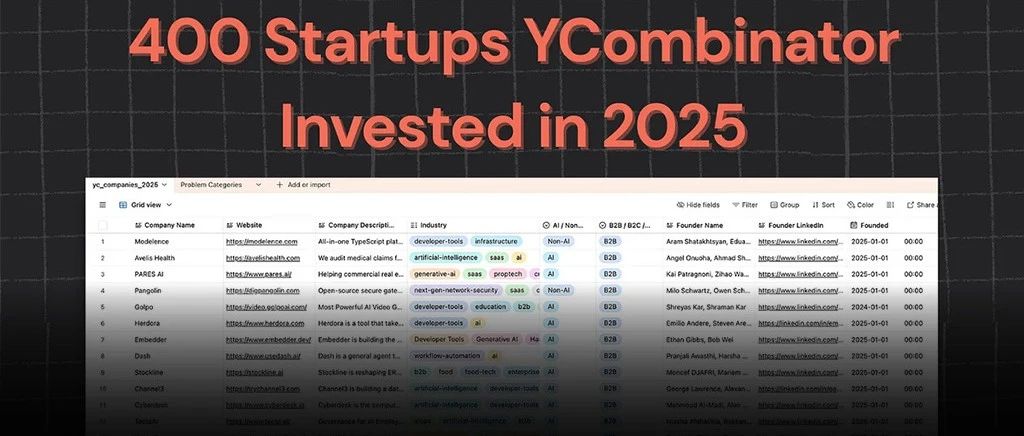
YC 2025 407 家创企复盘:B2B 模式占主导,AI 编程过度饱和,最大的机会还没人注意到
Founder Park· 2025-08-01 11:11
Core Insights - For AI entrepreneurs, identifying a precise entrepreneurial direction is more crucial than merely focusing on technology [2] - The analysis of over 400 startups in YC 2025 reveals that many AI entrepreneurs are competing in saturated markets, particularly in developer tools, with 94 companies in this space [2][18] - There are significant opportunities in underexplored sectors such as government technology, insurance, and construction, which have substantial market sizes but minimal AI startup presence [4][79] Market Saturation and Opportunities - The AI programming market is oversaturated, with a recommendation to focus on AI solutions that can fully automate high-salary jobs rather than just assist [22][18] - The B2B model dominates the YC ecosystem, accounting for nearly 90% of startups, reflecting a trend towards enterprise-level solutions [9][13] - Specific sectors like healthcare and finance show strong demand for AI solutions, particularly in automating administrative tasks and compliance [34][36] Emerging AI Agent Market - Approximately 34% of the companies in YC are developing AI Agent products or services, indicating a growing trend in this area [47] - Vertical specialization in AI Agents is proving to be more effective than general capabilities, with a focus on industry-specific knowledge [51][60] - The market is expanding into physical automation, with a notable increase in companies developing robotic and physical agents [59] Strategic Positioning - Companies are encouraged to adopt three main positioning strategies: vertical specialization, workflow specialization, and customer segment focus [60][62] - The value of market positioning is emphasized over technical capabilities, suggesting that deep industry understanding is more critical for success [67][68] - Successful AI companies should prioritize hiring industry experts rather than solely AI engineers to enhance their market relevance [68] Blue Ocean Opportunities - Six significant blue ocean opportunities have been identified, including government AI compliance, insurance AI underwriting, construction AI scheduling, agriculture AI inventory, restaurant AI quality control, and real estate AI documentation [79][80] - These sectors present minimal competition but substantial market potential, indicating a ripe environment for new AI solutions [79][80]