CPU市场竞争

Search documents
PC CPU市场格局,生变
半导体行业观察· 2026-01-24 02:39
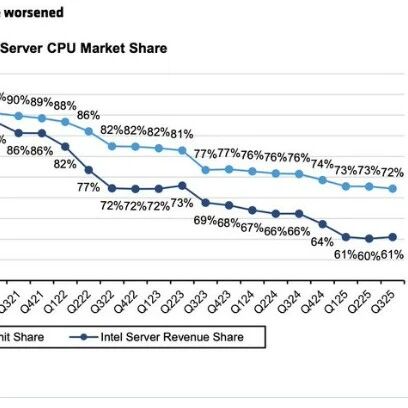
Core Viewpoint - Intel's market share has significantly declined from approximately 90% to 60% over the past eight years, primarily due to competition from AMD and Apple's transition to self-designed Arm architecture processors [1][3]. Market Share Analysis - AMD has steadily been gaining CPU market share, with recent analyses indicating that Apple's notebook CPU sales are now nearly on par with Intel's, each holding about 20% of the market [3]. - Since 2018, AMD and Apple have collectively reduced Intel's market share by over 20% in both the desktop and notebook CPU markets [3]. - Prior to 2018, Intel dominated the desktop CPU market with around 90% share and over 80% in the notebook CPU market; currently, it retains about 60% in both segments [3]. Competitive Landscape - AMD's fourth-generation Zen processors have accelerated its market share growth, while Intel's consumer-grade CPUs have stagnated due to stability issues and a lack of effective response to AMD's 3D V-Cache technology [11]. - AMD's CPUs now account for over 40% of Steam users, indicating strong adoption among gamers [11]. - Apple's M series processors have maintained a stable 10% share in the desktop market since their launch in 2022, reflecting a shift among users favoring Mac computers over Intel models [11]. Future Outlook - Intel's recent launch of the Core Ultra 3 series processors aims to counter the increasing competition from AMD's Ryzen AI 400 series and Apple's M5 processors [12]. - The impact of emerging players like Qualcomm and NVIDIA in the Arm CPU market is anticipated, with Qualcomm set to release a series of Arm-based Windows laptop processors in 2024 [12].


AMD Zen6登场,Intel强势反击,CPU大战一触即发
3 6 Ke· 2025-09-01 03:50
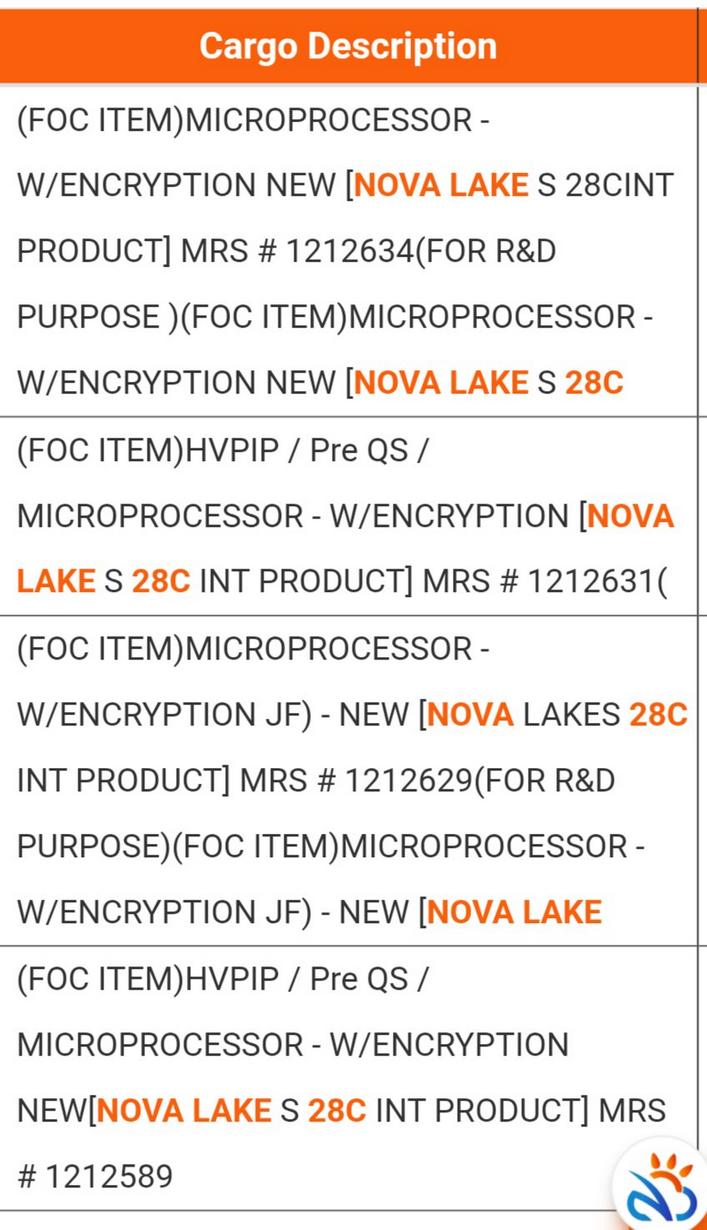
Core Insights - Intel is facing significant challenges as AMD's CPU retail sales have surpassed Intel's, particularly in the high-end gaming CPU market, which has become dominated by AMD's X3D series [1] - Intel's CFO David Zinsner acknowledged the company's poor performance in the high-performance desktop segment and emphasized the upcoming Nova Lake product line as a potential turnaround [1][2] - The competition between Intel's Nova Lake and AMD's Zen 6 is heating up, with both companies releasing information about their next-generation architectures around the same time [2] Intel's Nova Lake - Nova Lake is positioned as a critical product for Intel, with the desktop version potentially featuring up to 28 cores, including performance, efficiency, and low-power cores [2][4] - The new LGA1954 socket will be used for Nova Lake, which may deter some users who recently upgraded their motherboards [4] - Nova Lake's flagship version could feature a dual-die design with 52 cores, aimed at competing directly with AMD [4][5] - The release of Nova Lake is expected in 2026, with an interim product, Arrow Lake-S Refresh, likely launching in late 2023 or early 2024 [5][7] AMD's Zen 6 - AMD's Zen 6 architecture is anticipated to utilize TSMC's 3nm and 2nm processes, with a significant increase in core counts and L3 cache sizes compared to previous generations [8][9] - Zen 6 is expected to support up to 64 cores and 128 threads, with enhancements in multi-threading capabilities and L3 cache [9][11] - The desktop version of Zen 6 is projected to launch in the second half of 2026, while the mobile version may debut in the first half of 2026 [11] Competitive Landscape - The competition between AMD and Intel is intensifying, with both companies strategically timing their product announcements to counter each other [12] - AMD's advancements in core counts and cache sizes may give it an edge, but potential thermal issues with its 3D V-Cache technology could pose challenges [12][13] - Pricing strategies will be crucial, as AMD may face difficulties if Intel opts for a price war, especially given the high costs associated with TSMC's 2nm process [13]