Corporate Buybacks

Search documents
Why Corporate Buybacks Are Rising Even As Executives Warn Of A Slowing Economy
Benzinga· 2026-02-19 15:17
Core Insights - Corporate America is exhibiting contradictory signals, with executives discussing softer demand and economic risks while simultaneously authorizing significant share repurchases [1][2] Group 1: Buyback Trends - Share repurchases are increasing despite weakening economic confidence, raising questions about whether this indicates genuine belief in undervalued stocks or a strategy to support earnings per share [2] - Companies are sitting on substantial cash balances due to strong profits in previous years, leading to a preference for buybacks as capital spending becomes more selective [3] - The volatility in equity markets allows management to argue that their stock is undervalued, making buybacks a tool to convey confidence amid uncertain growth [4] Group 2: Earnings Per Share Impact - Buybacks can mechanically boost earnings per share (EPS) by reducing the share count, which is particularly appealing when total profits are flat or growing modestly [5] - Executives may use buybacks to meet analyst expectations during periods of slow revenue growth, which can blur the line between genuine business momentum and financial engineering [6] Group 3: Corporate Confidence Signals - Supporters of buybacks argue that they reflect management's confidence in long-term business value, as committing to repurchases suggests belief in future stock appreciation [7] - However, the current environment shows some executives warning about macro risks while buying back shares, indicating a more cautious approach rather than one driven by growth optimism [8] Group 4: Interest Rates and Capital Costs - Rising interest rates have altered corporate finance decisions, making it less attractive to fund buybacks with borrowed money, although many companies still have low-cost debt from earlier cycles [9] - The ability to repurchase shares varies significantly between companies, with cash-rich firms able to support buybacks while more leveraged firms must conserve capital [10] Group 5: Sector Variations - Technology companies with large cash reserves are among the most active in buybacks, while cyclical sectors are more cautious due to uncertainty about future cash flows [11][12] Group 6: Market Reactions - Historically, large buyback announcements have led to positive market reactions, as they are often seen as supportive of share prices and indicative of management confidence [13] - However, long-term performance is contingent on continued business growth, and buybacks may only temporarily mask underlying weaknesses [14] Group 7: Implications for Investors - The rise in buybacks amid cautious economic commentary indicates a market transition, where companies are focusing on shareholder returns while acknowledging uncertainty [18] - Investors should evaluate buybacks in context, considering the health of cash flows and revenue stability, as corporate behavior shifts towards a more defensive posture [19][20]


Softbank sells entire stake in Nvidia, the health of the AI trade, flight cancellations mount
Youtube· 2025-11-11 16:02
Government Shutdown - The Senate has passed a bill to end the government shutdown, which is expected to pass in the House and be signed into law by President Trump [1][7][10] - The House will begin a series of votes to pass the bill, with expectations of a close vote [8][9] - The reopening of the government is anticipated to reverse economic damage caused by the shutdown, including flight delays and lack of government data [10][11] SoftBank and Nvidia - SoftBank sold its entire stake in Nvidia, amounting to $5.8 billion, citing the sale as a necessary financing measure rather than a reflection on Nvidia's performance [3][4][14] - The sale allows SoftBank to provide investment opportunities for shareholders and maintain financial strength [4][14] - Nvidia's stock is experiencing downward momentum after Coreweave, a cloud computing provider, lowered its annual sales forecast due to a data center delay [2][16] Coreweave and Market Impact - Coreweave's annual sales forecast was cut from $5.15 billion to a range of $5.05 billion to $5.15 billion, disappointing investors [16] - Analysts note that supply constraints are short-term but highlight execution risks in the cloud computing sector [2][3] - The AI sector is experiencing volatility, with significant gains in the S&P 500 recently, but concerns remain about sustaining momentum [17][19] Corporate Buybacks - US corporate buybacks have reached approximately $1.2 trillion this year, 15% ahead of the same time last year, indicating confidence among companies [42][44] - The increase in buybacks suggests that companies may view their stocks as undervalued despite market highs [44][46] - The service sector's performance is crucial, as it constitutes a significant portion of GDP, and recent data shows a rebound in new orders [47][48] AI Sector Trends - The AI sector is seeing mixed performance, with companies like Coreweave facing challenges while others like Nebus report significant sales growth [39][41] - The adoption of AI is still in early stages, with many companies yet to scale their AI initiatives [28][30] - Investment opportunities may arise from companies addressing capacity constraints in the AI infrastructure space [21][22]


Momentum is powerful and there is a lot of it in this market, says Carson Group's Ryan Detrick
CNBC Television· 2025-09-23 19:17
Market Outlook - Carson Group expects a strong end-of-year rally, maintaining a bullish stance despite potential short-term volatility [1][2] - The fourth quarter is projected to be up almost 6% based on median returns, historically performing well after five consecutive months of gains [4] - The market may experience a 4% to 6% correction, which would be considered a healthy pullback [5] Economic Indicators - Strong earnings, profit margins, and consumer spending indicate no immediate recession [6] - Credit markets are functioning well, supporting ongoing deal-making activity, including AI deals [9] - Retail sales data from the previous week suggests a robust consumer base [6] Investor Behavior - Put-to-call ratios are at some of the lowest levels of the year, indicating increasing optimism [5] - US equity funds experienced inflows of $58 billion, the highest this year, reflecting growing investor confidence [5] - Corporate buybacks are at record highs, indicating corporations are deploying significant cash reserves [7] Potential Risks - Over-optimism and complacency in certain market segments could lead to a correction [10] - Technology sector concentration (34% of the market) poses a risk; diversification is recommended [14] - Lack of broad market participation, with only technology and communication services outperforming recently, suggests potential consolidation [11][12]

Momentum is powerful and there is a lot of it in this market, says Carson Group's Ryan Detrick
Youtube· 2025-09-23 19:17
Market Outlook - The market is expected to experience a strong end-of-year rally despite recent political uncertainties, such as Trump's cancellation of a meeting with congressional Democrats [1] - The market has shown five consecutive months of gains, which historically leads to a median return of almost 6% in the fourth quarter [4][3] - Momentum remains a significant factor in the current bull market, with expectations of continued upward movement [4] Investor Sentiment - There is a prevailing optimism among investors, with a notable increase in retail sales and strong profit margins, countering recession fears [6] - Corporate buybacks are at record highs, indicating that companies are actively investing their cash reserves back into the market [7][8] - Despite some concerns about market complacency and potential corrections, the overall sentiment remains bullish [10][11] Market Participation - Recent market performance has shown limited participation from mid-cap stocks, with only technology and communication services outperforming [11] - The technology sector constitutes approximately 34% of the market, raising concerns about over-reliance on this segment [14] Diversification Strategy - A diversified portfolio is recommended to mitigate risks associated with sector-specific downturns, particularly in technology [14][15] - Historical data suggests that a diversified approach can cushion the impact of market pullbacks, as seen in previous corrections [15]
Goodwin: 0.3% inflation now could mean 3.5% by year-end
CNBC Television· 2025-08-12 11:38
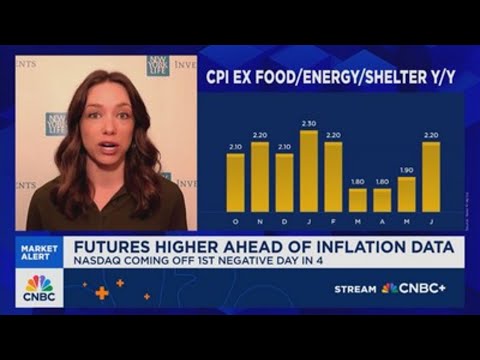
Life Investments. Lauren good morning. Good to see you.>> Good morning Frank. Great to be here. >> All right.We're going to talk a lot more about the integrity of this data for CPI or questions about it at least coming up later in the show. But first the number itself. What do you think this means for the market. >> There's a couple of things that this data means for the market.The first is to acknowledge that 0.3% month on month inflation doesn't sound like a big difference from 0.2% month on month, but if ...