DIY AI

Search documents
瑞银企业调查:六成企业选择“自制”AI而非购买现成,“AI智能体”仅有5%真正落地
Hua Er Jie Jian Wen· 2025-12-17 08:43
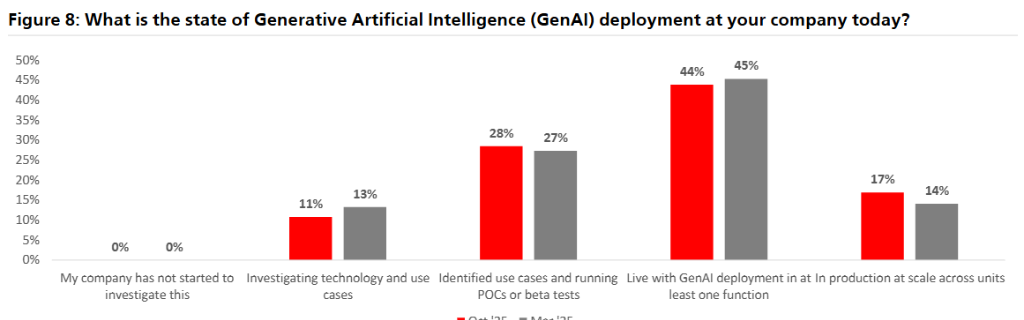
Core Insights - Despite the ongoing rise of artificial intelligence technology, the large-scale deployment of enterprise AI applications is progressing slowly, with only 17% of surveyed companies achieving large-scale production, a slight increase from 14% in March 2023 [1] Group 1: Market Leaders and Trends - Microsoft, OpenAI, and Nvidia continue to dominate the enterprise AI market, with Microsoft Azure leading in cloud infrastructure and OpenAI's GPT models occupying three of the top five spots in large language models [3] - Microsoft M365 Copilot remains the preferred enterprise AI tool, although OpenAI's ChatGPT commercial version is rapidly closing the gap [3][10] - The survey indicates a significant preference for self-built AI applications, with 60% of companies opting for a hybrid model of self-building or fully self-building, compared to only 34% relying entirely on third-party software vendors [4][5] Group 2: Deployment Challenges and Workforce Impact - The main challenges for AI deployment include unclear ROI, cited by 59% of respondents, up from 50% in March 2023, followed by compliance concerns (45%) and a lack of internal expertise (43%) [3] - AI applications are not leading to mass layoffs; 40% of companies expect AI to drive employee growth, while only 31% anticipate a reduction in workforce [3] Group 3: AI Agent Deployment and Market Outlook - The deployment of AI agents is still in its early stages, with only 5% of companies achieving large-scale production, while 71% are in pilot or small-scale production phases [9] - The slow progress in AI agent deployment supports the view that AI agents will not significantly replace human labor in the short term, and investors should maintain realistic revenue expectations for related technology suppliers [9] Group 4: Data Infrastructure and Spending Trends - There is a notable increase in demand for data infrastructure driven by AI projects, with an average of 52% of respondents expecting to increase spending across various data software categories [12] - The cloud data warehouse sector is expected to benefit significantly, with 69% of respondents anticipating increased spending, and 25% expecting substantial growth [12][14] - In contrast, the operational database sector shows a more moderate AI-driven spending increase, with only 10% of respondents expecting significant growth [14]