ETF基金管理

Search documents
5万亿元规模ETF的370名基金经理薪酬揭秘
Sou Hu Cai Jing· 2025-09-21 13:32
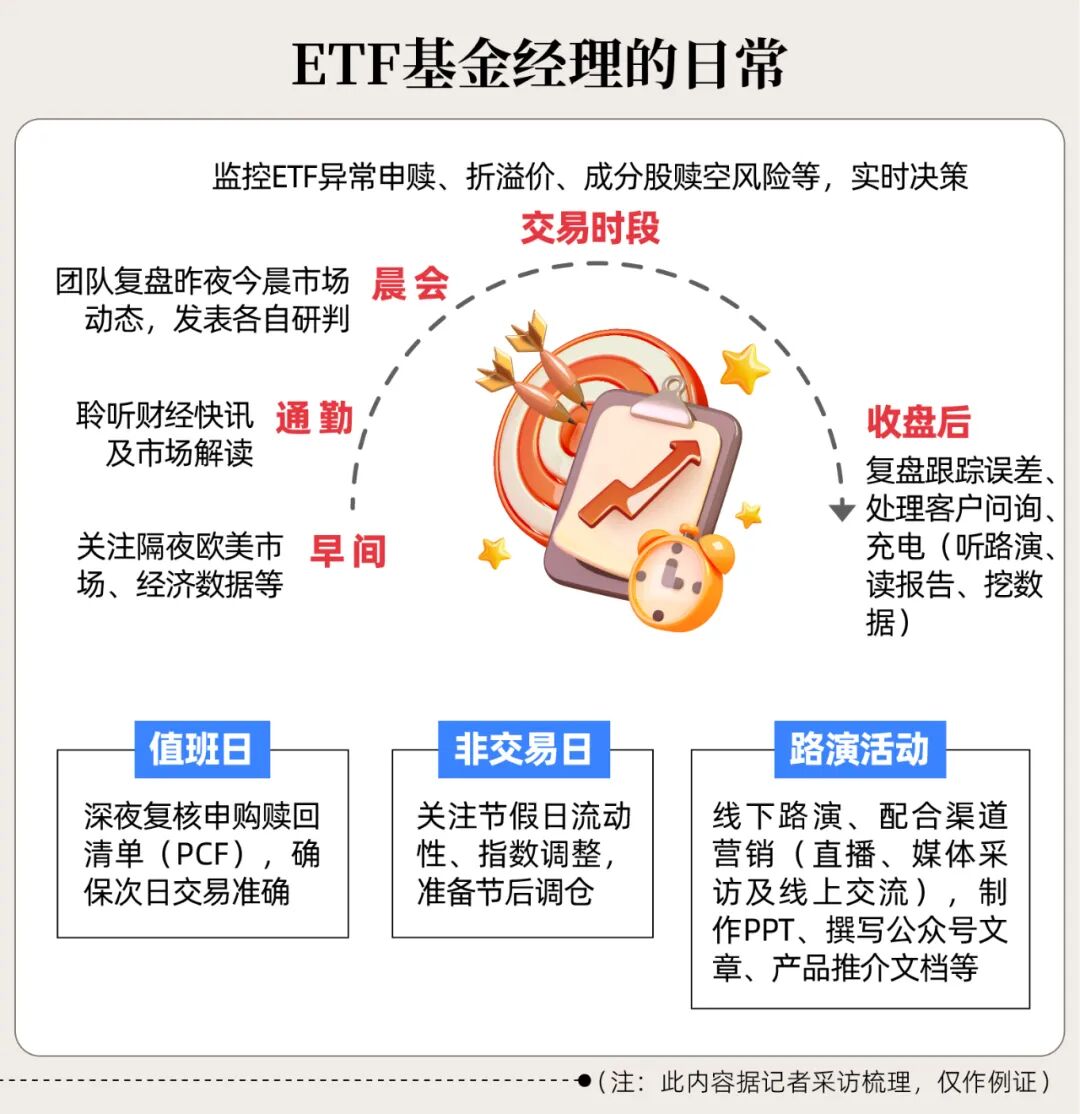
Core Insights - The article highlights the daily routines and responsibilities of ETF fund managers, emphasizing that their roles extend beyond simple index tracking to include active market monitoring and strategic decision-making [4][5][9]. Group 1: Daily Operations of ETF Fund Managers - ETF fund managers start their day by reviewing global market trends and economic data, followed by team discussions to analyze market dynamics [4][5]. - During trading hours, they closely monitor ETF transactions, manage risks, and make real-time decisions based on market conditions [4][5]. - Post-market hours involve further analysis, client communications, and preparation for the next trading day, often extending their work into late hours [5][6]. Group 2: Market Size and Structure - As of September 17, 2025, there are 1,311 ETF products in China, with a total market size of approximately 5.35 trillion yuan, managed by 370 ETF fund managers across 55 fund companies [6][7]. - Major players in the non-monetary ETF market include Huaxia Fund and E Fund, each managing over 800 billion yuan, while 14 public funds have non-monetary ETF sizes exceeding 1 trillion yuan, collectively managing about 4.55 trillion yuan [6][7]. Group 3: Managerial Challenges and Skills - ETF fund managers must balance risk and return stability, ensuring their portfolios align closely with target indices while managing liquidity and trading costs [9][10]. - Continuous research and understanding of market trends are crucial, as managers need to articulate the rationale behind their investment strategies to clients [9][10]. - The role requires participation in numerous roadshows and client interactions, with some managers attending around 100 events annually to promote their products [11][12]. Group 4: Compensation and Performance Metrics - ETF fund managers typically receive compensation based on a fixed salary and performance bonuses, with a focus on long-term performance metrics rather than short-term gains [13][14]. - The performance evaluation includes factors such as market position, client engagement, and the overall competitiveness of the fund management team [15][16]. - Despite the growth of the ETF market, compensation for ETF managers is generally lower than that of active equity fund managers, reflecting the industry's cost-cutting trends [16][17].


5万亿ETF的370名基金经理薪酬大揭秘,他们的日常工作,就是跟着指数买股票吗?
3 6 Ke· 2025-09-19 10:07
Core Insights - The article provides an in-depth look at the daily routines and responsibilities of ETF fund managers, highlighting the complexity and demands of their roles in managing over 5 trillion yuan in assets across more than 1,300 ETF products [2][8][24] Group 1: Daily Operations of ETF Fund Managers - ETF fund managers start their day by reviewing global market trends and economic data, ensuring they are informed about any developments that could impact their investments [3][4] - Their work involves constant monitoring of market conditions during trading hours, including tracking unusual subscription and redemption activities, and making timely decisions based on real-time data [4][7] - After market hours, fund managers continue their work by addressing client inquiries, reviewing product performance, and preparing for the next trading day, often working late into the night [7][8] Group 2: Market Overview and Scale - As of September 17, 2025, the total number of ETFs is 1,311, with a total market size of approximately 5.35 trillion yuan, indicating significant growth in the ETF sector [8][9] - The leading fund companies in terms of non-monetary ETF assets include Huaxia Fund and E Fund, each managing over 800 billion yuan, while 14 public funds have non-monetary ETF assets exceeding 100 billion yuan [8][9] Group 3: Fund Manager Responsibilities and Skills - ETF fund managers are required to maintain a stable risk-return profile, closely adhering to index compositions and weights, while also managing liquidity to minimize trading costs for investors [14][15] - Continuous research and understanding of market trends are crucial, as fund managers must articulate their investment strategies and rationales to clients effectively [14][15] - Sales support is a significant part of their role, necessitating frequent participation in roadshows and client interactions to promote ETF products and educate investors on index-based investment strategies [16][22] Group 4: Compensation and Performance Metrics - ETF fund managers typically receive compensation based on a fixed salary plus performance bonuses, with a focus on long-term performance metrics rather than short-term gains [18][21] - The performance evaluation criteria include not only the scale of assets managed but also the overall competitiveness of the fund company and the market position of the products [21][22] - Despite the growth of the ETF market, compensation for ETF fund managers is generally lower than that of active equity fund managers, reflecting the competitive nature of the industry [22][24]
5万亿ETF的370名基金经理薪酬大揭秘!他们的日常工作,就是跟着指数买股票吗?
Mei Ri Jing Ji Xin Wen· 2025-09-19 09:13
Core Insights - The daily routine of an ETF fund manager involves constant monitoring of global markets, economic data, and active engagement in trading and client communication, highlighting the complexity of their role beyond simple index tracking [2][3][5] - The ETF market in China has grown to approximately 5.35 trillion yuan, managed by 370 fund managers across 55 companies, indicating a significant scale and competitive landscape [6][9] - Major players in the non-monetary ETF space include Huaxia Fund and E Fund, each managing over 800 billion yuan, while 14 public funds have non-monetary ETF scales exceeding 100 billion yuan, collectively accounting for 85% of the market [6][9] Market Overview - As of September 17, 2025, there are 1,311 ETF products with a total scale of about 5.35 trillion yuan, of which 1,284 are non-monetary ETFs [6][9] - The top three fund companies by non-monetary ETF scale are Huaxia Fund (over 800 billion yuan), E Fund (over 800 billion yuan), and Huatai-PB Fund (over 570 billion yuan) [6][9] - A significant portion of the ETF market is concentrated, with 14 public funds managing approximately 4.55 trillion yuan in non-monetary ETFs [6][9] Fund Manager Responsibilities - ETF fund managers are responsible for daily management of ETF portfolios, ongoing research, and sales support, emphasizing the need for risk management and liquidity control [14][15] - The role requires a deep understanding of market dynamics and the ability to communicate effectively with clients, especially during product launches and roadshows [17][19] - Fund managers often participate in numerous roadshows, with some reporting up to 200 events annually, reflecting the importance of client engagement in the ETF space [19][22] Compensation Structure - ETF fund managers typically receive a compensation package that includes a fixed salary and performance bonuses, with a focus on long-term performance metrics [22][25] - The performance evaluation criteria for ETF managers include not only the scale of assets managed but also the overall competitiveness of the index team and market position [25][27] - Despite the growth of the ETF market, compensation for ETF managers is generally lower than that of active equity fund managers, reflecting the industry's competitive nature and cost pressures [27]