
Future Industry

Search documents
重磅发布!5000+终端和买家第①批名单!拥抱未来产业新材料万亿市场,就在FINE2026
合成生物学与绿色生物制造· 2026-03-22 10:08
备受瞩目行业盛会—— 2026未来产业新材料博览会(FINE 2026) 将于 6月10-12日 在 上海新国际博览中心 隆重举行! 从机器人到eVTOL,从半导体到数据中心液冷,从电池到能源,从热管理到轻量化,从可持续到功能材料。 百年变局,时代机遇,中国未来产业崛起引领 全球新材料创新发展! 第一批参观预登记终端和买家单位 (截至2026年3月13日,排名不分先后) | 向下滑动查看所有内容 | | --- | 截至目前, FINE2026已有 500+ 企业 携全新技术与创新产品报名参展, 展位预订率 达 7 0% , 30+ 前沿主题 论坛正紧锣密鼓筹备, 1000+ 终端和应用企 业已报名参会参观和采购合作交流。 诚邀全球未来产业的精英翘楚齐聚上海,共赴这场行业年度盛会! "码"上预登记▲ 免费观展,解锁多重好礼! 5,惊喜福利 早鸟礼 :前500名预登记观众可领取一张 100元 京东卡 (需凭短信通知,展会现场兑换) 组团礼 :成功组织5人以上观展的团长可领取一张 100元 京东卡 (信息需经主办方审核) 2026未来产业新材料博览会 中国未来产业崛起引领全球新材料创新发展 6月10-12日 上海 ...


重磅发布!5000+终端和买家第①批名单!拥抱未来产业新材料大市场,就在FINE2026
DT新材料· 2026-03-17 16:04
备受瞩目行业盛会—— 2026未来产业新材料博览会(FINE 2026) 将于 6月10-12日 在 上海新国际博览中心 隆重举行! 从机器人到eVTOL,从半导体到数据中心液冷,从电池到能源,从热管理到轻量化,从可持续到功能材料。 百年变局,时代机遇,中国未来产业崛起引领 全球新材料创新发展! 截至目前, FINE2026已有 500+ 企业 携全新技术与创新产品报名参展, 展位预订率 达 7 0% , 30+ 前沿主题 论坛正紧锣密鼓筹备, 1000+ 终端和应用企 业已报名参会参观和采购合作交流。 诚邀全球未来产业的精英翘楚齐聚上海,共赴这场行业年度盛会! 第一批参观预登记终端和买家单位 (截至2026年3月13日,排名不分先后) | 向下滑动查看所有内容 | | --- | "码"上预登记▲ 免费观展,解锁多重好礼! 早鸟礼 :前500名预登记观众可领取一张 100元 京东卡 (需凭短信通知,展会现场兑换) 组团礼 :成功组织5人以上观展的团长可领取一张 100元 京东卡 (信息需经主办方审核) 2026未来产业新材料博览会 中国未来产业崛起引领全球新材料创新发展 6月10-12日 上海新国际博览中心 ...

温州新晋“万亿之城” 长三角“深水博弈”开场
2 1 Shi Ji Jing Ji Bao Dao· 2026-01-27 16:19
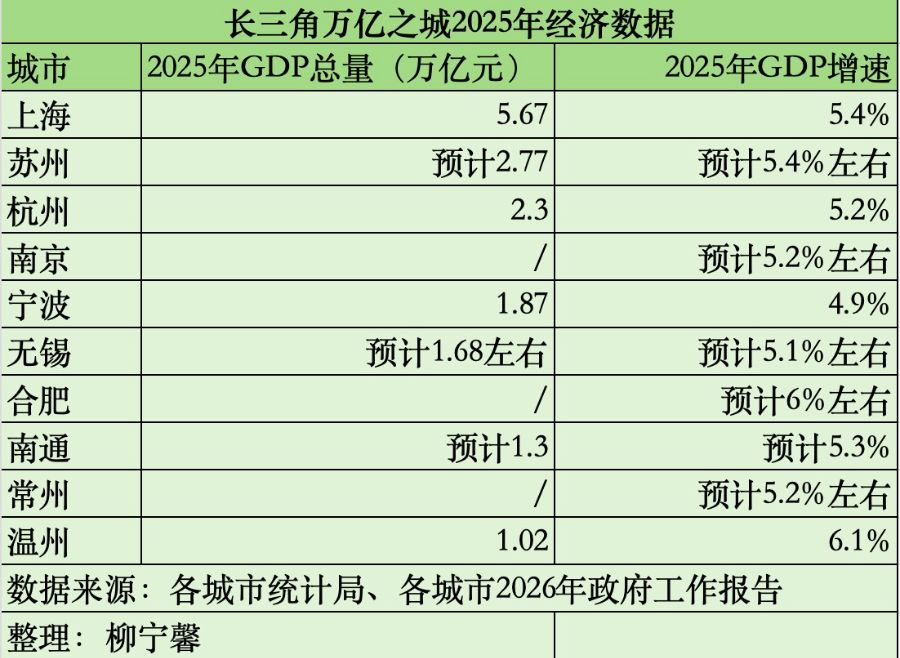
Core Insights - The Yangtze River Delta region is witnessing a significant increase in the number of cities with a GDP exceeding 1 trillion yuan, reaching a total of 10 by 2025, with Shanghai leading at 5.67 trillion yuan [1][2] - The focus of urban competition is shifting from merely achieving a trillion GDP to enhancing the quality and sustainability of economic growth, emphasizing innovation, industrial structure, and living standards [2][6] Economic Data Summary - Shanghai's GDP is projected to be 5.67 trillion yuan with a growth rate of 5.4% in 2025 [1][3] - Suzhou's GDP is expected to reach 2.77 trillion yuan, while Nanjing is approaching the 2 trillion yuan mark [2][4] - Hangzhou's GDP is estimated at 2.3 trillion yuan, with a growth rate of 5.2% [1][3] - Ningbo's GDP is projected at 1.87 trillion yuan, growing at 4.9% [1][4] - Wenzhou has recently crossed the 1 trillion yuan threshold, achieving a GDP of 1.02 trillion yuan with a growth rate of 6.1% [1][5] Industrial Development Trends - Shanghai is focusing on high-end industrial clusters, with significant growth in advanced manufacturing sectors such as integrated circuits (15.1% growth) and artificial intelligence (13.6% growth) [3][8] - Hangzhou is emphasizing the integration of digital economy with advanced manufacturing, with notable growth in new energy vehicles and industrial robots [4][9] - Suzhou is transitioning from traditional manufacturing to a modern industrial system, targeting sectors like biomedicine and high-end medical devices [8][10] - Wenzhou's economic growth is driven by its manufacturing sector, with strategic emerging industries and high-tech sectors showing substantial growth [5][11] Future Industry Layout - Cities in the Yangtze River Delta are actively planning for future industries, focusing on sectors like quantum technology, synthetic biology, and advanced semiconductor materials [10][11] - The competition among cities is increasingly defined by their ability to innovate and create sustainable industrial ecosystems rather than just GDP figures [6][7] Long-term Competitiveness Factors - Key variables for long-term competitiveness include the originality and resilience of industrial ecosystems, efficiency in innovation and technology transfer, and the ability to attract and retain talent [11][12] - Cities are encouraged to create favorable living conditions and cultural experiences to enhance their attractiveness to talent [11]
温州新晋“万亿之城”,长三角“深水博弈”开场
2 1 Shi Ji Jing Ji Bao Dao· 2026-01-27 12:33
Core Viewpoint - The quality of industries is becoming a longer-term competitive variable for the trillion GDP cities in the Yangtze River Delta region, shifting the focus from mere GDP scale to the quality and sustainability of development [1][4]. Economic Data Summary - In 2025, the total number of trillion GDP cities in the Yangtze River Delta will increase to 10, with Shanghai leading at 5.67 trillion yuan and new entrant Wenzhou reaching 1.02 trillion yuan [2][3]. - Expected GDP growth rates for 2025 include: Suzhou at approximately 5.4%, Hangzhou at 5.2%, Nanjing at around 5.2%, and Ningbo at 4.9% [2][3]. Industry Development Trends - The new industrial layout in the Yangtze River Delta is focusing on high-end industrial clusters and the extension of new tracks based on existing manufacturing strengths [3][10]. - Shanghai's GDP growth is supported by new momentum in industries such as integrated circuits and artificial intelligence, with respective growth rates of 15.1% and 13.6% [5]. - Hangzhou's economy is characterized by a strong service sector, contributing 73.8% to its GDP, with significant growth in the digital economy [6][12]. - Wenzhou's manufacturing sector is evolving towards technology-intensive and intelligent production, with strategic emerging industries growing by 14.4% [8][12]. Long-term Competitiveness Factors - Key variables for long-term competitiveness include the originality and resilience of the industrial ecosystem, innovation efficiency, and the ability to attract and retain talent [13]. - The focus is shifting from GDP scale to the health of industries, innovation density, and sustainable growth metrics as new evaluation criteria for urban competitiveness [10][13].
我国创新质量持续提升,知识产权效益加速显现
Xin Lang Cai Jing· 2026-01-23 02:26
一是创新质量持续提升。我国国内(不含港澳台)有效发明专利中,高价值发明专利同比增速比总体水 平高2.2个百分点,数量达到229.2万件。信息技术管理方法、计算机技术、医学技术等领域的有效发明 专利增速最快,人工智能专利有效量居全球前列,在量子科技、生物制造、脑机接口、第六代通讯等未 来产业布局了一批关键核心技术专利,有力促进了高水平科技自立自强。 来源:央视新闻客户端 国务院新闻办公室今天上午举行新闻发布会,国家知识产权局披露的知识产权数据,反映出以下主要特 点: 三是知识产权效益加速显现。最新数据显示,我国专利密集型产业的增加值突破18万亿元,占GDP的比 重从2020年的11.97%提升到2024年的13.38%,对经济增长的贡献度稳步提高。全球前5000个品牌中, 我国品牌价值达1.81万亿美元,位居全球第二。地理标志产品直接年产值接近1万亿元,实现五连增, 成为特色产业增收致富的"金名片",有效助力了区域经济发展。 二是重点区域创新活跃。截至2025年底,长三角地区、京津冀地区和广东省的发明专利有效量分别为 173.4万件、91.6万件和89.9万件,合计约占国内总量的2/3;有效注册商标量合计280 ...
高校院所成果转化不足5%,问题出在哪里?
Di Yi Cai Jing· 2025-12-11 09:01
Core Insights - The article highlights the significant gap between the vast annual research funding of nearly 1 trillion yuan in Chinese universities and research institutions and the low technology transfer rate of less than 5%, attributing the issue to a lack of effective "algorithms" rather than a deficiency in technology [1][2] - Photonic technology is identified as a core support for future information technology, with a projected global market growth from $920 billion in 2023 to over $1.2 trillion by 2027, driven by the increasing demand for AI computing power [1][2] Research Funding and Technology Transfer - Chinese universities and research institutions receive nearly 1 trillion yuan annually for research, yet the technology transfer rate remains below 5% [2] - The disconnect between innovation and industry is a longstanding issue, with market success not guaranteed by technological breakthroughs alone [2] Photonic Technology and Market Growth - The global photonics market is experiencing explosive growth, with the Chinese Academy of Information and Communications Technology reporting a market size of $920 billion in 2023, expected to exceed $1.2 trillion by 2027 [1] - The demand for AI computing power is a key driver of this growth, indicating a shift towards photonic chips for signal processing in computing and AI [2] Industrialization Strategies - A new industrialization "algorithm" has been implemented by Zhang Long's team at the Hangzhou Institute of Optics, focusing on a "selection-cultivation-marriage" logic to enhance technology transfer [3] - The establishment of the Xihe Optoelectronic Industry Incubator in Shanghai represents a collaborative model involving government, research, and capital to foster innovation and entrepreneurship [3] Supportive Ecosystem and Initiatives - The Pudong New Area has developed the largest and most comprehensive photonic scientific facility cluster globally, providing robust research support [4] - The 895 Incubator in Zhangjiang focuses on high-tech startups, having invested in 20 projects with a total investment of approximately 700 million yuan, with five companies already listed [4] - Shanghai's "Technology Innovation Action Plan" aims to cultivate technology-driven small giant enterprises, enhancing the efficiency of technology transfer and industry development [4]