
Income inequality

Search documents
I Asked ChatGPT What Would Happen If Lower-Income Americans Didn’t Pay Taxes — and If the Rich Paid More
Yahoo Finance· 2026-03-09 14:46
Core Idea - The discussion revolves around the idea of eliminating taxes for lower-income Americans while increasing taxes on the wealthy, exploring the implications and potential outcomes of such a tax structure. Group 1: Current Tax Structure - The U.S. tax system is progressive, with tax rates increasing as income rises, resulting in many lower-income households owing little or no federal income tax due to credits like the Earned Income Tax Credit and the Child Tax Credit [2] - Lower-income Americans still pay various taxes, including payroll taxes, state income taxes, sales taxes, and property taxes, despite having low federal income tax obligations [3][5] Group 2: Implications of Eliminating Taxes for Lower-Income Americans - If lower-income households stopped paying both income and payroll taxes, it could lead to more disposable income, helping families cover essentials and potentially boosting local economies [4][5] - However, eliminating these taxes raises significant funding issues, as payroll taxes are crucial for Social Security and Medicare, necessitating policymakers to find alternative funding sources [5][6] Group 3: Increasing Taxes on Higher-Income Americans - Higher-income Americans already contribute a significant share of federal income taxes, and increasing their tax rates could generate additional revenue and reduce after-tax income inequality [8] - Potential benefits of higher taxes on the wealthy include additional funding for government programs, lower federal deficits, and an expanded social safety net, although there may be trade-offs affecting financial behavior [8]
NY Fed Chief Sees Growing Divide Between Low-Income and High-Income Households
PYMNTS.com· 2026-03-03 18:29
A top Federal Reserve official said he sees an increasing divide between low-income and high-income households.By completing this form, you agree to receive marketing communications from PYMNTS and to the sharing of your information with our sponsor, if applicable, in accordance with our Privacy Policy and Terms and Conditions .Complete the form to unlock this article and enjoy unlimited free access to all PYMNTS content — no additional logins required.John C. Williams, president and CEO of the Federal Rese ...


了解和释放马来西亚州级增长潜力(英)2026
Shi Jie Yin Hang· 2026-02-24 03:05
Investment Rating - The report does not explicitly provide an investment rating for the industry Core Insights - Malaysia is on the verge of becoming a high-income economy, but significant regional inequalities persist, with many citizens remaining below the high-income threshold [16][36] - The report highlights that richer states have experienced faster growth than poorer states, leading to increased regional income inequality [19][87] - It identifies that the actual growth of lagging states falls short of their potential growth, indicating that these states could have caught up if they had matched their potential [22][87] Summary by Sections Summary - Malaysia is approaching high-income status, yet a significant portion of the population will remain below this threshold, with regional disparities evident [16][36] - The average income in the poorest state, Kelantan, is only about 12.8% of that in Kuala Lumpur, indicating pronounced regional income disparity [18][19] Context - The report outlines that Malaysia is likely to transition to a high-income economy, but many states will not achieve this due to significant income disparities and slower growth in poorer states [36][40] - In 2023, five states surpassed the World Bank's high-income threshold, while others, like Kelantan, are projected to take decades to reach it [40][41] Methodological Narrative - The report employs various quantitative techniques to analyze growth dynamics across Malaysian states, focusing on convergence/divergence, potential output estimation, and the Economic Potential Index [75][84] - It integrates satellite night-light data with traditional economic indicators to provide a comprehensive view of regional disparities [83][84] Results - Key findings indicate that richer states have outpaced poorer states in growth, resulting in divergence and increased regional income inequality [19][87] - The report emphasizes that the actual growth of lagging states is significantly below their potential, suggesting that targeted interventions could help these regions catch up [22][87] - Structural factors contributing to divergence include frictions in labor and capital mobility, regulatory inefficiencies, and lower educational attainment in poorer states [26][31]
Resist ‘catastrophe’! Paul Krugman & Ari on MAGA billionaires buying media, tech & Democracy
MSNBC· 2026-02-20 01:33
There aren't a lot of functioning democracie around the world that work this way, where you can basically have millionaires and billionaires bankrolling, whoever they want, however they want. In some cases undisclosed. And what it means is ordinary Americans are shut out of the process. That's what it means.The warnings about billionaires hijacking American elections. Your voting power date back to President Obama there discussing the Supreme Court gutting what were legal limits on just how much billionaire ...

How the middle class was hollowed out from 1979 to 2022, according to new federal data
Yahoo Finance· 2026-01-22 21:58
Core Insights - The Congressional Budget Office (CBO) report highlights a significant transformation in the American economy over the past four decades, indicating a widening wealth gap where the richest households have greatly increased their economic influence while the middle class has diminished [1] Income Distribution - From 1979 to 2022, the top 1% of households increased their share of income before transfers and taxes from 9% to 18%, effectively doubling their portion of national income [2] - The share of income going to the lowest quintile decreased from 5% to 4%, indicating that the middle class has faced significant challenges as the top 1% captured a larger share of market income [3] Middle Class Decline - The relative status of the middle class has declined, with the share of income after transfers and taxes held by the middle three income quintiles decreasing by 6 percentage points over 43 years, while the top 1% saw their share of after-tax income double from 7% to 14% [4] Growth Rates Disparity - Income growth rates have been markedly different across income groups, with the highest quintile's income more than doubling since 1979, and the top 0.01% experiencing a more than sevenfold increase in average income after taxes and transfers [5] Overall Wealth Creation - Despite the increasing wealth concentration among the rich, the overall wealth in the U.S. has grown, leading to a record number of millionaires, a phenomenon described by UBS as the "everyday millionaire" [6] Behavioral Economics Perspective - A behavioral economics concept known as "money illusion" may explain why individuals do not perceive their increased wealth, despite improvements in living standards over the past few decades [7]
X @The Economist
The Economist· 2025-12-19 17:10
The author’s grasp of the fine gradations of income was the product of experience, not just imagination https://t.co/ahze4Mc0bB ...
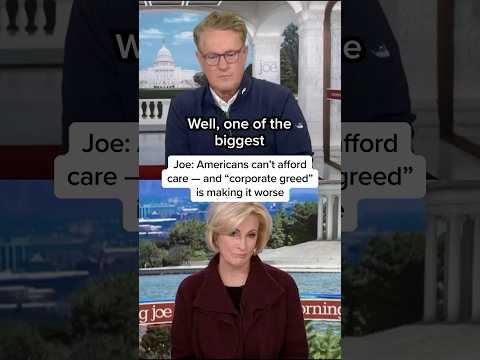
Joe: Americans can't afford care -- and 'corporate greed' is making it worse
MSNBC· 2025-12-11 17:27
Well, one of the biggest problems here, ma, is you actually have in this health care issue, you have three things coming together. You have affordability, obviously, because Americans can't afford their healthcare. That's number one.Number two, you have the issue of the rich getting richer. You look at what executives make uh and why they make it and how much they make it. Private health insurance companies making more money every year.And third, and this is a real problem, uh you you you look at uh what wh ...
X @Nick Szabo
Nick Szabo· 2025-11-08 15:25
Productivity & Wealth Distribution - Productivity gains in more normal times tended to accrue proportionally to both workers and owners [1] - In recent decades, productivity gains have disproportionately gone to the owners [1]
Mamdani advisor shares key to candidates' success: 'Let them cook'
MSNBC· 2025-11-07 06:52
Political Strategy & Analysis - The Democratic coalition has expanded to include both moderates and socialists [1] - Winning candidates share the characteristic of understanding and addressing the specific issues relevant to their communities [2] - Candidates are aiming to replicate successful strategies for the 2026 midterms [3] - A key strategy involves candidates authentically representing themselves, allowing voters to see themselves reflected in politics [12] - Showing up in unexpected places and engaging with diverse communities is crucial for building broad support [13][15] Campaign Tactics - Focus on affordability as a key issue that resonates with voters, even when public safety is perceived as the top concern [7][8] - Avoid applying the same playbook to every candidate; allow candidates to "cook" and be themselves [10][12] - Showing up in places people didn't expect is important [13] - A "both end strategy" involves campaigning on policies while also pushing back on Trump's broken promises [17][18] - Address the root causes of political issues, such as income inequality, rather than solely focusing on individual figures like Donald Trump [18]

Musk the trillionaire? Debate over his Tesla pay package rages
Yahoo Finance· 2025-11-05 16:12
Core Viewpoint - Elon Musk's political involvement has negatively impacted Tesla's car sales, yet the company's stock has increased significantly, leading Musk to seek a substantial pay package that could make him the first trillionaire in history [1]. Group 1: Shareholder Meeting and Voting - Shareholders will vote on Musk's pay package at Tesla's annual meeting in Austin, Texas, with the outcome potentially granting him a significant amount of stock [1]. - The vote has generated intense debate, with some pension funds opposing the package due to concerns over the board's loyalty to Musk and the perceived recklessness of his behavior [2]. - Musk has the ability to vote his own shares, which constitute 15% of the company, thereby improving his chances of securing the pay package [4]. Group 2: Support and Criticism - Supporters argue that Musk is essential for Tesla's future, envisioning a world dominated by self-driving Tesla cars and humanoid robots, and claim that the pay package is necessary to keep him focused [3]. - Critics, including some pension funds, have labeled Musk's behavior as reckless and argue that the proposed compensation is excessive [2]. Group 3: Pay Package Details - The pay package was first introduced to shareholders in September, detailed in a 200-page filing, which also includes other proposals such as investments in Musk's other company, xAI [5]. - To receive the full compensation, Musk must meet several ambitious operational and financial targets, including delivering 20 million Teslas over the next 10 years and producing one million robots [6].
