
Job Growth

Search documents
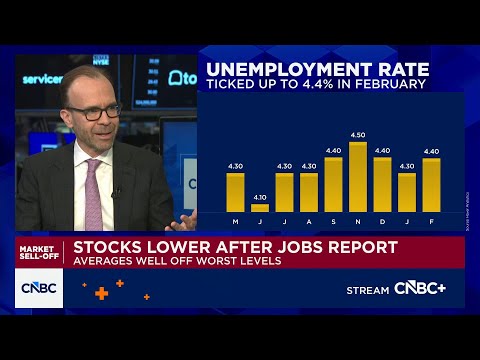
It's still a pretty weak labor market with very little job growth, says Goldman Sachs' Jan Hatzius
CNBC Television· 2026-03-06 16:47
group. Sticking with the jobs report, here's what NEC director Kevin Hasset from the White House said last hour about it here on CNBC. >> There have been so many strong indicators this month that it's something of a surprise, but there are some weather.There are strikes on the West Coast and I think that we also have this birth death model, the change in the procedure at the BLS. And so I think what we need to start doing with these jobs numbers, at least on the payroll side, is take the average over a few ...

BREAKING: Markets roiled by surprise February jobs loss and spike in oil prices
MSNBC· 2026-03-06 16:00
We're back with breaking news on the state of the U .S. economy. Stocks cratering this morning, as President Trump says there will be no deal to to end this war with Iran without unconditional surrender.That's sending oil prices soaring. Wall Street also rocked by the February's jobs report, Just In, which shows the U .S. lost $92 WELL, WE HAVE TO TAKE UP TO 4 .4%.LET'S GO RIGHT TO CNBC SENIOR ECONOMICS REPORTER STEVE LEASMANN. STEVE, IT WAS ALREADY A ROUGH WEEK ON WALL STREET. WHAT EXACTLY ARE WE SEEING FR ...

Time To Go To Med School? Most New Jobs Likely To Be In Health Care
Investopedia· 2026-03-06 01:00
-- Time To Go To Med School? Most New Jobs Likely To Be In Health Care Stocks Sink as Oil Prices SoarWhy Rising Oil Prices Are Making Investors AnxiousWhat To Expect From Friday's Jobs ReportUS-Iran Conflict Clouds Fed's Path on Interest Rates- Top StoriesA large part of job growth has been concentrated in health care.Paul Bersebach / MediaNews Group / Orange County Register via Getty ImagesClose### Key Takeaways- Laid-off workers in other sectors may have a hard time transitioning to the growing field, as ...

The Economy Is Growing: So Where Are The New Jobs?
Yahoo Finance· 2026-02-19 21:07
Economic Growth and Job Creation - The U.S. economy is experiencing steady growth, with a projected 2.5% inflation-adjusted annual growth rate in the fourth quarter, despite challenges such as a government shutdown [3] - Job creation in 2025 was notably poor, marking the worst year for job growth outside a recession in over two decades, indicating a disconnect between economic expansion and employment [3][6] Impact of AI and Automation - Companies are investing heavily in data centers and AI technology, leading to increased productivity but not necessarily job creation, raising concerns about future consumer spending and overall economic health [4][6] - The current job market is heavily reliant on the health care sector, which has shown slow productivity growth and is not considered a dynamic industry, suggesting potential sustainability issues [7][9] Job Market Dynamics - Job growth outside the health care sector has been essentially flat in recent years, indicating a troubling trend in employment opportunities [8] - The automation of tasks through AI may be contributing to a decline in entry-level job opportunities, with economists warning that a wave of AI-related job losses could trigger a recession [9]
X @Anthony Pompliano 🌪
Anthony Pompliano 🌪· 2026-02-12 17:02
The jobs data proved one thing… we are done hiring useless bureaucrats into the government who contribute nothing.Job growth is now coming from the private sector, which is exactly what should be happening. https://t.co/B4DbD3zW1l ...
The jobs picture still looks muddy, even with surprisingly strong January growth
CNBC· 2026-02-11 20:22
Labor Market Overview - January job gains totaled 130,000 nonfarm payrolls, with the unemployment rate decreasing to 4.3%, the lowest since August [2] - Despite these gains, the labor market remains stagnant, with significant revisions indicating virtually no job growth in the second half of 2025 [2][3] - The concentration of job growth in a few sectors raises concerns about the overall health of the labor market [3] Economic Projections - The chief economist at EY-Parthenon anticipates subdued job growth for the remainder of 2026, potentially not exceeding 50,000 jobs per month [3] - Revisions from the Bureau of Labor Statistics revealed an average job gain of only 15,000 per month last year, with a net loss of 1,000 jobs in the last six months [3] Consumer Income and Spending - Average hourly earnings increased by 0.4% in January, but the annual gain of 3.71% is the lowest since July 2024, indicating pressure on consumer income [5] - Retail sales were unexpectedly flat in December, which could pose risks given that consumer spending accounts for over two-thirds of U.S. economic activity [5] - The combination of stagnant job growth and income pressures suggests a shift towards an "income-less expansion," affecting many families' financial stability [6]

X @Watcher.Guru
Watcher.Guru· 2026-02-11 17:30
JUST IN: 🇺🇸 US records lowest job growth in 2025 for a non-recession year since 2003. https://t.co/ZeCAcILjs5 ...
Healthcare Still Leads as Job Engine
Barrons· 2026-02-11 14:11
Healthcare Still Leads as Job EngineCONCLUDED[The U.S. Added 130,000 Jobs in January. Unemployment Rate Ticks Down to 4.3%.]Last Updated:---5 hours ago# Healthcare Still Leads as Job EngineBy[Megan Leonhardt]Job growth varied dramatically by sector last month, though healthcare and social assistance remained stalwart employment engines.The healthcare sector started off the year strong with the addition of 82,000 jobs in January, after a softer month in December. That's much higher than the average monthly g ...
X @The Wall Street Journal
The Wall Street Journal· 2026-02-11 13:37
Breaking: Job growth was unexpectedly strong in January, with 130,000 jobs added. The unemployment rate declined to 4.3%. https://t.co/rOgdoWivtA ...
X @Bloomberg
Bloomberg· 2026-02-06 21:36
Job growth in Texas was almost flat last year as migration to the state plunged and oil prices lagged https://t.co/6h9XnCXT6N ...