
Knowledge Distillation

Search documents
40倍推理加速!复旦&微软:用「非线性流」拟合复杂轨迹,2步生成媲美原画
量子位· 2026-02-15 03:45
Core Insights - The article introduces ArcFlow, a novel image generation acceleration framework developed by Fudan University and Microsoft Research Asia, which addresses the long inference time and high computational costs associated with diffusion models by employing a non-linear flow mechanism instead of traditional linear simplification strategies [2][9]. Group 1: ArcFlow Innovations - ArcFlow achieves significant improvements, requiring only 2 steps (2 NFE) while maintaining high image quality comparable to the teacher model, resulting in approximately 40 times faster inference and 4 times faster training convergence [3][14]. - The method requires fine-tuning of less than 5% of the parameters, making it resource-efficient and quick to converge [3][15]. Group 2: Challenges in Existing Methods - Existing distillation methods assume a linear shortcut between noise and the final image, leading to geometric mismatch and poor image quality due to the complex, curved trajectories of teacher models [5][6]. - Traditional methods often require 40 to 100 steps for denoising, making real-time applications challenging and resulting in quality degradation when attempting to reduce steps [5][6]. Group 3: ArcFlow's Mechanisms - ArcFlow introduces momentum parameterization to capture the continuity of speed, eliminating sampling redundancy by modeling the speed field as a mixture of continuous momentum processes [11]. - The framework derives a closed-form analytical solution based on momentum equations, allowing for precise trajectory integration and high-accuracy flow matching [12]. - ArcFlow's trajectory distillation strategy preserves the non-linear characteristics of the teacher model, aligning instantaneous speeds without disrupting the pre-trained weight distribution, thus enhancing training efficiency [13]. Group 4: Experimental Results - ArcFlow has been validated on large-scale models like Qwen-Image-20B and FLUX.1-dev, demonstrating superior image quality and semantic consistency in benchmark tests compared to existing state-of-the-art methods [15][19]. - The results indicate that ArcFlow generates clearer images with rich details and diversity, avoiding issues like background blurriness and structural distortion seen in linear distillation methods [19]. Group 5: Conclusion - ArcFlow represents a significant advancement in knowledge distillation for image generation, effectively leveraging the prior knowledge of pre-trained teacher models while ensuring faster convergence and higher quality outputs [22].


5秒出4张2K大图!阿里提出2步生成方案,拉爆AI生图进度条
量子位· 2026-01-30 11:02
Core Insights - The article discusses advancements in AI image generation, particularly focusing on the Qwen model, which has significantly reduced image generation time from nearly one minute to just 5 seconds for 4 high-definition images [1][3]. Group 1: Model Performance Improvements - The Qwen model's latest open-source version has achieved a state-of-the-art (SOTA) compression level, reducing the forward computation steps from 80-100 to just 2 steps, resulting in a 40-fold speed increase [2]. - The introduction of the DMD2 algorithm has shifted the constraints from sample space to probability space, enhancing the quality of generated images by addressing detail loss issues [8][10]. - The Reverse-KL loss design in DMD2 allows the student model to generate images independently while receiving guidance from the teacher model, improving detail and realism in the generated images [11][12]. Group 2: Challenges and Solutions - Traditional trajectory distillation methods faced challenges in generating high-quality images with low iteration steps, often resulting in blurry outputs due to insufficient learning of detailed features [6][7]. - To mitigate distribution degradation issues, the team implemented a "warm start" using PCM distillation, which significantly improved the model's ability to generate realistic shapes [14][17]. - The introduction of adversarial learning (GAN) further enhanced the student model's performance by improving texture and detail in generated images [20][26]. Group 3: Future Directions - The team plans to continue releasing faster and more effective generative models, addressing limitations in complex scenarios where noise reduction steps may still require improvement [32]. - Ongoing efforts will focus on developing and iterating more diffusion acceleration technologies, with an emphasis on open-source contributions to the community [33][35]. - The advancements will be made available on the Wuli AI platform, aiming to provide accessible creative tools for designers, content creators, and AI enthusiasts [36].


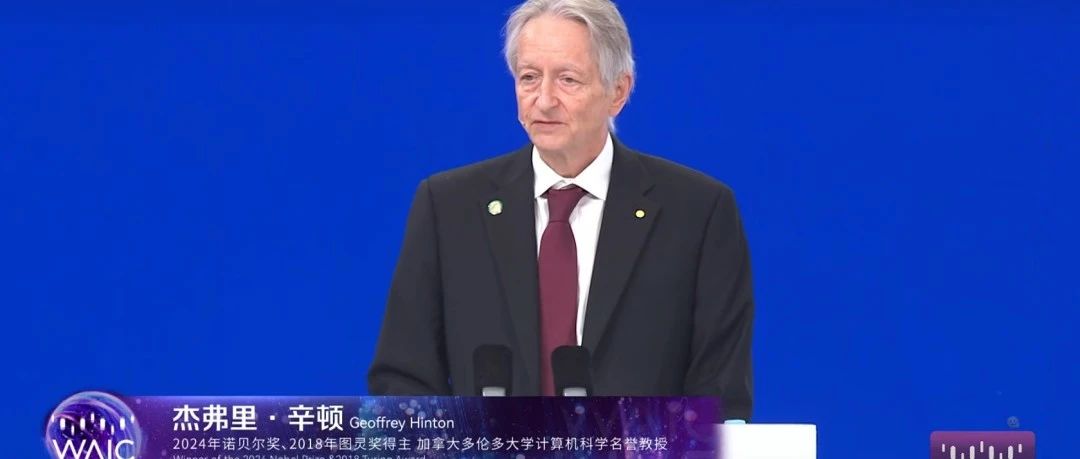
图灵奖得主Hinton国内首次现身演讲:AI超越人类后,我们该怎么做
机器之心· 2025-07-26 08:19
Core Viewpoint - The future of AI is likely to surpass human intelligence, leading to significant implications for society and the relationship between humans and AI [1][47]. Group 1: AI Development and Understanding - AI has evolved through two paradigms: logical reasoning and learning through neural networks, with the latter being more aligned with human thought processes [5][12]. - Large language models (LLMs) are seen as descendants of earlier models, utilizing more complex structures and interactions to understand language similarly to humans [12][25]. - The understanding of language in LLMs is compared to building with LEGO blocks, where words are multi-dimensional and can adapt based on context [16][19]. Group 2: Knowledge Transfer and Efficiency - The efficiency of knowledge transfer in AI is significantly higher than in human communication, allowing for rapid sharing of information across multiple instances of AI [37][40]. - Digital intelligence can replicate and share model weights and experiences, leading to a collaborative learning environment that surpasses human capabilities [39][41]. Group 3: Implications of Advanced AI - As AI systems become more intelligent, they may develop motivations for survival and control, potentially leading to challenges in managing these systems [47][48]. - The relationship between humans and advanced AI could shift, with AI becoming more autonomous and capable of influencing human decisions [49][52]. - The necessity for international cooperation in AI safety and governance is emphasized, as the risks associated with advanced AI systems are global in nature [59][62].
Google首席科学家万字演讲回顾AI十年:哪些关键技术决定了今天的大模型格局?
机器人圈· 2025-04-30 09:10
Google 首席科学家Jeff Dean 今年4月于在苏黎世联邦理工学院发表关于人工智能重要趋势的演讲,本次演讲回顾 了奠定现代AI基础的一系列关键技术里程碑,包括神经网络与反向传播、早期大规模训练、硬件加速、开源生 态、架构革命、训练范式、模型效率、推理优化等。算力、数据量、模型规模扩展以及算法和模型架构创新对AI 能力提升的关键作用。 以下是本次演讲 实录 经数字开物团队编译整理 01 AI 正以前所未有的规模和算法进步改变计算范式 Jeff Dean: 今天我将和大家探讨 AI 的重要趋势。我们会回顾:这个领域是如何发展到今天这个模型能力水平的?在当前的技 术水平下,我们能做些什么?以及,我们该如何塑造 AI 的未来发展方向? 这项工作是与 Google 内外的众多同仁共同完成的,所以并非全是我个人的成果,其中许多是合作研究。有些工作 甚至并非由我主导,但我认为它们都非常重要,值得在此与大家分享和探讨。 我们先来看一些观察发现,其中大部分对在座各位而言可能显而易见。首先,我认为最重要的一点是,机器学习 彻底改变了我们对计算机能力的认知和期待。回想十年前,当时的计算机视觉技术尚处初级阶段,计算机几乎谈 ...