Moore's law

Search documents
Comparing Intel With Industry Competitors In Semiconductors & Semiconductor Equipment Industry - Intel (NASDAQ:INTC)
Benzinga· 2026-01-12 05:19
Core Insights - The article provides a comprehensive comparison of Intel against its competitors in the Semiconductors & Semiconductor Equipment industry, focusing on financial metrics, market position, and growth prospects for investors [1] Company Overview - Intel is a leading digital chipmaker specializing in microprocessors for personal computers and data centers, holding a significant market share in both sectors [2] - The company aims to revitalize its chip manufacturing business and develop advanced products within its Intel Products segment [2] Financial Metrics - Intel's Price to Earnings (P/E) ratio is 685.17, which is 9.61 times above the industry average, indicating a premium valuation [5] - The Price to Book (P/B) ratio stands at 1.84, slightly below the industry average, suggesting potential undervaluation based on book value [5] - The Price to Sales (P/S) ratio is 3.39, which is 0.27 times the industry average, indicating possible undervaluation based on sales performance [5] - Return on Equity (ROE) is 3.98%, which is 1.69% below the industry average, indicating inefficiency in profit generation [5] - EBITDA is reported at $7.85 billion, which is 0.2 times below the industry average, suggesting lower profitability [5] - Gross profit is $5.22 billion, indicating 0.15 times below the industry average, reflecting lower revenue after production costs [5] - Revenue growth for Intel is at 2.78%, significantly lower than the industry average of 34.59%, indicating a challenging sales environment [5] Debt to Equity Ratio - Intel has a debt-to-equity (D/E) ratio of 0.44, which is lower than its top four peers, indicating a stronger financial position and less reliance on debt financing [9][8] - This favorable balance between debt and equity is viewed positively by investors [9] Comparative Analysis - Intel's high P/E ratio compared to peers suggests potential overvaluation, while low P/B and P/S ratios indicate undervaluation relative to competitors [10] - In terms of ROE, EBITDA, gross profit, and revenue growth, Intel lags behind its peers, signaling weaker financial performance and growth prospects within the sector [10]



Evaluating Intel Against Peers In Semiconductors & Semiconductor Equipment Industry - Intel (NASDAQ:INTC)
Benzinga· 2026-01-02 15:01
Core Insights - The article provides a comprehensive comparison of Intel against its competitors in the Semiconductors & Semiconductor Equipment industry, focusing on financial metrics, market position, and growth prospects to offer insights for investors [1] Company Overview - Intel is a leading digital chipmaker specializing in microprocessors for personal computers and data centers, holding a significant market share in both PC and server markets [2] - The company aims to revitalize its chip manufacturing business and develop advanced products within its Intel Products segment [2] Financial Metrics Comparison - Intel's Price to Earnings (P/E) ratio is 615, significantly higher than the industry average, indicating potential overvaluation [3] - The Price to Book (P/B) ratio is 1.65, slightly below the industry average, suggesting possible undervaluation [3] - Intel's Price to Sales (P/S) ratio is 3.04, which is lower than the industry average, indicating potential undervaluation based on sales performance [3] - The Return on Equity (ROE) for Intel is 3.98%, which is below the industry average, indicating inefficiency in generating profits from equity [3] - Intel's EBITDA stands at $7.85 billion, which is below the industry average, suggesting lower profitability [3] Profitability and Growth - Intel's gross profit is $5.22 billion, indicating lower revenue after production costs compared to the industry average [7] - The revenue growth for Intel is 2.78%, significantly lower than the industry average of 34.59%, indicating a slowdown in sales expansion [7] Debt to Equity Ratio - Intel has a debt-to-equity ratio of 0.44, which is lower than its top four peers, suggesting a more favorable balance between debt and equity [9]

Former Intel CEO explains why the Trump administration is taking a stake in his chip startup
Youtube· 2025-12-03 21:16
Core Viewpoint - The Trump administration is investing up to $150 million in semiconductor startup XLite to develop advanced manufacturing techniques, potentially making the government XLite's largest shareholder [1] Company Overview - XLite is focused on creating a new light source for semiconductor manufacturing, which is essential for lithography machines used in the production process [2][3] - The new light source aims to enhance productivity in current manufacturing and support future advancements in semiconductor technology, particularly in relation to Moore's Law [6][7] Technological Breakthrough - The breakthrough involves a new light source that can operate at 13.5 nanometers and is designed to integrate with ASML scanners, which are the industry standard for advanced lithography [4][6] - This technology is expected to lower manufacturing costs in the U.S. and improve competitiveness against global sources [8] Government Involvement - The investment from the U.S. government reflects a sense of urgency to advance semiconductor manufacturing capabilities domestically [10][11] - The discussions leading to this investment have been ongoing for several years, indicating a strategic focus on rejuvenating the U.S. semiconductor industry [11][12] Industry Context - The current administration is seen as more proactive compared to the previous one, utilizing a full range of government tools, including trade policy and incentives, to support the semiconductor sector [13][14] - There is a growing emphasis on reshoring and rebuilding the U.S. semiconductor manufacturing industry, with new companies emerging and research flourishing [9][14]

Trump admin. invests in chip manufacturer xLight, why small-cap stocks are entering a 'sweet spot'
Youtube· 2025-12-03 18:57
Market Overview - The US stock market is showing mixed results, with the Dow slightly up, while the S&P and Nasdaq are down [2][5] - The ADP report indicates a weakening labor market, with private payrolls unexpectedly falling by 32,000 in November, although October's numbers were revised upwards [6][8] Federal Reserve Insights - The ADP report is not expected to significantly alter the Federal Reserve's plans, with a rate cut anticipated at the December 10 meeting [9][59] - Concerns about the labor market's fragility may lead to calls for a rate cut, but some believe the labor market is stable [9][66] AI and Technology Sector - The AI race is intensifying, with Wall Street closely monitoring competition in the sector [2][24] - Autodesk's CEO highlighted the importance of infrastructure buildout in the AI ecosystem, noting a significant backlog in data center projects due to labor shortages [26][28] Company-Specific Developments - Micron's stock is down over 3%, while Netflix has seen a nearly 6% decline without clear headlines [4][5] - ASML is being favored by Bank of America as a top semiconductor pick, with a price target increase to $1,331 per share [49][50] - Oracle is seen as an emerging AI infrastructure leader, with a new price target of $280 from Wells Fargo [51] Investment Opportunities - UBS initiated coverage on Roblox with a neutral rating and a $13 price target, citing its unique position in gaming trends [52] - CrowdStrike reported strong earnings and raised its fiscal 2026 guidance, indicating resilient demand for its cybersecurity products [55][56] - Anthropic, an AI startup, is planning a significant IPO, potentially valuing the company above $300 billion [57][58] Government and Industry Collaboration - The Trump administration is investing $150 million in chip startup Xite, which aims to develop advanced semiconductor manufacturing techniques [78][89] - Xite's breakthrough technology involves creating a new light source for semiconductor manufacturing, which could enhance productivity and support future advancements [79][81]

Is This Beaten-Down Cathie Wood Artificial Intelligence (AI) Stock a Buy?
The Motley Fool· 2025-06-16 09:30
Core Viewpoint - Recursion Pharmaceuticals is a biotech company leveraging AI to transform drug development, but it faces challenges in demonstrating its approach's effectiveness and has seen its stock decline by 19% this year [2][7]. Company Overview - Recursion Pharmaceuticals has partnered with Nvidia to build a powerful supercomputer, highlighting its commitment to AI technology in drug development [1]. - The company has attracted interest from notable investors, including Cathie Wood of Ark Invest, which holds approximately $164 million in Recursion stock [2]. Business Model and Innovation - Recursion has developed an AI-powered operating system that tests clinical compounds against a library of human genes, aiming to streamline drug discovery and development [5]. - The potential benefits of this approach include faster discovery, reduced costs, and higher profit margins, which could significantly impact the pharmaceutical industry [6]. Market Position and Challenges - Despite its innovative approach, Recursion has not yet brought any products to market and has abandoned the development of several compounds, raising concerns about its viability [7]. - The company faces competition from more established firms like Novo Nordisk, which are also investing in AI for drug development [8]. Investment Considerations - Recursion Pharmaceuticals presents a high-risk, high-reward investment opportunity, appealing to risk-tolerant investors, while those averse to risk may seek alternatives [9].


Exclusive look at the making of High NA, ASML's new $400 million chipmaking colossus
CNBC· 2025-05-22 12:11
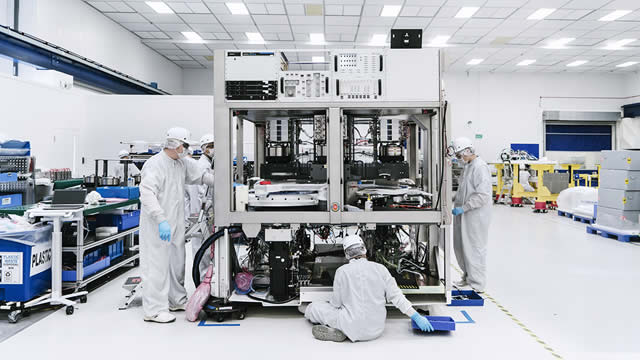
Core Insights - ASML has developed the High NA machine, the world's most advanced and expensive chipmaking machine, with a cost exceeding $400 million, which is set to transform microchip production [1][4][12] - The first commercial installation of High NA occurred at Intel's Oregon chip fabrication plant in 2024, with only five machines shipped to date [3][4] - High NA is expected to be utilized by all ASML's EUV customers, including major chipmakers like TSMC, Samsung, and Micron, enhancing chip production efficiency and yield [4][21] Technology and Development - High NA machines are larger than a double-decker bus and consist of four modules manufactured in different locations, requiring significant logistics for delivery [2] - The technology behind High NA allows for higher resolution projections of chip designs, reducing the need for multiple patterning and improving yield [7][13] - ASML's High NA machines have shown significant improvements over previous EUV machines, with Intel reporting a 100% increase in reliability and Samsung noting a 60% reduction in cycle time [6][7] Market Position and Strategy - ASML holds a dominant position in the EUV lithography market, being the exclusive manufacturer of these machines, which are essential for producing advanced microchips [4][5] - The company sold 44 EUV machines in 2024, with a starting price of $220 million, while its older DUV machines accounted for 60% of its business [16][17] - ASML's sales to China peaked at 49% of its business in Q2 2024, but are expected to normalize to 20%-25% in 2025 due to U.S. export controls on EUV technology [17][18] Future Outlook - ASML plans to ship at least five more High NA systems in the current year and aims to ramp up production capacity to 20 machines in the coming years [24] - The company is also developing the next generation of machines, Hyper NA, expected to be needed between 2032 and 2035, with draft optical designs already in progress [23][24] - ASML is establishing a training center in Arizona to train 1,200 individuals annually on EUV and DUV technologies, addressing the growing demand for skilled labor in the semiconductor industry [23]