OEM代工

Search documents
冲击港股上市!爷爷的农场IPO前大手笔分红,拳头产品均价走低
Bei Jing Shang Bao· 2026-01-07 13:12
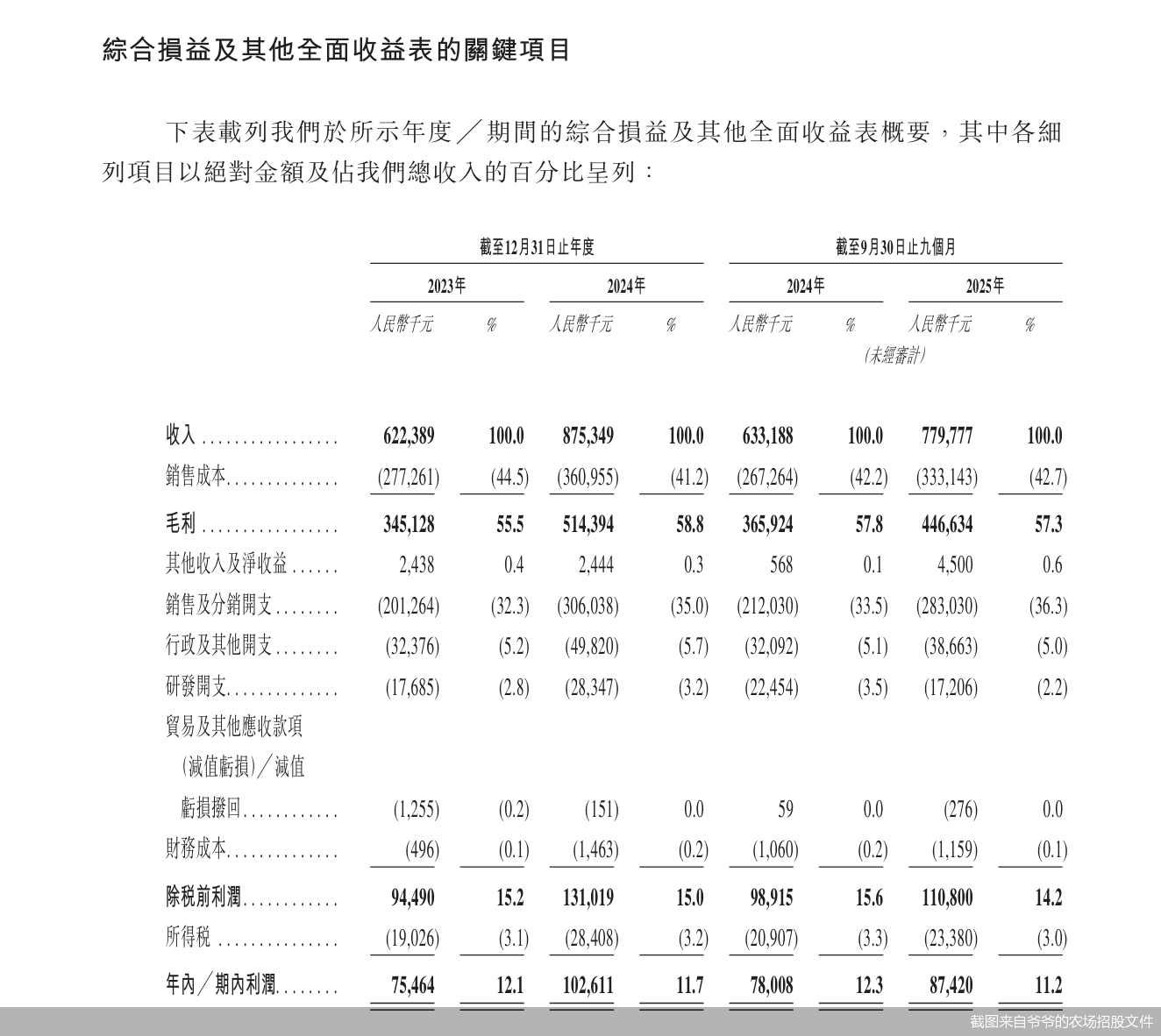
Core Viewpoint - The company "爷爷的农场" has submitted its listing application to the Hong Kong Stock Exchange, showcasing strong revenue and profit growth, but also significant marketing expenditures and a high dividend payout prior to the IPO [1][3][9]. Financial Performance - In 2023, the company reported revenue of approximately 622.4 million RMB, with a net profit of about 75.5 million RMB. For 2024, revenue is projected to reach 875.3 million RMB, with a net profit of around 103 million RMB. In the first three quarters of 2025, revenue was approximately 780 million RMB, up from 633.2 million RMB in the same period of 2024, with a corresponding profit of about 87.4 million RMB [2][3]. Product Segmentation - The company's product categories include infant complementary food and family food. The revenue share from infant complementary food has decreased from 93.1% in 2023 to 80.4% in the first three quarters of 2025, while family food's share has increased from 6.9% to 19.6% during the same period [4]. Marketing and Sales Expenditure - The company has significantly increased its sales and distribution expenses, totaling approximately 790 million RMB over the reporting periods, which represents 32.3% to 36.3% of total revenue. As of the end of the third quarter of 2025, 72.97% of the company's 640 full-time employees were in sales and marketing roles [6][7]. Research and Development Spending - The company's R&D expenditures have been relatively low, amounting to 0.18 billion RMB, 0.28 billion RMB, and 0.17 billion RMB over the reporting periods, which are significantly lower than sales expenses, indicating a focus on marketing over product development [7]. Dividend Distribution - Prior to the IPO, the company distributed dividends totaling 63 million RMB in the first three quarters of 2025, which accounted for approximately 72.07% of the net profit for that period [9]. Production and Quality Control - The company outsources nearly all of its product manufacturing to third-party OEM manufacturers, raising concerns about production quality and potential reputational risks if issues arise with the outsourced products [10].

大行折叠车IPO:物理学家从商,66%由OEM生产
3 6 Ke· 2025-07-24 07:36
Core Insights - The article highlights the success of Dahan Technology (Shenzhen) Co., Ltd., which has become the largest folding bike brand in China, driven by a growing cycling trend and significant revenue growth [1][4]. Company Overview - Dahan Technology has 326 employees and sold 229,500 bicycles in 2024, generating revenue of 450 million yuan [1]. - The company has experienced a compound annual growth rate (CAGR) of 24% in revenue over the past three years [1][8]. - The average net profit per bicycle sold is 228 yuan, with a total net profit of 52.3 million yuan in 2024 [1]. Product Pricing and Market Position - 70% of Dahan's folding bikes are priced between 2,500 and 5,000 yuan, while 10% are priced above 5,000 yuan [1]. - Dahan holds a 36.5% market share in the folding bike industry in mainland China as of 2024 [8]. Production and Supply Chain - The proportion of bicycles produced by OEM suppliers increased from 29.5% in 2022 to 65.5% in the first four months of 2025 [9]. - The internal production gross margin is 34.9%, compared to 27.3% for OEM-produced bikes, leading to an average gross margin of 32.1% [10]. Sales and Distribution - Dahan collaborates with 38 distributors covering 680 retail points, with 70% of sales coming from these distributors [13]. - The company has also started selling customized folding bikes through Sam's Club [13]. Future Growth and Revenue Streams - Dahan plans to establish new production facilities in Huizhou and invest in existing facilities in Tianjin and Jiangsu to increase capacity [11]. - The company has begun exploring additional revenue streams through brand and patent technology licensing, which currently accounts for about 1.2% of total revenue [14].

悍高集团IPO:OEM代工研发存疑,降薪酬费率升毛利,业绩稳定性被问询
3 6 Ke· 2025-07-20 23:40
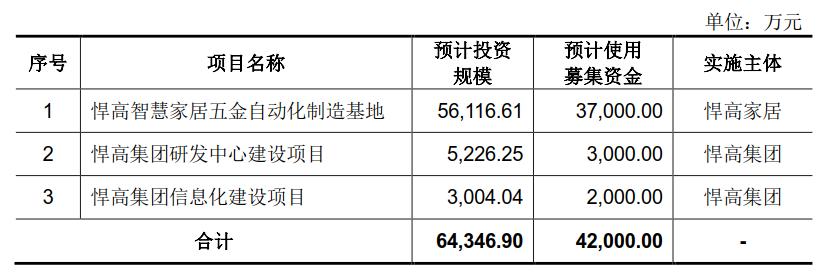
Core Viewpoint - The company is undergoing scrutiny regarding its research and development capabilities, operational model, and revenue margins, with a focus on its future performance stability and information disclosure improvements [1][2]. Investment Projects - The company has planned three major investment projects with a total expected investment of 643.47 million yuan and anticipated fundraising of 420 million yuan [1]. R&D and Patent Utilization - The company claims that 95% of its main business revenue is derived from products utilizing its patents, with a focus on core products such as pull baskets, hinges, and beds [2][3]. - The revenue from patent-utilized products has shown significant growth, increasing from 138.41 million yuan in 2021 to 211.32 million yuan in 2023 [3]. - The company has 1,116 patents, with a majority being utility models and design patents, raising concerns about the longevity and strength of its technological barriers [5]. Financial Performance - For the first half of 2024, the company reported revenue of 1.185 billion yuan and a net profit of 189 million yuan, with year-on-year growth rates of 28.57% and 58.11%, respectively [6]. - The company anticipates a strong second half of 2024 due to seasonal demand in home renovations, projecting that nearly 60% of its annual revenue will occur in this period [7]. - The gross profit margin for 2024 is expected to increase to 35.62%, driven by a rise in self-produced basic hardware and a decrease in raw material costs [8][9]. Cost Management - The company has successfully reduced its expense ratio by 2.48 percentage points in 2024, primarily due to lower employee compensation and advertising costs [9][10]. - The proportion of self-produced basic hardware has increased by 10.12 percentage points, contributing positively to the gross margin [8]. Order Backlog and Market Outlook - The company's order backlog has increased by 7.54% from the end of 2023, indicating a positive outlook based on customer expectations [11]. - The company is closely monitoring raw material prices to mitigate risks associated with price fluctuations, ensuring a stable cost structure [11][12].