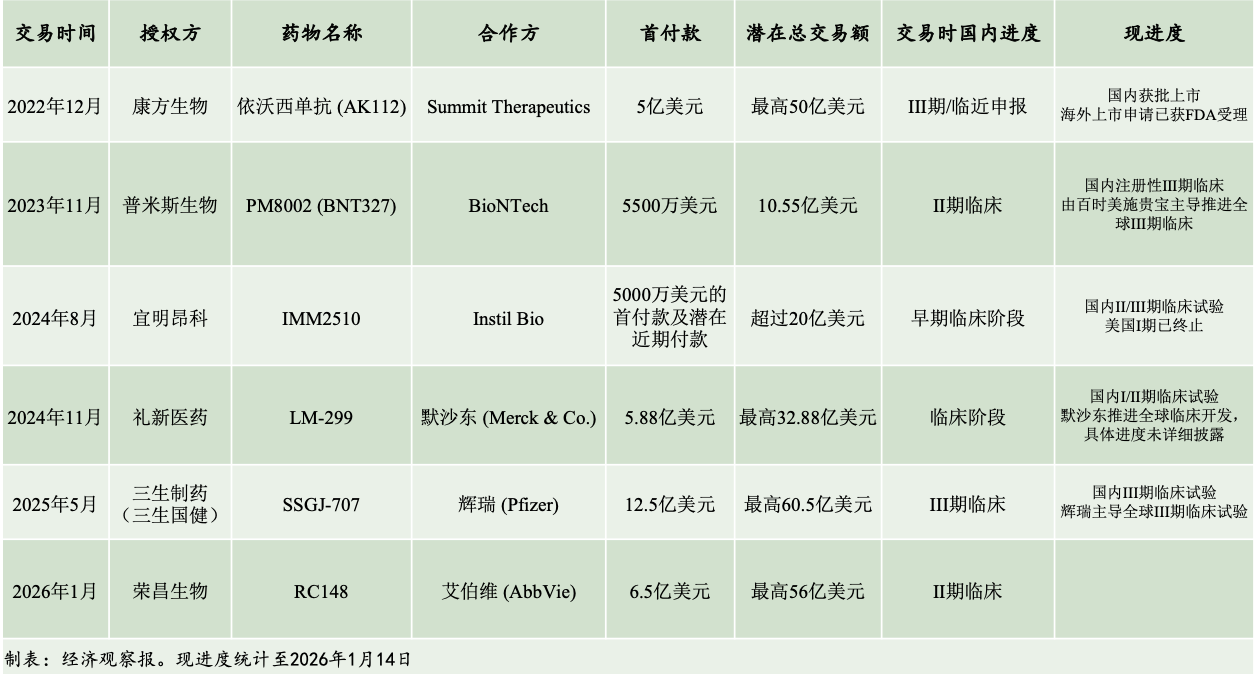
PD-(L)1/VEGF靶点药物

Search documents
跨国药企“必备”肿瘤药中国药企还有机会卖
Jing Ji Guan Cha Wang· 2026-01-16 16:20
Core Viewpoint - The recent exclusive licensing agreement between Rongchang Biologics and AbbVie for the dual-specific antibody drug RC148, targeting PD-1/VEGF, highlights the competitive landscape in the oncology drug market, with significant financial implications for both companies [1][5]. Group 1: Licensing Agreement Details - Rongchang Biologics has entered into an exclusive licensing agreement with AbbVie for RC148, which is currently in Phase II clinical trials [1]. - The deal includes an upfront payment of $650 million and potential milestone payments up to $4.95 billion, along with tiered royalties on net sales, bringing the total potential value of the agreement to $5.5 billion [1]. - Following the announcement, Rongchang Biologics' stock surged, with a 20% increase in A-shares and a 7.87% increase in Hong Kong shares [1]. Group 2: Market Context and Comparisons - The PD-1/VEGF target has seen multiple drugs developed, with over five similar drugs already in the market, leading to skepticism about the market share for later entrants [1][4]. - Other Chinese biotech firms have also engaged in significant licensing deals for PD-1/VEGF drugs, with notable transactions including a $500 million upfront payment from Summit to Kanyos Biologics and a $1.25 billion upfront payment from a partnership involving 3SBio and Pfizer [4]. - Despite being ranked lower in the market, Rongchang Biologics' deal value is comparable to that of Kanyos Biologics, raising questions about the valuation of later-stage products [5]. Group 3: Future Prospects and Trends - There is an expectation for continued licensing transactions in the PD-1/VEGF space, driven by efficacy, different indications, and combination therapies [8]. - Companies with PD-1/VEGF candidates that have not yet been licensed are actively seeking opportunities, with the potential for significant deals depending on product data and market conditions [8]. - Major multinational pharmaceutical companies, including Eli Lilly, Novartis, and AstraZeneca, have not yet announced new PD-1/VEGF acquisitions, indicating potential future market activity [9].

跨国药企“必备”肿瘤药,中国药企还有机会卖
Jing Ji Guan Cha Wang· 2026-01-15 03:32
Core Viewpoint - The recent licensing agreement between Rongchang Biologics and AbbVie for the dual-specific antibody drug RC148 highlights the competitive landscape of PD-1/VEGF targeted therapies, with significant financial implications for both companies involved [1][6]. Group 1: Licensing Agreement Details - Rongchang Biologics has entered into an exclusive licensing agreement with AbbVie for RC148, a dual-specific antibody currently in Phase II clinical trials, granting AbbVie rights outside Greater China [1][6]. - The deal includes an upfront payment of $650 million and potential milestone payments up to $4.95 billion, along with tiered royalties on net sales, bringing the total potential value of the agreement to $5.5 billion [1][6]. - This transaction's total amount is considered high, especially for a product not ranked among the top three in its category, raising questions about market share potential [6]. Group 2: Market Context and Comparisons - The PD-(L)1/VEGF target has gained significant attention in recent years, combining immunotherapy and targeted therapy, with expectations of enhanced efficacy [3]. - Several Chinese biotech companies have previously licensed their PD-(L)1/VEGF drugs to international firms, with notable deals including a $500 million upfront payment from Summit Therapeutics to Kanyin Biologics, and a $1.25 billion upfront payment from Pfizer to Sanofi [4][5]. - Despite the presence of multiple PD-1/VEGF drugs in the market, there remains potential for further licensing agreements, as efficacy and specific indications will play a crucial role in market segmentation [10]. Group 3: Future Trends and Industry Insights - The combination of PD-(L)1/VEGF drugs with ADCs (antibody-drug conjugates) is anticipated to be a major development trend among pharmaceutical companies [9]. - Companies that have not yet licensed their PD-1/VEGF drugs are actively seeking opportunities, with the success of future deals dependent on finding suitable partners and demonstrating strong clinical data [10]. - Major multinational pharmaceutical companies, including Eli Lilly, Novartis, and Sanofi, have yet to announce new licensing agreements, indicating a cautious approach while awaiting more mature data [12].