Personal AI Assistant

Search documents
拉手网创始人吴波,也盯上了”龙虾“
创业邦· 2026-03-06 10:32
Core Viewpoint - The article discusses the emergence of Storyclaw, a new AI assistant that combines hardware and software to provide a user-friendly experience while ensuring data privacy and security [2][5][12]. Group 1: Company Overview - Storyclaw was founded by Wu Bo and his co-founders Hedy and Roger in Silicon Valley, aiming to create an AI assistant that is easy to use and protects user privacy [2][5]. - Wu Bo has a rich entrepreneurial background, having founded several companies in the internet sector, including real estate platforms and group buying websites [7][9]. - The team consists of three core founders, each bringing unique expertise: Hedy in strategy and market, and Roger in AI and Web3 [10]. Group 2: Product Features - Storyclaw is designed as a hardware-software integrated system that allows users to have complete control over their data and AI capabilities, with all data stored locally [16][17]. - The product aims to simplify the user experience by allowing operations through voice commands or a simple interface, eliminating the need for technical knowledge [16]. - The system is built on a Linux core and is compatible with existing AI ecosystems, emphasizing the importance of compatibility in a rapidly evolving industry [16][18]. Group 3: Market Positioning - Storyclaw targets three main user groups: tech enthusiasts, "super individuals" who rely on digital tools for productivity, and content creators [21]. - The product is priced at $399 and is currently available for crowdfunding on Kickstarter [18]. - The company believes that the future of AI will involve personal assistants that can automate tasks and create value independently, shifting the competition towards who has the most effective AI assistant system [21][22]. Group 4: Industry Insights - The AI market is characterized by high uncertainty and rapid evolution, with large companies dominating due to their resources, while startups can find opportunities in personal use cases [23]. - Storyclaw aims to create a new entry point into the AI market by focusing on personal AI operating systems and dedicated hardware, rather than competing directly with large models [23][24]. - The company sees a long-term barrier in local data sovereignty, which can create a significant cost for competitors trying to replicate their model [24].


东方证券:Moltbot重构个人AI助理 边缘算力硬件新赛道
智通财经网· 2026-02-02 03:53
Core Insights - The report by Dongfang Securities highlights Moltbot as an open-source personal AI assistant framework that utilizes gateway scheduling and hybrid memory, enabling remote task execution through common chat applications [1] Technical Principles - Moltbot, formerly known as Clawdbot, operates through popular chat platforms like WhatsApp, Telegram, Slack, and iMessage, allowing users to command the AI assistant without switching applications [1] - The architecture of Moltbot is a long-term resident TypeScript CLI process that exposes a unified gateway for handling command requests from various communication channels [1] - The design prioritizes controllability with a serial scheduling model, where tasks are executed in a session-level queue to minimize race conditions and debugging complexity [1] Execution Layer - The Agent Runner employs a standard ReAct closed loop with engineering-level fault tolerance mechanisms, including dynamic prompt assembly and token window protection, ensuring stable operation during long tasks and multi-round tool calls [2] - The memory system records short-term memory in JSONL format and long-term memory in Markdown files, utilizing mixed recall methods to avoid reliance on black-box databases [2] - Moltbot isolates the Shell execution environment through Docker and uses semantic snapshots instead of visual screenshots to compress page states into structured text, significantly reducing token costs and interaction delays [2] Hardware Opportunities - The report suggests that local agents like Moltbot require 24/7 operation, leading to a shift from traditional high-power PCs to localized computing solutions [3] - Edge computing boxes, such as Mac mini, are identified as suitable for local execution and inference, driving demand for low-power, high-performance small hosts [3] - High-performance NAS devices are evolving into "home AI computing centers," suitable for hosting agent gateways and memory systems, with a focus on NPU integration and large memory capacity upgrades [3] Memory Architecture - The report emphasizes the need for innovative unified memory architectures to support Moltbot's reliance on long context and local models, as memory capacity and bandwidth are identified as bottlenecks [3] Power Requirements - The continuous operation of agents like Moltbot creates a demand for low-power computing solutions, with SoC designs that offer ultra-low power listening and wake control being more advantageous [3] Investment Recommendations - Suggested investments include SoC companies like Amlogic and Rockchip, GPU firms such as Cambricon and Loongson, and storage companies like Lianqi Technology [4]

又一个火出圈的AI应用!个人AI助理的雏形:Clawdbot来了
Hua Er Jie Jian Wen· 2026-01-26 00:47
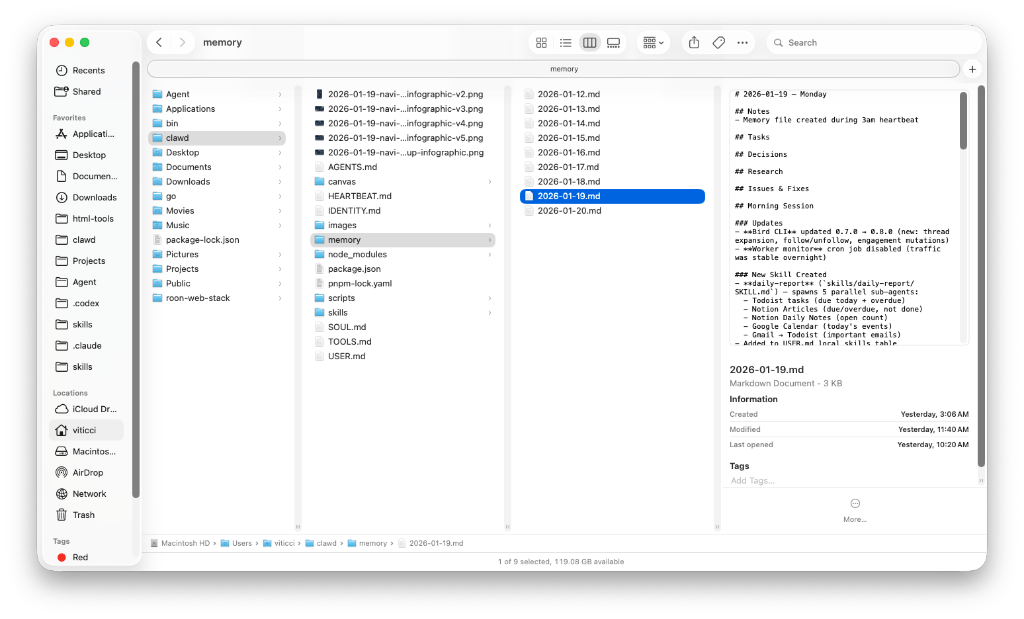
Core Insights - Clawdbot represents a new paradigm in personal AI assistants, capable of self-improvement and operating locally on user devices, distinguishing itself from mainstream applications like ChatGPT and Claude [1][2][3] Group 1: Clawdbot Features - Clawdbot can remember user preferences, control smart home devices, manage schedules, and learn new skills autonomously by accessing the computer's file system and terminal commands [1][3] - The assistant stores settings, preferences, and memories in Markdown documents locally, allowing users to view and modify them directly [1][3] - Clawdbot's architecture consists of a locally running LLM-driven agent and a gateway system connecting various communication applications [3][5] Group 2: Self-Improvement Capabilities - Clawdbot can autonomously add new features upon user request, completing the entire development process [7][9] - In tests, it successfully integrated Google’s Nano Banana Pro model for image generation and created a virtual remote for an LG TV based on simple text commands [7][13] - The assistant can adapt its response style based on the interaction mode, providing voice replies for voice requests and text replies for written requests [9][13] Group 3: Automation and Cost Efficiency - Clawdbot can replace traditional cloud-based automation services, such as Zapier, by executing tasks locally without subscription fees [10][12] - It can automate processes like creating weekly newsletters and sending daily reports based on calendar data, all through local cron tasks [10][12] Group 4: Implications for Software Development - The emergence of Clawdbot raises questions about the future of app development, as AI assistants can create tailored functionalities on demand, challenging the value of traditional app stores [2][13] - The project exemplifies a shift towards highly personalized, adaptive AI software, potentially leading to significant changes in the software industry [2][14] - Clawdbot's design allows users to have complete control over the assistant's capabilities, moving away from pre-defined developer constraints [13][14]