QDII基金溢价风险

Search documents
超10只QDII基金同日预警风险
21世纪经济报道· 2026-03-20 00:39
Core Viewpoint - The article highlights the increasing premium risk associated with cross-border ETFs and LOFs amid heightened volatility in international financial markets, urging investors to be cautious and monitor secondary market prices closely [1][2]. Group 1: Premium Risk Alerts - Multiple QDII funds, including the E Fund's crude oil LOF and various ETFs, have issued over ten announcements since early March regarding premium risks, indicating a growing trend of frequent alerts [1][3]. - As of March 18, the E Fund's crude oil LOF had a premium rate of approximately 15%, with its secondary market closing price significantly exceeding its net asset value [3][4]. - The frequency of premium risk alerts has increased, with some funds resorting to temporary trading halts to manage high premium rates [3][4]. Group 2: Factors Contributing to High Premiums - The high premium rates are attributed to concentrated demand for overseas assets, such as oil, U.S. stocks, and semiconductors, combined with exhausted QDII foreign exchange quotas, leading to a supply-demand imbalance [4][5]. - The misalignment of trading hours in cross-border markets and lengthy subscription cycles further exacerbates price deviations, resulting in sustained high premiums [4]. Group 3: Investment Recommendations - Investors are advised to focus on the premium rates of QDII funds, avoiding purchases during high premium periods to mitigate potential losses from price corrections [6][7]. - It is recommended to prioritize funds with good liquidity and low tracking errors, and to adopt a long-term investment strategy rather than short-term speculation [7][9]. - Awareness of external factors such as foreign exchange quotas, subscription rules, and market risks is crucial for informed investment decisions [8][9]. Group 4: Regulatory and Company Actions - To address high premium risks, regulatory bodies should consider increasing QDII foreign exchange quotas and improving allocation efficiency, while fund companies need to issue timely alerts and implement subscription limits [9]. - Enhanced investor education regarding the risks of price deviations from net asset values is essential to reduce impulsive buying during high premium periods [9].


超30只QDII基金扎堆预警,纳指ETF溢价高企
2 1 Shi Ji Jing Ji Bao Dao· 2026-02-25 12:54
Core Viewpoint - The recent surge in premium risks associated with QDII funds has raised concerns, with over 30 funds announcing premium risks shortly after the Spring Festival holiday, indicating a significant disparity between secondary market prices and net asset values [1][2][6]. Group 1: Premium Risk Announcements - More than 30 QDII funds issued announcements regarding premium risks within two trading days after the Spring Festival, including products like Nasdaq ETF, S&P 500 ETF, and others [1][2]. - On February 25, eight QDII funds reported that their secondary market prices were significantly higher than their reference net asset values, with some products showing a premium of up to 6% [2]. - The frequency of premium risk announcements has increased, with some funds issuing multiple warnings within a short period [4]. Group 2: Trading Suspension Measures - Some QDII funds have taken suspension measures to protect investors, such as the E Fund's crude oil LOF, which suspended trading on February 25 due to high premium levels [3]. - The Huatai-PineBridge Korea-China Semiconductor ETF also suspended trading on February 24, indicating a proactive approach to manage premium risks [4]. Group 3: Market Dynamics and Investor Behavior - The high frequency of premium risks is attributed to two main factors: strong market interest in overseas high-growth assets and limited QDII investment quotas [6]. - Analysts suggest that the current high premiums may lead to significant losses for investors if they purchase QDII funds at inflated prices, emphasizing the need for caution [6]. - The overall market sentiment reflects a growing demand for cross-border investments, with a notable shift in investor behavior towards high-premium products [6][12]. Group 4: Purchase Restrictions - A significant number of QDII products are currently under purchase restrictions, with over 60% of them limiting new subscriptions due to tight quotas [10]. - Fund managers are implementing these restrictions to protect existing investors and ensure stable fund operations amid high demand [9][10]. - The trend of imposing purchase limits is becoming more common as fund managers seek to balance supply and demand in the context of limited foreign exchange quotas [8][10].
QDII基金高频提醒溢价风险,更有产品单月发布20余次提示公告
Bei Jing Shang Bao· 2025-07-28 10:56
Core Viewpoint - Multiple funds have issued premium risk alerts, particularly QDII funds, indicating a significant increase in premium risk notifications since July, with a notable impact on investor decisions [1][3]. Group 1: Premium Risk Alerts - As of July 28, five funds issued premium risk alerts, contributing to over 70 notifications in July alone, with six out of ten being QDII funds [1][3]. - The Guotai S&P 500 ETF (QDII) and the Invesco Great Wall S&P Consumer ETF (QDII) have issued 21 premium risk alerts since July [1][3]. - The premium rates for the aforementioned funds reached 7.95% and 20.64% respectively as of July 28 [3]. Group 2: Market Performance and Fund Returns - The three major U.S. stock indices have shown year-to-date gains of 5.54%, 9.31%, and 8.62% respectively [4]. - The performance of QDII funds has been notable, with the Huatai-PineBridge Hong Kong Advantage Selected Mixed Fund (QDII) achieving a year-to-date return of 135.58%, ranking first among all market products [4]. - Other QDII funds in the healthcare and innovation sectors have also reported year-to-date returns exceeding 80% [4]. Group 3: Market Valuation and Investment Considerations - The forward P/E ratio of the S&P 500 index has reached 23.3, indicating limited valuation attractiveness [5]. - Market analysts suggest that while the U.S. market may continue to trend upward, uncertainties remain, and significant investments should be approached with caution due to high premium risks [5]. - Investors are advised to monitor premium rates closely, with alerts for rates exceeding 5% and heightened caution for rates above 10% due to potential liquidity risks [5].
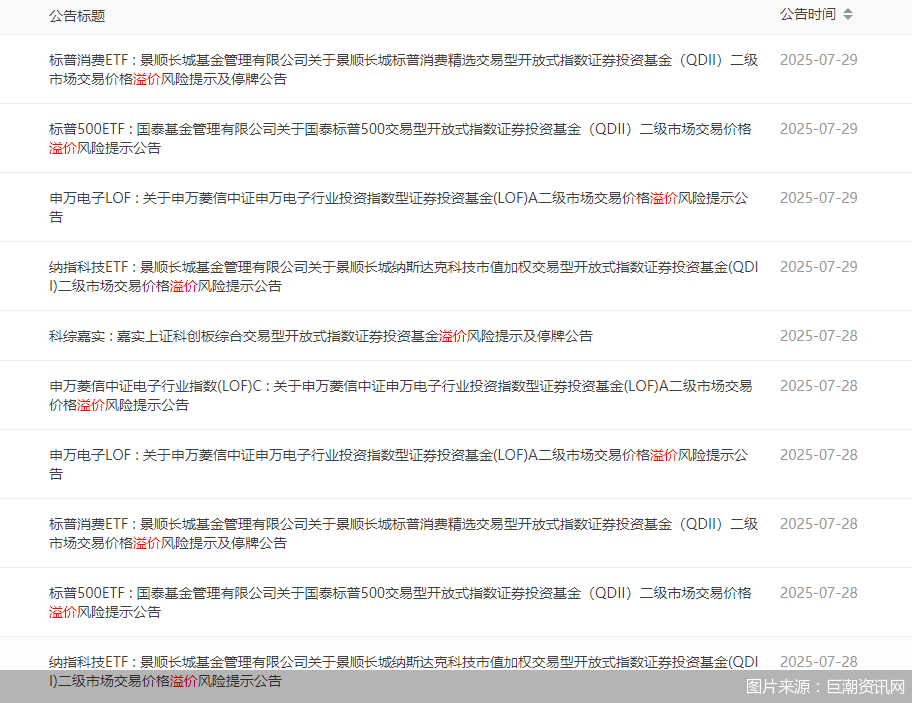
持续上涨!一天8只QDII基金提示溢价风险
Bei Jing Shang Bao· 2025-05-27 12:41
Core Insights - The QDII funds have shown significant performance this year, but many products are frequently warning about premium risks due to price discrepancies between the market and net asset values [1][5] - As of May 27, eight QDII funds issued premium risk alerts, with some funds having issued multiple warnings throughout May [1][2] - Investors are advised to monitor premium rates closely, especially when they exceed 10%, and to wait for a return to reasonable levels before investing [1][5] Performance Overview - As of May 23, out of 650 QDII funds, 425 achieved positive returns this year, representing 65.38% of the total, with 46 funds exceeding a 30% return [4] - The top-performing fund, Huatai-PineBridge Hong Kong Advantage Selection Mixed Fund (QDII), recorded a year-to-date return of 68.45%, while its C-class shares achieved 67.96% [3][4] - The strong performance of QDII funds is largely attributed to investments in the Hong Kong stock market, which has seen significant gains this year [4] Market Context - The Hang Seng Index and the Hang Seng Tech Index have risen by 16.56% and 15.99% respectively since the beginning of the year, contributing to the positive performance of QDII funds focused on Hong Kong stocks [4] - In contrast, some QDII funds investing in US and European markets have reported negative returns, highlighting the variability in performance based on market focus [4]
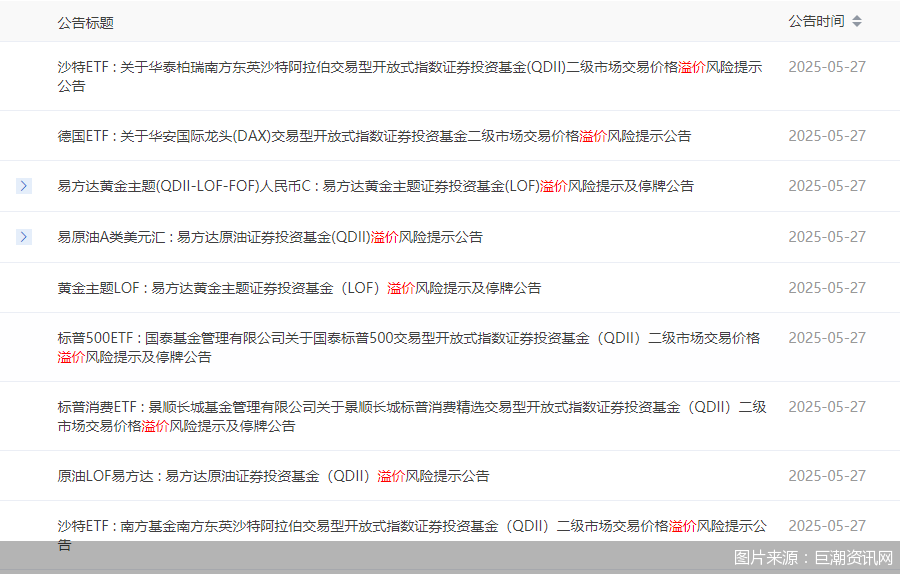
资金狂热!跨境ETF双双涨停,基金急发风险提示
券商中国· 2025-05-13 11:52
Core Viewpoint - The article highlights the increasing premium risk associated with QDII funds, driven by market volatility and speculative trading, urging investors to exercise caution to avoid significant losses [2][4][10]. Group 1: Premium Risk Alerts - Multiple QDII funds have issued frequent premium risk alerts, with 21 alerts in April alone and over 1660 alerts issued by fund companies in total this year [3][10]. - On May 13, both the S&P Consumer ETF and S&P 500 ETF experienced a trading halt due to their prices significantly exceeding their net asset values, prompting urgent risk warnings from fund companies [5][6]. Group 2: Market Dynamics - The surge in premium rates for cross-border ETFs and LOF funds has been notable, with some funds issuing daily alerts since early May [3][8]. - Factors contributing to the heightened premium include positive signals from US-China trade talks, short-term rebounds in overseas markets, and liquidity issues in certain ETFs [9]. Group 3: Specific Fund Examples - The S&P Consumer ETF and S&P 500 ETF recorded price increases of 10.04% and 10.01% respectively on May 13, with trading volumes reaching 30.15 billion and 36.49 billion yuan, and premium rates of 25.03% and 19.68% [6]. - Other funds, such as the Huashang Nasdaq ETF and Huabao New Opportunities LOF, have also reported significant premiums, prompting similar risk warnings from their respective fund companies [9].