标普消费ETF

Search documents
收好不谢!容易出现高溢价的基金清单~
Sou Hu Cai Jing· 2025-12-26 10:17
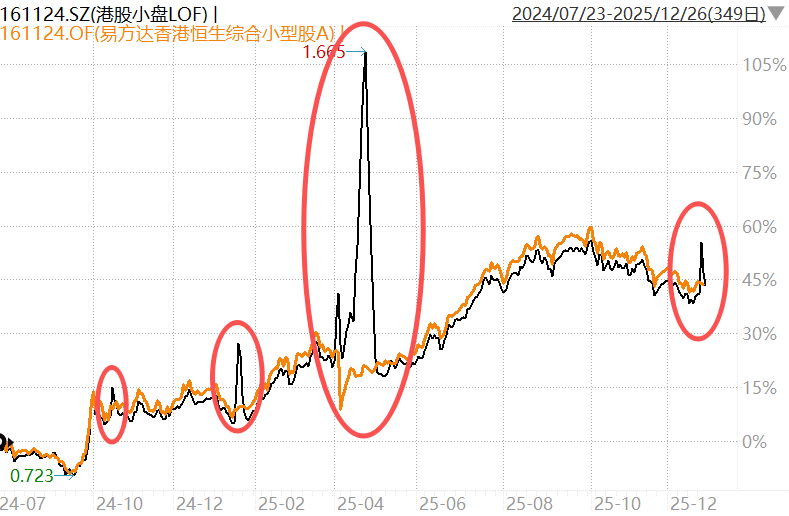
Group 1 - The article discusses the phenomenon of certain funds, particularly small-cap Hong Kong funds, being sold at high premiums intermittently, suggesting a potential trading strategy to buy during low premium periods and sell during high premium periods [5][6][10] - Specific funds that have shown high premiums include "Hong Kong Small Cap LOF" with a premium of 9.69% and "Guotou China Value LOF" with a premium of 8.63% as of September 24 [7][6] - The underlying reason for these high premiums is attributed to the small scale of the funds, making them susceptible to speculative trading [6][10] Group 2 - QDII commodity funds, particularly those related to gold, frequently experience high premiums due to factors such as purchase limits and rising underlying asset prices [10][12] - The "Gold Theme LOF" is highlighted as a fund that often sees significant premiums, with a recent premium of 18.43% [12] - The article also notes that the "National Investment Silver LOF" had a high premium but historically has not maintained such levels consistently [10][12] Group 3 - QDII stock funds, especially those linked to the Nasdaq and S&P 500, are also mentioned as having premiums due to quota restrictions and the strong performance of U.S. stocks [17][18] - The Nasdaq Technology ETF has been noted for maintaining a long-term premium of around 20% [17] - The article suggests that if premiums disappear, investors holding related funds might consider converting their holdings from off-market to on-market [17]

【首席观察】全球流动性变奏
Sou Hu Cai Jing· 2025-12-17 11:02
Core Viewpoint - The market is reassessing the value of "time" as the era of "free" yen and "abundant" dollars comes to an end, leading to a potential revaluation of risk premiums based on current cash flows and valuation safety nets [2][15]. Group 1: Market Dynamics - On December 15, a "global liquidity variation" was observed, with mixed signals: U.S. Treasury yields fell and the dollar weakened, indicating a marginal easing of liquidity, while the yen strengthened and risk appetite contracted [3][4]. - Despite a decline in major U.S. stock indices, certain sectors like consumer ETFs showed resilience, suggesting a shift in market dynamics towards undervalued areas such as value stocks and small-cap stocks [4][5]. - The market is experiencing a transition where investors are less willing to pay high premiums for distant narratives, focusing instead on current cash flows and valuation safety [5][20]. Group 2: Central Bank Policies - The Federal Reserve's recent decision to lower interest rates by 25 basis points signals a shift in monetary policy, with an emphasis on maintaining liquidity through short-term Treasury purchases [6][8]. - The Fed's actions are not traditional quantitative easing but are aimed at ensuring sufficient liquidity in the banking system, indicating a complex approach to managing interest rates and market expectations [7][10]. - The Bank of Japan is expected to continue its normalization process, with market anticipation of further interest rate hikes, which could impact yen financing costs and exchange rate volatility [10][13]. Group 3: Risk Assessment - The potential for a stronger yen could lead to a chain reaction affecting global risk assets, prompting a shift from high-leverage, high-volatility investments to more stable cash flow assets [14][19]. - The current environment suggests that while liquidity remains, the cost of "time" has increased, leading to a re-evaluation of risk premiums across various asset classes [15][22]. - Investors are advised to focus on quality earnings, risk control, and opportunities in the Chinese market, rather than blindly chasing high beta assets [22].

资金涌入,持续加仓!
Zhong Guo Zheng Quan Bao· 2025-12-16 14:08
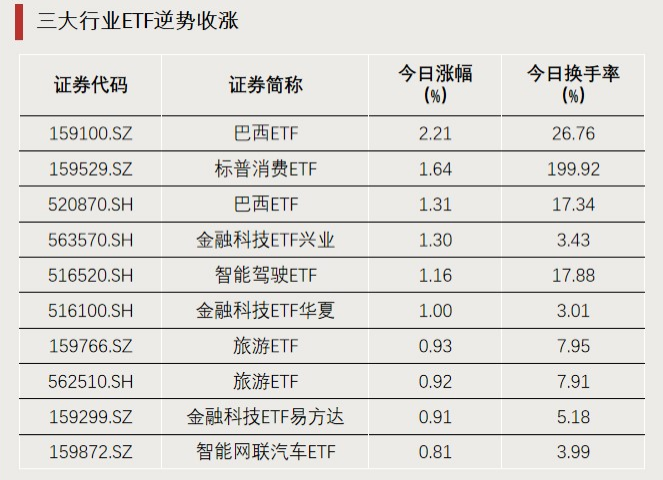
Market Overview - On December 16, A-shares and Hong Kong stocks experienced a pullback, with only about 50 out of over 1300 ETFs closing higher, and 6 of these ETFs rising by 1% or more. Financial technology, tourism, and automotive sector ETFs showed relative resilience [1] - In the cross-border ETF segment, two Brazilian ETFs and one S&P Consumer ETF led the market in terms of gains [1] ETF Performance - Notably, several ETFs that rose against the market trend saw significant increases in trading volume. The S&P Consumer ETF (159529) had a turnover rate of 199.92%, with a trading volume nearing 2 billion yuan, four times that of the previous day. The Smart Driving ETF (516520) also saw its trading volume increase to approximately seven times that of the previous day [2] - On December 16, financial technology, tourism, and automotive sector ETFs performed well, with multiple products ranking among the top gainers. The financial technology ETFs linked to the CSI Financial Technology Index saw over half of their constituent stocks close in the green, with notable gains from companies like Chuangshi Technology (300941) and Cuiwei Co. (603123) [4] Fund Flows - On December 15, despite the market pullback, ETFs experienced a net inflow of approximately 6.7 billion yuan, with broad-based ETFs attracting significant capital. Several ETFs linked to the CSI A500 Index ranked among the top for net inflows, with three A500 ETFs collectively receiving over 13.5 billion yuan in net inflows over the past five trading days [3][9] - The A500 ETF from Southern Fund (159352) led with a net inflow of 3.915 billion yuan on December 15, significantly outpacing other products [11] Sector-Specific Insights - The gold stock ETFs faced a sharp decline on December 16, with the largest drop exceeding 4%. Six out of the top ten ETFs with the largest declines were gold-related, reflecting a cautious market sentiment ahead of key economic data releases [7] - The CSI A500 Index has over 280 public funds linked to it, with more than 80 asset management firms involved, totaling over 240 billion yuan in assets. Over 80% of this is held in ETF products, with 40 ETFs exceeding 210 billion yuan in total assets [10] Upcoming Products - On December 19, Huatai-PB Fund will launch the Sci-Tech Entrepreneurship Artificial Intelligence ETF, adding to the growing list of innovative ETF products in the market [13]
数据看盘实力游资集体出逃商业航天概念股 7.61亿元资金抢筹永辉超市
Sou Hu Cai Jing· 2025-12-16 09:51
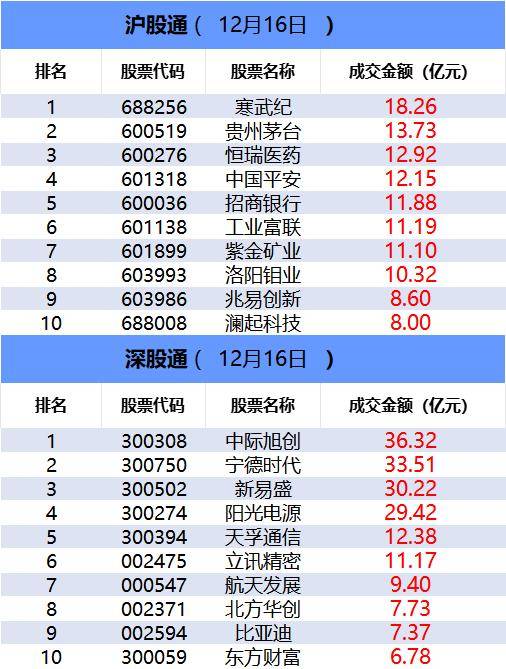
Group 1 - The total trading volume of the Shanghai and Shenzhen Stock Connect today reached 207.635 billion, with Cambricon and Zhongji Xuchuang leading in trading volume for the Shanghai and Shenzhen stock connect respectively [1][2] - The main inflow of funds was observed in the retail sector, with a net inflow of 33.38 billion, representing a 6.97% net inflow rate [6][7] - The Standard & Poor's Consumer ETF (159529) saw a significant increase in trading volume, with a 301% growth compared to the previous trading day [9] Group 2 - The top ten stocks by trading volume in the Shanghai Stock Connect included Cambricon at 18.26 billion, followed by Kweichow Moutai at 13.73 billion and Heng Rui Medicine at 12.92 billion [3] - In the Shenzhen Stock Connect, Zhongji Xuchuang led with a trading volume of 36.32 billion, followed by CATL at 33.51 billion and Xinyi Technology at 30.22 billion [3] - The retail, education, dairy, and diversified finance sectors showed the highest gains, while precious metals, film and television, and Hainan sectors experienced the largest declines [5]




ETF今日收评 | 卫星相关ETF涨超1%,通信、人工智能相关ETF跌超3%
Sou Hu Cai Jing· 2025-12-11 07:12
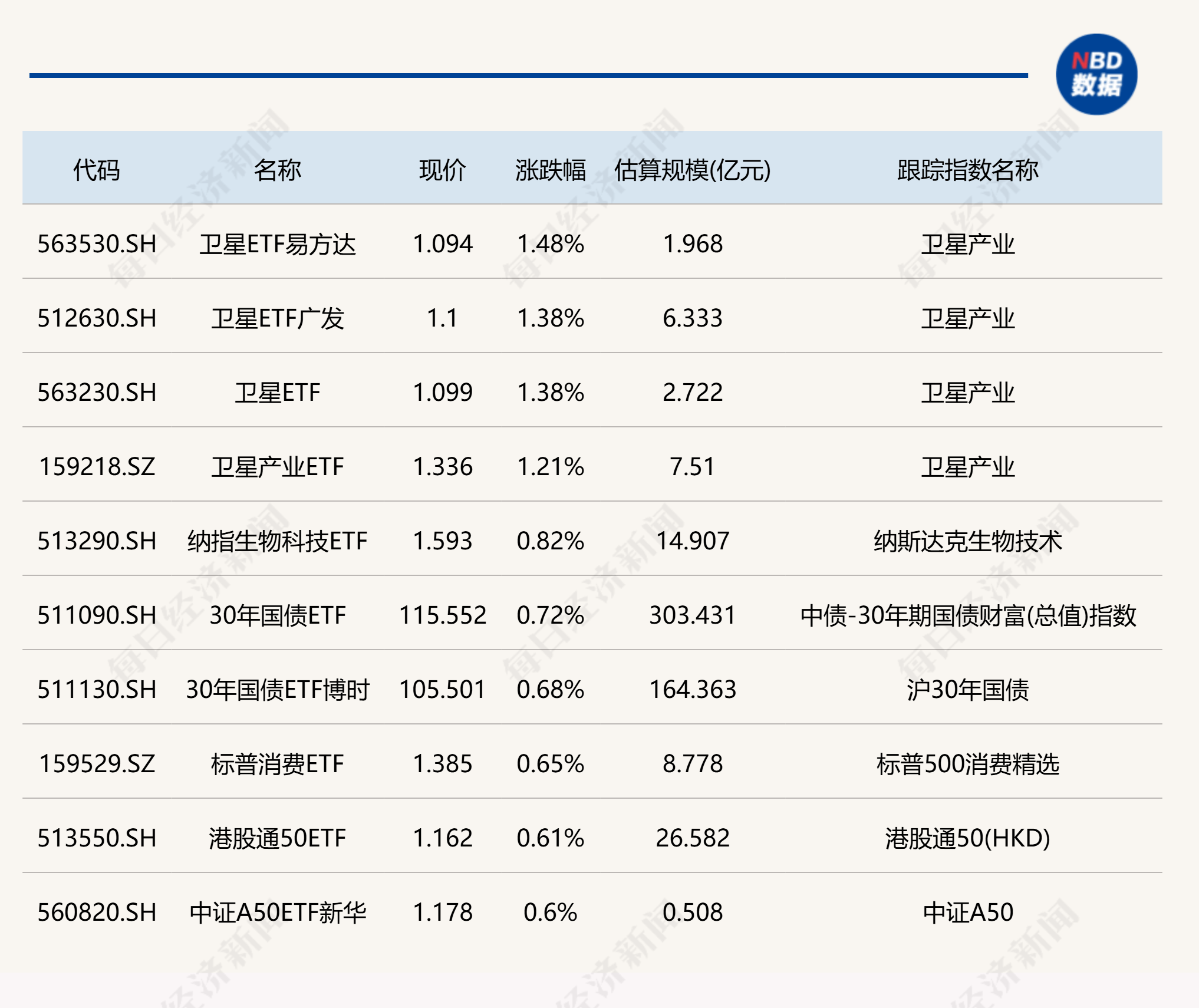
Market Overview - The market experienced fluctuations, with the Shanghai Composite Index opening high but closing lower. The commercial aerospace sector showed resilience, while the communication and real estate sectors weakened [1]. ETF Performance - Satellite-related ETFs saw gains, with the following notable performances: - E Fund Satellite ETF (563530.SH) increased by 1.48% to 1.094 - GF Satellite ETF (512630.SH) rose by 1.38% to 1.1 - Satellite Industry ETF (159218.SZ) grew by 1.21% to 1.336 [2]. Sector Insights - Analysts indicated that China is at a pivotal moment similar to SpaceX's network development from 2018 to 2020. The G60 and GW National Grid are entering a phase of intensive launches, transitioning satellite manufacturing from custom lab production to assembly line production. Companies providing standardized power, communication, and attitude control systems are expected to realize performance gains first [3]. Declining Sectors - Communication and artificial intelligence-related ETFs experienced declines, with the following notable performances: - Communication ETF (515880.SH) fell by 3.92% to 2.939 - AI-related ETFs, such as the ChiNext AI ETF (159279.SZ), decreased by 3.63% to 1.09 [4]. Artificial Intelligence Insights - Artificial intelligence is identified as a core driver of the new technological revolution, with its value lying not just in efficiency improvements but in creating new possibilities and driving industries towards intelligence. The development of large model technology is expected to reshape the global industrial landscape, potentially generating trillions in new commercial value for the financial sector. However, challenges such as technical bottlenecks, high investment costs, and regulatory balance must be addressed [5].
【数据看盘】实力游资扎堆地产股 3亿元资金抢筹神农种业
Xin Lang Cai Jing· 2025-12-10 09:48
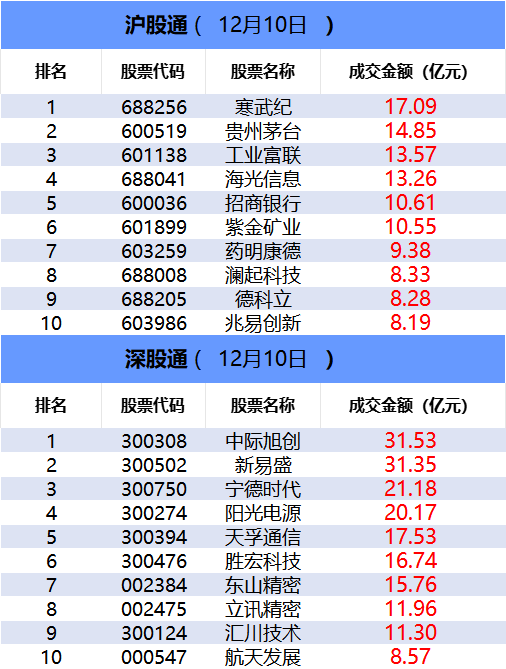
Summary of Key Points Core Viewpoint - The trading volume of the Shanghai and Shenzhen Stock Connect reached a total of 204.41 billion, with significant activity in the real estate sector, which saw the highest net inflow of funds [1]. Group 1: Trading Volume and Key Stocks - The total trading amount for the Shanghai Stock Connect was 92.19 billion, while the Shenzhen Stock Connect totaled 112.23 billion [1]. - The top traded stock in the Shanghai Stock Connect was Cambricon (寒武纪) with a trading amount of 17.09 billion, followed by Kweichow Moutai (贵州茅台) at 14.85 billion [2]. - In the Shenzhen Stock Connect, the leading stock was Zhongji Xuchuang (中际旭创) with a trading amount of 31.53 billion, followed closely by Xinyi Technology (新易盛) at 31.35 billion [3]. Group 2: Sector Performance - The real estate sector led the net inflow of funds with 19.96 billion, representing a net inflow rate of 6.31% [4]. - Other sectors with notable net inflows included commercial retail at 10.13 billion and energy metals at 7.31 billion [4]. - Conversely, the electronics sector experienced the highest net outflow at -136.61 billion, with a net outflow rate of -4.13% [4]. Group 3: ETF Trading Activity - The S&P Consumer ETF (标普消费ETF) saw a remarkable trading volume increase of 591% compared to the previous trading day, reaching 10.07 billion [7]. - The top ten ETFs by trading volume included the A500 ETF Huatai Baichuan, which had a trading amount of 82.99 billion, and the A500 ETF Fund at 75.46 billion [6]. Group 4: Institutional and Retail Activity - Institutional buying was prominent in stocks like Shennong Agricultural (神农种业), which saw a 20.07% increase and received 2.65 billion from four institutions [8]. - Vanke A (万科A) experienced significant buying from top retail investors, with purchases totaling 1.47 billion from three major trading desks [10]. - The retail sector, particularly Yonghui Supermarket (永辉超市), faced substantial selling pressure, with 4.57 billion sold by three institutions [9].


ETF午评 | 算力硬件产业链下挫,跨境ETF领涨,标普消费ETF涨2%
Ge Long Hui· 2025-12-10 04:01
Market Overview - The Shanghai Composite Index fell by 0.72%, the Shenzhen Component Index decreased by 0.56%, and the ChiNext Index dropped by 1.23% [1] - The total market turnover was 1.15 trillion yuan, a decrease of 118.4 billion yuan compared to the previous day [1] Sector Performance - The computing hardware industry chain experienced a decline, with servers and storage leading the losses [1] - Sectors such as photovoltaic, superhard materials, AI applications, and consumer electronics saw significant declines [1] - Conversely, sectors like Hainan Free Trade Zone, outbound tax refunds, lithium mining, and retail concepts performed well against the trend [1] ETF Performance - In the ETF market, Invesco Great Wall Fund's S&P Consumer ETF and Invesco Great Wall Fund's NASDAQ Technology ETF rose by 2.07% and 1.97%, respectively [1] - The engineering machinery sector saw gains, with Da Cheng Fund's Engineering Machinery ETF increasing by 1.44% [1] - The satellite sector also rose, with China Merchants Fund's Satellite Industry ETF up by 1.16% [1] - Gold-related ETFs, including Yongying Fund's Gold Stock ETF and Huaxia Fund's Gold Stock ETF, both increased by 1% [1] Declining Sectors - The photovoltaic sector led the declines, with leading photovoltaic ETFs such as E Fund's Photovoltaic ETF and others falling by 2.84%, 2.71%, and 2.67% respectively [1] - The big data sector weakened, with Big Data ETF and Data ETF both declining by 2.5% [1]
ETF今日收评 | 标普消费ETF涨超2% 传媒ETF跌超2%
Mei Ri Jing Ji Xin Wen· 2025-12-02 07:42
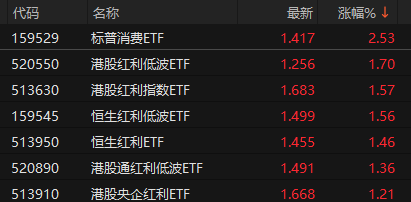
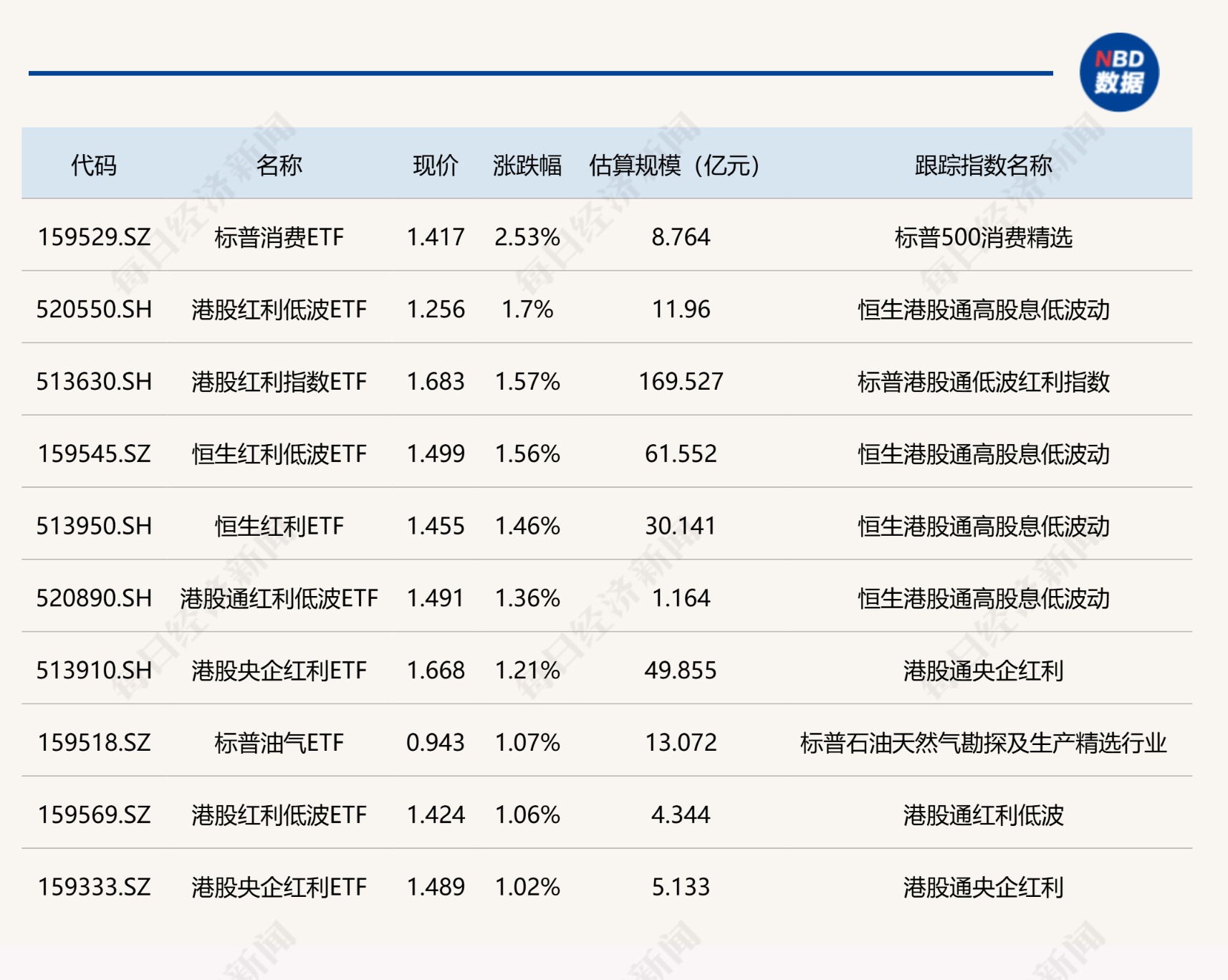
Market Overview - The market experienced fluctuations throughout the day, with the Shenzhen Component Index and the ChiNext Index both dropping over 1% at one point [1] - The Fujian sector showed strong performance, while the battery and shipping sectors faced declines [1] ETF Performance - The S&P Consumer ETF rose by over 2%, and several dividend-related ETFs increased by more than 1% [1] - Specific ETF performance includes: - S&P Consumer ETF: 2.53% increase, estimated size of 8.764 billion [2] - Hong Kong Dividend Low Volatility ETF: 1.7% increase, estimated size of 11.96 billion [2] - Hong Kong Dividend Index ETF: 1.57% increase, estimated size of 169.527 billion [2] - Other notable ETFs include the Hang Seng Dividend Low Volatility ETF and the Hang Seng Dividend ETF, both showing increases around 1.5% [2] Institutional Investment Trends - Analysts suggest that some institutions may sell high-valuation, volatile growth stocks to lock in annual returns, shifting towards high-dividend, high-safety margin Hong Kong dividend sectors [2] - The period from December to January is noted as a peak for insurance premiums, leading some insurance funds to quickly build positions in high-dividend assets to match liability costs, creating a rigid buying pressure [2] Media Industry Outlook - Long-term prospects for the media industry are expected to improve due to a gradual recovery in content supply, ongoing AI technology integration, and supportive policies alongside consumer recovery expectations [4] - Companies in the film and television, gaming, and advertising sectors are recommended for their strong performance, as well as those involved in digital assets and AIGC-related technologies [4]
ETF今日收评 | 标普消费ETF涨超2%,传媒ETF跌超2%
Sou Hu Cai Jing· 2025-12-02 07:37
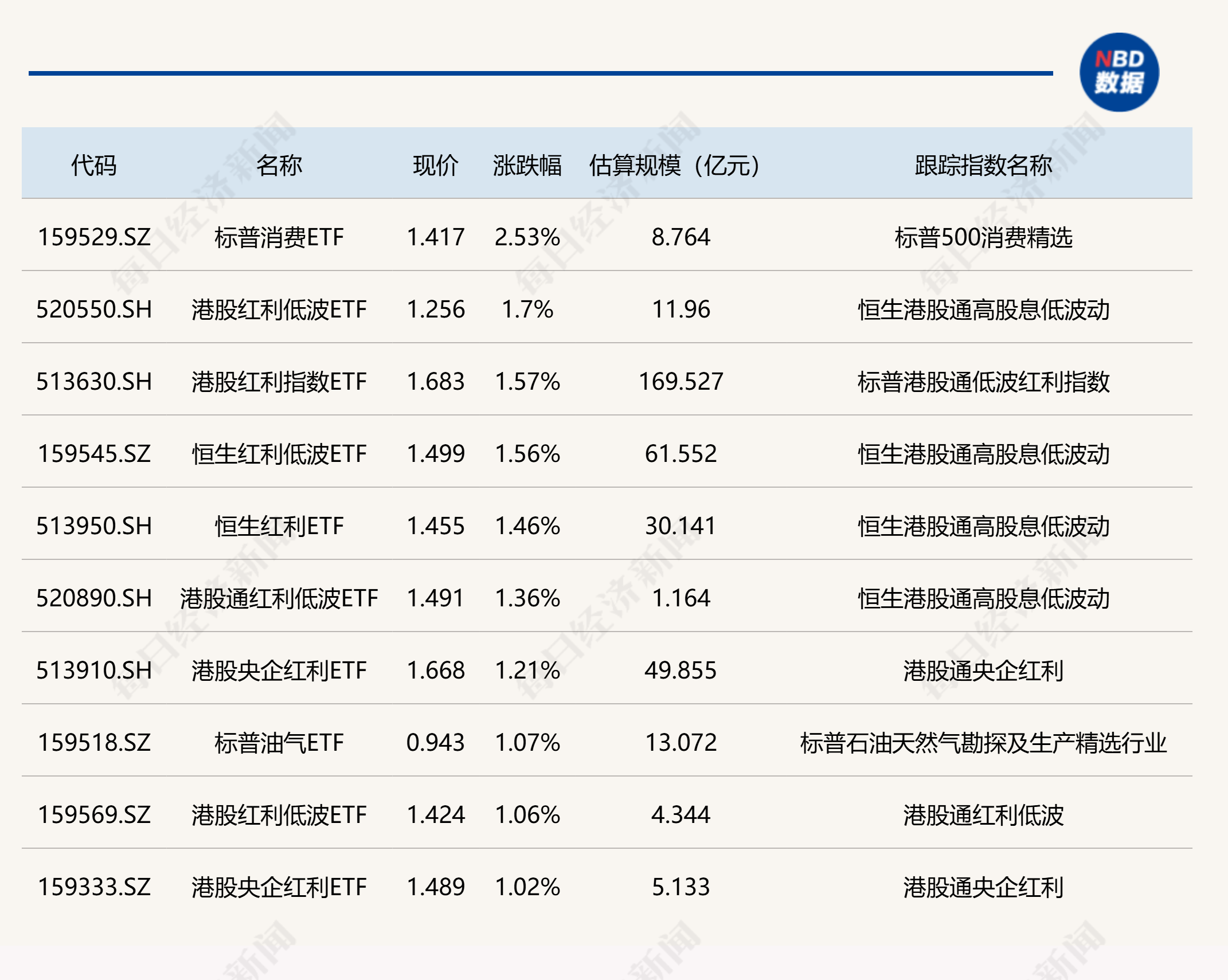
Market Overview - The market experienced fluctuations throughout the day, with both the Shenzhen Component Index and the ChiNext Index dropping over 1% at one point [1] - The Fujian sector showed strong performance, while the battery and shipping sectors faced declines [1] ETF Performance - The S&P Consumer ETF rose by over 2%, with several dividend-related ETFs increasing by more than 1% [1][2] - Specific ETFs and their performance include: - S&P Consumer ETF: 1.417, up 2.53% [2] - Hong Kong Dividend Low Volatility ETF: up 1.7% [2] - Hong Kong Dividend Index ETF: 1.683, up 1.57% [2] - Other notable ETFs include the Hang Seng Dividend Low Volatility ETF and the Hang Seng Dividend ETF, both showing increases [2] Institutional Behavior - Analysts suggest that some institutions may sell high-valuation, volatile growth stocks to lock in annual returns, shifting focus to high-dividend, high-margin safety stocks in the Hong Kong dividend sector [3] - The period from December to January is noted as a peak for insurance premiums, leading some insurance funds to quickly build positions in high-dividend assets to match liability costs, creating a rigid buying pressure [3] Sector Declines - The Media ETF experienced a decline of over 2% [3][4] - Other ETFs in the media and technology sectors also reported losses, including: - Media ETF: down 2.3% [4] - S&P Biotechnology ETF: down 2.2% [4] - Various other ETFs in the entertainment and technology sectors also showed declines [4][5]
ETF收盘:标普消费ETF涨2.53% 传媒ETF跌2.3%
Sou Hu Cai Jing· 2025-12-02 07:24
Core Insights - The ETF market experienced mixed performance on December 2, with the S&P Consumer ETF leading gains at 2.53% while several media-related ETFs faced declines [1][2] Performance Summary - **Top Performers:** - S&P Consumer ETF (159529) increased by 2.53% [2] - Hong Kong Dividend Low Volatility ETF (520550) rose by 1.70% [2] - Hong Kong Dividend Index ETF (513630) gained 1.57% [2] - **Bottom Performers:** - Media ETF (512980) decreased by 2.30% [2] - S&P Biotechnology ETF (159502) fell by 2.20% [2] - Entertainment Media ETF (516190) dropped by 2.12% [2]