RaaS(Robot as a Service)

Search documents
IDC:2025年全球人形机器人出货量接近1.8万台 同比增长约508%
Zhi Tong Cai Jing· 2026-02-09 05:50
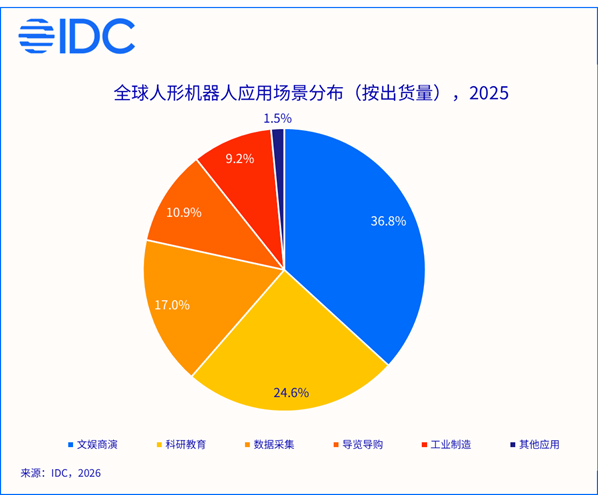
Core Insights - The global humanoid robot market is set to reach a significant scale in 2025, with an expected shipment of nearly 18,000 units, representing a year-on-year growth of approximately 508%, and sales revenue projected at around $440 million [1] - Chinese manufacturers are leading the market with a robust manufacturing system, rapid iteration capabilities, and cost advantages, establishing a dominant position globally [2] - The market is primarily driven by bipedal humanoid robots, which contribute 66.3% of the total sales revenue, with full-sized bipedal robots accounting for 41.6% of the sales [3] Market Dynamics - In 2025, the demand for humanoid robots is mainly driven by applications in entertainment, education, and data collection, emphasizing display effects and interactive experiences [4] - The industry is transitioning from one-time hardware sales to a model that includes Robot as a Service (RaaS), operational services, and a platform ecosystem, creating conditions for scalable applications and sustained revenue [6] Technological Advancements - Humanoid robots are advancing towards engineering and scalable applications, with a focus on enhancing intelligent collaboration capabilities [7] - The integration of upper limb dexterity and the fusion of cognitive models are key breakthroughs that will enhance autonomous operations and human-robot collaboration [7]


“擎天租”机器人租赁平台发布,明年将渗透200+城市
Xin Lang Cai Jing· 2025-12-23 13:41
Core Insights - The article discusses the launch of the "Qingtian Rental" platform by Zhiyuan Robotics, which aims to revolutionize the robot rental industry by creating a Robot as a Service (RaaS) model, facilitating easier access to humanoid robots for consumers and businesses [3][7]. Group 1: Platform Overview - "Qingtian Rental" will integrate users, rental companies, content developers, and equipment manufacturers to enhance the overall value of the robot rental industry [3][7]. - The platform's innovative approach transforms high-barrier robot usage scenarios into a convenient rental model similar to shared power banks, addressing high operational costs, complex collaboration chains, and content homogenization in the current market [3][7]. Group 2: Strategic Goals - The "Qingtian Rental 1234 Strategic Plan" aims to achieve the following by 2026: over 10 original equipment manufacturers, more than 200 premium service rental companies, 3,000 content creators, and 400,000 rental customers [3][7]. - The platform is expected to penetrate over 200 cities by 2026, with plans to implement user growth and merchant incentive policies to stimulate both sides of the market [4][8]. Group 3: Market Development - The current market features robots primarily focused on emotional and interactive functions, with expectations for faster model development as data accumulates [4][8]. - Industrial robot rentals are anticipated to begin in simple factory scenarios by next year, with significant advancements expected between 2027 and 2028, while household robot rentals may take 3 to 5 years to become more prevalent [4][8].