
全尺寸双足人形机器人

Search documents
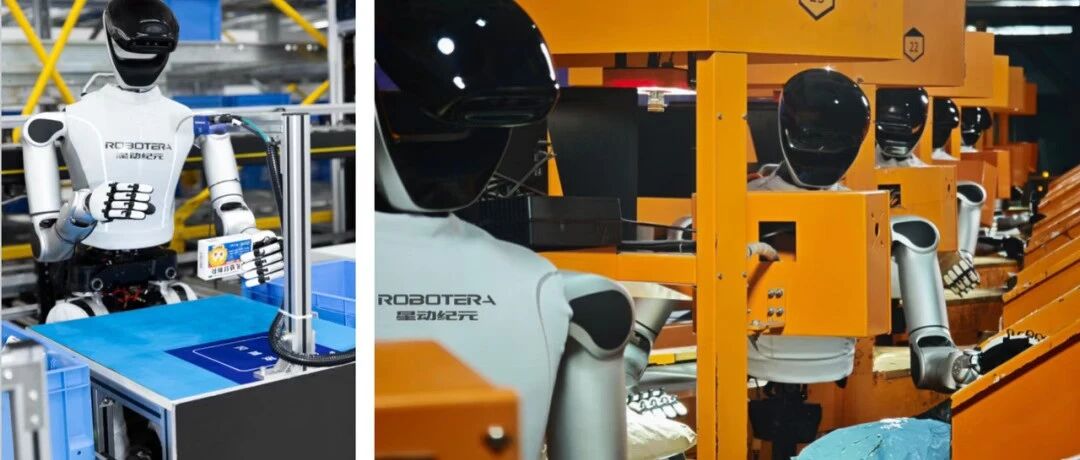
星动纪元获三星等10亿投资:最多产业方加持的具身企业,模型登顶全球第一
IPO早知道· 2026-03-05 01:30
Core Viewpoint - Xingdong Era has completed a strategic financing round of 1 billion RMB, with a valuation exceeding 10 billion RMB, attracting significant investment from both domestic and international industry leaders, indicating strong market confidence and growth potential in the embodied intelligence sector [3][4]. Group 1: Financing and Investment - The recent financing round occurred just two months after the previous one, with the intended investment amount significantly exceeding the fundraising target [4]. - A total of 16 domestic and international industrial investors have been attracted, including major players like Geely Capital, Alibaba, and Samsung, forming a robust ecosystem of "international giants + domestic leaders" [3]. Group 2: Technological Capabilities - Xingdong Era is the only company in China with full-stack self-research capabilities in embodied intelligence, having developed a comprehensive technical support system that includes perception, decision-making, and control [5][6]. - The company has achieved global recognition with its ERA-42 model, which integrates the entire process of perception, decision-making, and control, making it the first to accomplish full-body and dexterous hand operations [6][8]. Group 3: Market Performance and Applications - Xingdong Era has accumulated orders exceeding 500 million RMB, with international business accounting for 50%, indicating strong market penetration across North America, Europe, and Asia [12]. - The company has made significant advancements in logistics applications, including the first embodied intelligence logistics solution in China, achieving operational efficiencies of up to 70% in various cities [14][16]. Group 4: Future Outlook - The company plans to expand its logistics applications into e-commerce, industrial manufacturing, and pharmaceutical distribution, aiming to build a comprehensive embodied logistics service system [16]. - The recent financing is seen as a new starting point for accelerating technological and commercial upgrades, reinforcing the company's leadership position in the embodied intelligence industry [16].

IDC:2025年全球人形机器人出货量接近1.8万台 同比增长约508%
Zhi Tong Cai Jing· 2026-02-09 05:50
Core Insights - The global humanoid robot market is set to reach a significant scale in 2025, with an expected shipment of nearly 18,000 units, representing a year-on-year growth of approximately 508%, and sales revenue projected at around $440 million [1] - Chinese manufacturers are leading the market with a robust manufacturing system, rapid iteration capabilities, and cost advantages, establishing a dominant position globally [2] - The market is primarily driven by bipedal humanoid robots, which contribute 66.3% of the total sales revenue, with full-sized bipedal robots accounting for 41.6% of the sales [3] Market Dynamics - In 2025, the demand for humanoid robots is mainly driven by applications in entertainment, education, and data collection, emphasizing display effects and interactive experiences [4] - The industry is transitioning from one-time hardware sales to a model that includes Robot as a Service (RaaS), operational services, and a platform ecosystem, creating conditions for scalable applications and sustained revenue [6] Technological Advancements - Humanoid robots are advancing towards engineering and scalable applications, with a focus on enhancing intelligent collaboration capabilities [7] - The integration of upper limb dexterity and the fusion of cognitive models are key breakthroughs that will enhance autonomous operations and human-robot collaboration [7]


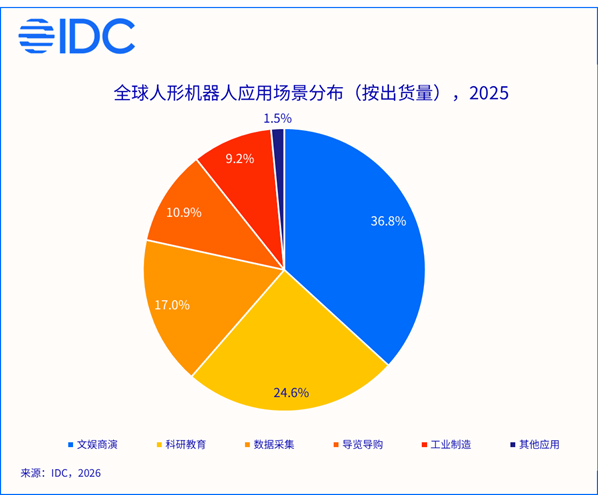
2025年全球人形机器人出货量近1.8万台 智元、宇树等中企产品占据主导
Feng Huang Wang· 2026-02-09 04:50
Core Insights - The global humanoid robot shipment is projected to reach nearly 18,000 units by 2025, representing a year-on-year growth of approximately 508%, with a market size of around $440 million [1] - Cumulative order volume is expected to exceed 35,000 units during the same period [1] Company Landscape - Chinese companies dominate the shipment volume, with Zhiyuan Robotics and Yuzhu Technology each shipping around 5,000 units [1] - Other companies such as Leju Robotics, Accelerated Evolution, and Songyan Power shipped approximately 1,000 units each [1] - Companies like Galaxy General, UBTECH, Zhongqing Robotics, and Stardust Intelligence shipped between 400 to 1,000 units [1] - Emerging companies including Xingdong Jiyuan, Magic Atom, Beijing Humanoid Robot Innovation Center, Xinghai Map, Mojia Zhichuang, and Zhujiji Power achieved shipments of over 100 units [1] - In contrast, international firms like Apptronik and Figure AI are still in pilot testing phases, with shipment volumes in the tens [1] - Tesla's humanoid robot is expected to begin large-scale production in 2026 [1] Product Form Factor - Bipedal robots (including full-size and small-to-medium size) contribute to 66.3% of market sales [1] - Full-size humanoid robots account for the highest sales proportion at 41.6%, with Zhiyuan Robotics leading in this segment [1] Industry Analysis - IDC analysis indicates that Chinese manufacturers hold a first-mover advantage in the current stage of humanoid robot commercialization due to a complete industrial chain, rapid iteration capabilities, and cost advantages [1] - Future industry competition is expected to shift from hardware sales to dimensions such as technical services and ecosystem development [1]

在拉斯维加斯,看见中国智造的“灵魂”
21世纪经济报道· 2026-01-06 05:23
Core Viewpoint - The article highlights the significant advancements and global expansion of Chinese technology companies showcased at CES 2026, emphasizing their transition from being perceived as low-cost hardware providers to leaders in innovation and technology integration [1][21]. Group 1: Embodied Intelligence - Embodied intelligence has transitioned from being a showcase to practical applications, with companies like Star Motion Era demonstrating robots that can predict outcomes and evolve autonomously [3]. - The market is now focused on the productivity value of real-world applications rather than mere technological gimmicks, as evidenced by Star Motion Era's successful deployment of humanoid robots in various sectors, achieving over 500 million yuan in orders [4]. - The industry faces challenges in model robustness and data efficiency, with ongoing efforts to create a closed-loop system for embodied intelligence [4]. Group 2: Globalization and Market Expansion - Star Motion Era has achieved a 50% share of overseas orders, serving major markets in North America, Europe, and Asia, with significant contributions from global tech giants [5]. - Dreame has expanded its global presence to 120 countries, leading in market share in 22 of them, and is focusing on emotional connections with users through flagship stores [9]. - ULS Robotics has successfully entered key markets like Germany and Canada, emphasizing the importance of technological innovation and user-centric product development in their globalization strategy [14]. Group 3: System Capability and User Experience - The industry is moving away from merely stacking hardware features to enhancing system capabilities, as highlighted by Ninebot's development of an integrated operating system that improves user experience [16]. - The focus is on creating a seamless interaction between hardware and software to provide a stable and intelligent overall experience for users [17]. - Companies are adapting their products to local markets by understanding regional user habits and preferences, which is crucial for successful globalization [18]. Group 4: Cultural and Technological Integration - The competition among Chinese companies is shifting towards a more multifaceted role in globalization, moving beyond manufacturing to include technology, design, and localized operations [20]. - The essence of globalization is to transcend borders while empowering human potential, as articulated by ULS Robotics [21]. - The article concludes that the advancements in technology and the evolving role of Chinese companies at CES signify a new era of global localization and technological value [21].

在拉斯维加斯,看见中国智造的“灵魂”
2 1 Shi Ji Jing Ji Bao Dao· 2026-01-06 02:31
Core Insights - The 2026 CES in Las Vegas highlights the significant advancements of Chinese tech companies, showcasing their transition from being perceived as low-cost hardware providers to leaders in innovative technology [1][2] Group 1: Embodied Intelligence - Embodied intelligence has moved from being a showcase to practical applications, with companies like Star Era demonstrating real-world use cases for humanoid robots [3] - Star Era has achieved a 50% share of overseas orders, indicating strong global market penetration, with major clients including nine of the top ten tech giants [4][19] - The company emphasizes the importance of academic collaboration with institutions like MIT and Stanford to enhance its technological capabilities and establish global influence [5][19] Group 2: Smart Home Innovations - Dreame has expanded its presence at CES, showcasing advancements in AI and embodied intelligence in vacuum cleaners, marking a shift from novelty to essential household infrastructure [7][8] - The company has established a strong global footprint, operating in 120 countries and holding the top market share in 22 of them [8][19] - The vacuum cleaner industry is evolving towards continuous system capability improvements, enhancing user experience and redefining product roles within households [9] Group 3: Exoskeleton Technology - ULS Robotics is transitioning exoskeleton technology from industrial applications to everyday consumer use, focusing on lightweight and intelligent designs [10][12] - The company has successfully entered key markets in Germany, Canada, and the UAE, with operations in over 25 countries [12][19] - ULS Robotics aims to enhance user experience through AI integration and localized adaptations, ensuring their products meet diverse consumer needs [13] Group 4: Systemic Capability and Globalization - Ninebot emphasizes the shift from hardware competition to systemic capability, focusing on integrated software and hardware solutions to enhance user experience [14][15] - The company has over 34 million global users, with a stable 40% of revenue coming from overseas markets, reflecting its successful globalization strategy [17][18] - Ninebot's approach includes deep localization efforts, tailoring products to regional preferences and participating in global standards discussions [16][19]
中联重科:预计2026年起开启机器人批量生产并面向市场销售
Zheng Quan Shi Bao Wang· 2025-11-04 10:19
Core Viewpoint - The company has made significant advancements in its embodied intelligence business, with multiple self-developed robot products undergoing 2 to 3 rounds of iteration and achieving engineering success [1] Group 1: Product Development - One small bipedal humanoid robot has reached industry benchmark performance [1] - Three full-sized bipedal humanoid robots can compete with international and domestic flagship benchmark products, demonstrating stable walking, running, and full-body coordinated movement capabilities [1] Group 2: Application and Testing - Dozens of robots are currently validating and collecting data in various scenarios, including pre-assembly of engineering machinery, goods sorting, plating, scanning for loading, assembly of medium-sized components, and quality inspection [1] Group 3: Future Plans - The company plans to gradually start mass production and market sales from 2026 onwards [1]

从行业探路者到创业家 齐建伟与他的“浩海星空”
Shang Hai Zheng Quan Bao· 2025-10-30 18:29
Core Insights - The establishment of Haohai Xingkong marks a significant entry into the increasingly competitive embodied intelligence industry, with a focus on leveraging key breakthroughs in energy, materials, costs, and large models [3][4] - The company aims to capitalize on the upcoming critical phase of the industry, where leading companies are expected to emerge, by forming a unique founding team of 15 members with extensive experience in the robotics sector [4][5] Company Structure and Strategy - The founding team consists of 14 individuals, each with over 7-10 years of experience in the robotics industry, allowing for clear role delineation and rapid integration into existing industrial ecosystems [5][6] - Haohai Xingkong's strategy involves a "pick and choose" approach in its market positioning, focusing on education, healthcare, and commercial applications while avoiding direct competition with established players [6][7] Application Scenarios - The company prioritizes three main application scenarios: education, healthcare, and commercial services, leveraging the team's expertise in education and healthcare to develop comprehensive solutions [7][8] - In education, the company plans to provide solutions across all age groups, enabling students to learn programming and mechanical principles through robotics [7] - In healthcare, the focus is on hospital logistics and surgical assistance, utilizing a step-by-step approach to data collection and algorithm optimization for future scalability [7] Recent Developments - Haohai Xingkong has secured an order worth 30 million yuan, emphasizing the importance of focusing on areas that can generate cash flow [8] - The company is developing a full-size humanoid robot with approximately 10 unique innovations aimed at balancing motion performance and interactive intelligence, with plans for future applications in rehabilitation and companionship [9][10] - A strategic investment of 40 million yuan from Zhejiang Xiantong has been secured, allowing for the establishment of a joint venture to build a manufacturing base for robots, enhancing production capabilities [9][10] Future Goals - The company aims to leverage Zhejiang Xiantong's extensive manufacturing experience and quality management to transition from research and development to large-scale market deployment [10] - Long-term objectives include positioning Haohai Xingkong within the second tier of leading companies by the end of next year and striving for the top tier within 2-3 years, ultimately promoting harmonious coexistence between robots and humans [10]


首发首秀!这场大会将颠覆对AI的认知?
Sou Hu Cai Jing· 2025-08-12 11:47
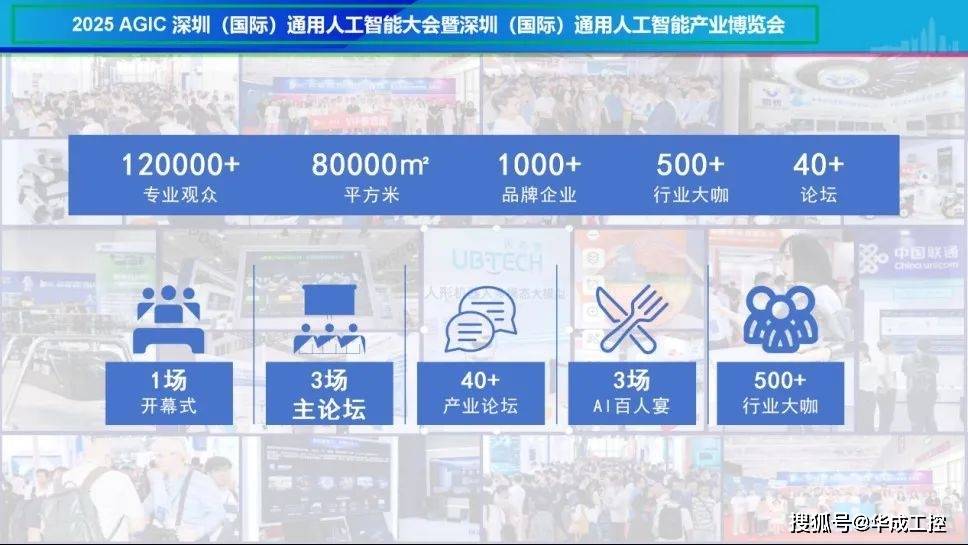
Group 1 - The conference "2025AGIC Shenzhen (International) General Artificial Intelligence Conference and General Artificial Intelligence Industry Expo" will be held from August 27 to 29 at the Shenzhen International Convention and Exhibition Center, featuring an exhibition area of 80,000 square meters and over 1,000 participating companies [1][5] - The theme "Model-Driven, Intelligent Future" highlights a pivotal moment in the development of the artificial intelligence industry, focusing on large language models (LLMs) and multimodal models as the new generation of AI's "intelligent brain" [2][4] - Major companies such as Tencent, Huawei, and Baidu will showcase cutting-edge technologies, including the launch of the first full-size bipedal humanoid robot by Pudu Robotics, designed to resemble the human body [5][10] Group 2 - The event will feature over 20 Japanese companies, demonstrating agricultural robots and collaborative robots, showcasing the potential for technological collaboration in AI applications [7] - The exhibition will include immersive experiences across eight industry scenarios, with dedicated theme pavilions for general AI, intelligent sensing, and smart terminals, as well as a special "AI Future City" experience area [8] - The conference will release the "China Artificial Intelligence Industry White Paper" and the "Artificial Intelligence Development Characteristics (Greater Bay Area Plan)," providing authoritative standards and future trend analyses for the AI industry [11]
具身智能、大模型、灵巧手……在这场大会看“人工智能+”如何在深圳具象化
Sou Hu Cai Jing· 2025-08-02 20:34
Core Insights - The 2025 AGIC Shenzhen International General Artificial Intelligence Conference and Expo will take place from August 27 to 29, showcasing over 1,000 companies and covering 80,000 square meters, highlighting the practical applications of "Artificial Intelligence+" [1][4] Group 1: Industry Trends - Large models are transitioning from pure software to hardware, becoming the core operating system for robots, smart terminals, and industrial equipment, demonstrating AI's evolution from code to physical capabilities [2][4] - The conference theme "Model-Driven, Intelligent Future" emphasizes the integration of AI with hardware, showcasing products like sensors from Huawei and robots from DJI, which are now equipped with intelligent cores from major AI models [2][4] Group 2: Event Highlights - The event will feature eight industry scenarios including security, finance, manufacturing, and healthcare, with dedicated exhibition areas for general AI, smart sensing, and intelligent terminals [5] - A total of 100 groundbreaking AI technologies will have their global debut at the conference, covering areas such as AI chips, generative AI, and intelligent robots [6] Group 3: International Participation - Over 20 Japanese companies will participate, showcasing innovations like agricultural robots and collaborative robots, highlighting the global collaboration in AI technology [4][6] - The event has attracted nearly 8,876 overseas buyers from over 30 countries, indicating strong international interest and engagement in the AI sector [6]




AI力量集结,头部企业汇聚,这场大会本月在深圳举办
Nan Fang Du Shi Bao· 2025-08-02 12:42
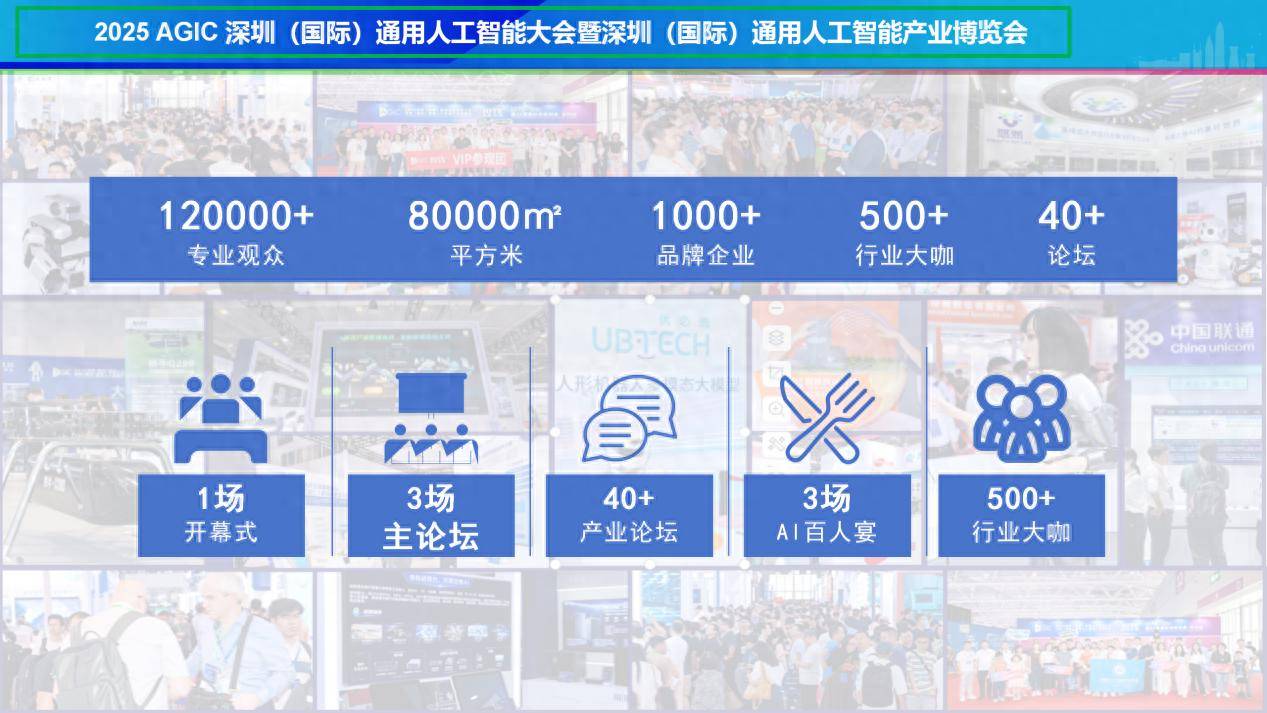
Group 1 - The core theme of the conference is "Model-Driven, Intelligent Future," focusing on the integration of AI technology across various industries, showcasing the promising future of "AI+" [1][2] - The event will feature over 1,000 brand enterprises, including leading companies like Tencent, Huawei, Baidu, and others, demonstrating cutting-edge technologies and innovations in the AI sector [2][3] - The conference will include immersive experiences in AI applications across eight major industries, such as security, finance, manufacturing, and healthcare, highlighting the transformative impact of AI on daily life and production [3] Group 2 - New products and technologies will be launched during the conference, covering areas like AI chips, generative AI, intelligent robots, and more, allowing attendees to experience the latest innovations firsthand [4] - The event will also release the "China Artificial Intelligence Industry White Paper" and the "Artificial Intelligence Development in the Greater Bay Area," providing insights into industry trends and guiding sustainable development [4] - A significant number of overseas buyers, with 8,876 registered for attendance, will participate in the conference, promoting a collaborative ecosystem among industry, academia, and research [4]