SPAC模式

Search documents
纳斯达克摘牌后,美国OTC市场成中企赴美上市新选择
Sou Hu Cai Jing· 2026-01-21 04:08
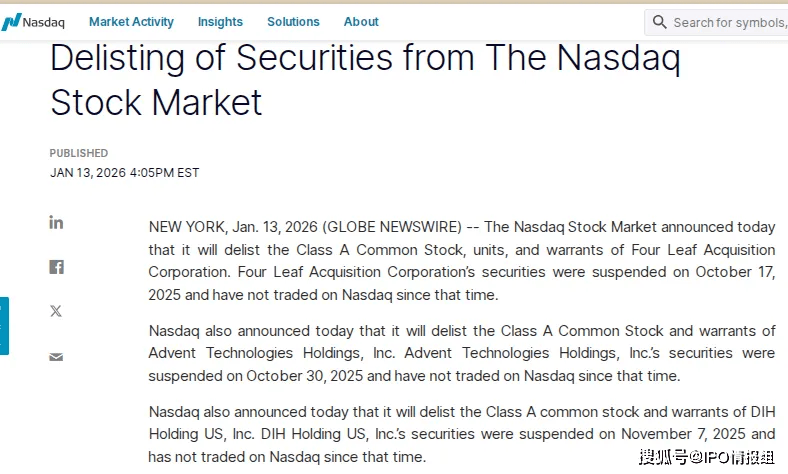
Core Viewpoint - The recent delisting of SPACs associated with Chinese companies has halted their plans for U.S. listings, highlighting the risks of the SPAC model and the unique value of the OTC market [1] Group 1: SPAC Delisting and Its Implications - Nasdaq delisted 13 securities on January 13, including three SPACs (Four Leaf, DT Cloud, AlphaTime) linked to Chinese companies, transferring them to the OTC market [1] - The delisting exposes the vulnerabilities of the SPAC model, particularly the reliance on the SPAC's continued listing status [4] - The case of Xiaoyu Tidata illustrates that even with stable business operations, a SPAC's delisting can abruptly halt the entire listing process [4] Group 2: Regulatory Changes and Challenges - New Nasdaq regulations effective January 17, 2026, will raise the minimum public float market value requirement from $5 million to $15 million and mandate that SPAC mergers must raise at least $25 million in public funds [4] - These regulatory changes create significant barriers for many small and medium-sized enterprises [4] Group 3: Advantages of the OTC Market - The OTC market offers a crucial buffer, allowing SPACs to continue merger transactions even after delisting from the main board [5] - OTC has lower financial requirements, with no strict profitability criteria and minimal annual fees ranging from a few thousand to $20,000 [6] - The listing process on the OTC market can be completed in 3-6 months, significantly faster than the 12-24 months required for a Nasdaq IPO [7] Group 4: Structured Compliance and Growth Opportunities - The OTC market features a four-tier compliance structure, catering to different stages of company development [8] - Companies already listed on domestic boards can issue ADRs on OTCQX without meeting stringent SEC registration requirements, facilitating exposure to U.S. investors [9] - The OTC market serves as a "golden stepping stone" for companies aiming to transition to Nasdaq or NYSE, with approximately 15% of Nasdaq-listed companies having previously grown on the OTC market [10] Group 5: Diverse Financing Options - The OTC market supports various financing methods, including private placements and convertible bonds, which are particularly suitable for light-asset companies in technology and biomedicine [11] - Companies can leverage the OTC market to access global financing while providing liquidity options for early investors [11] - The current delisting trend reinforces the need for Chinese companies to consider paths beyond the main board for U.S. listings [11]
快讯|SPAC模式遇阻 中企赴美上市转向OTC市场
Sou Hu Cai Jing· 2026-01-21 03:45
Core Viewpoint - The listing plans of Chinese company Xiaoyu Dida in the U.S. have changed due to its partner SPAC, Four Leaf Acquisition Corp, being delisted from Nasdaq and moving to OTC trading, alongside three other SPACs involving Chinese companies facing similar situations [1] Group 1: Regulatory Changes - Nasdaq's new regulations effective January 17, 2026, significantly raise the listing thresholds for SPACs, contributing to a cautious attitude from capital towards Chinese SPAC projects [1] Group 2: Market Trends - The financing scale for Chinese companies listing in the U.S. has decreased by 41% year-on-year as of mid-2025, further exacerbating the cautious approach from investors [1] Group 3: OTC Market Opportunities - The OTC market is emerging as a new option for cross-border financing for Chinese companies due to its lower thresholds, reduced costs, simplified approval processes, and more lenient information disclosure requirements [1] - Institutions like Edenhall Global Capital are assisting Chinese companies in achieving cross-border capital operations through the OTC market [1]

黑桃资本第三家SPAC公司登陆纽交所 募资1.5亿美元
Xin Lang Cai Jing· 2026-01-06 06:39
Core Viewpoint - Black Spade Acquisition III Co, a special purpose acquisition company (SPAC) initiated by the family office of Ho Yau Long, is set to debut on the New York Stock Exchange with a target fundraising of $150 million through the issuance of 15 million units priced at $10 each [1]. Group 1 - The SPAC listing marks the third capital operation completed by Black Spade Capital within two years [1]. - The first SPAC project, Black Spade Acquisition Co, merged with Vietnamese electric vehicle manufacturer VinFast Auto in August 2023 [1]. - The second project, Black Spade Acquisition II Co, successfully merged with media entertainment company Generation Essentials in June 2025 [1]. Group 2 - The newly issued SPAC III will continue the investment strategy of focusing on high-growth sectors in the Asian market [1]. - Black Spade Capital, as the core investment platform of Ho Yau Long's family, has raised over $500 million cumulatively through the SPAC model in recent years [1].
中概股赴美潮再升级:上市企业数激增,指数强势破局领跑
Sou Hu Cai Jing· 2025-08-18 01:43
Group 1 - The core viewpoint is that geopolitical tensions have not hindered Chinese companies from listing in the U.S., with a record number of listings expected in 2024 and 2025 [2] - In 2024, 64 Chinese companies have already listed in the U.S., and 36 more are expected in the first half of 2025, primarily small and medium-sized enterprises, many utilizing SPACs to expedite the process [2] - Over 40 Chinese companies are currently waiting to list on NASDAQ, driven by stricter domestic listing regulations and the attractive valuations in the U.S. market [2] Group 2 - In July 2025, 13 Chinese companies successfully listed in the U.S., all on NASDAQ [3] - The financing landscape for Chinese companies listing in July showed significant stratification, reflecting the flexibility of U.S. capital tools and differing financing strategies among companies [5][11] Group 3 - The SPAC model has emerged as a leading capital tool in the U.S., with A Paradise Acquisition raising $200 million, accounting for over 69% of the total IPO scale for Chinese companies during the same period [6][11] - Companies like Youlan International and Meihua Chuangfu are focusing on core sectors, raising $27 million and $15 million respectively, indicating a trend towards securing funds for technology development and market expansion [8] Group 4 - Smaller companies are adopting a "lightweight listing" strategy, with firms like Weimei Holdings and Anba Finance raising $2.5 million and $5 million respectively, prioritizing brand exposure and flexible post-listing financing [9] - The differentiation in fundraising among Chinese companies is influenced by industry attributes and listing models, with emerging industries attracting more capital due to clear growth potential [11] Group 5 - Foreign institutions are becoming more optimistic about Chinese stocks, as evidenced by the 16.76% increase in the NASDAQ Golden Dragon China Index since the beginning of the year, outperforming major U.S. indices [12] - Approximately 72% of Chinese companies choose to list on NASDAQ, favoring technology and growth-oriented firms, while 25% opt for the NYSE, primarily for established industry leaders [12][13]

惊天跨界!黑石前大佬联手 Tether 创始人砸 10 亿搞加密基金,SPAC 模式要掀翻币圈格局?
Sou Hu Cai Jing· 2025-06-26 15:30
Core Insights - The collaboration between Chinh Chu, former co-head of private equity at Blackstone, and Reeve Collins, co-founder of Tether, represents a significant industry milestone, combining traditional finance expertise with crypto market insights [1] - The launch of a $1 billion crypto fund through CC Capital and the acquisition of M3-Brigade highlights a strategic move to bridge institutional capital into the crypto space [1][2] Fundraising Market Logic - M3-Brigade utilizes the SPAC model to rapidly raise funds for digital assets, despite a recent 12% drop in stock price to $11.04, reflecting mixed market sentiment [2] - The fund aims to create a diversified portfolio including Bitcoin, Ethereum, and Solana, supported by a high-profile management team [2] - The SPAC model allows for dynamic asset allocation but faces challenges from SEC regulations on digital assets [2] Diversification Against Single Asset Dependence - The fund's "multi-token strategy" contrasts with other institutions like MicroStrategy, which focuses solely on Bitcoin [3] - This strategy aims to cover various segments: Bitcoin as a store of value, Ethereum for smart contracts, and Solana for high-performance transactions [3] - The approach aligns with a March 2025 executive order encouraging Bitcoin reserves and multi-token holdings, providing a policy framework for diversification [3] Regulatory Changes and Institutional Capital Influx - Global crypto regulation is shifting from exclusion to inclusion, with U.S. executive orders recognizing Bitcoin's strategic role [4] - Institutional investment in crypto assets is projected to increase by 230% in 2024, with diversified funds making up 32% of the market [4] - The partnership between Blackstone's former executive and Tether's co-founder signifies a deepening integration of traditional finance and crypto [4] Compliance and Market Volatility Challenges - The fund faces challenges from ambiguous SEC regulations regarding the legal status of digital assets, which could raise compliance costs [5] - Managing $1 billion in digital assets requires balancing cold wallet security and compliance audits, especially in light of past hacking incidents [5] - The high volatility of cryptocurrencies, such as Bitcoin's over 40% fluctuation in Q1 2025, poses risks to net asset values [5] - The collaboration represents a critical experiment in mainstreaming digital assets, as traditional finance and crypto expertise converge [5]
全球第二大成人网站,正在被打包出售。。。
猿大侠· 2025-05-25 04:04
Core Viewpoint - OnlyFans' parent company, Fenix International Ltd, is in discussions to sell the company, with an estimated valuation of approximately $8 billion, equivalent to over 57 billion RMB [2][3]. Group 1: Company Valuation and Sale - Fenix International has been negotiating the sale since March 2023, indicating a prolonged discussion period without conclusive results [3][4]. - The company reported revenue of $6.6 billion for the fiscal year ending November 2023, a nearly 20-fold increase from $375 million in 2020 [7]. Group 2: IPO Considerations - Fenix International is also contemplating the possibility of an initial public offering (IPO), suggesting the company is weighing different capital operation paths to maximize shareholder value [9]. - The challenges of an IPO for an adult website are significant, as exchanges impose strict scrutiny, necessitating the removal of non-mainstream content from the platform [9]. Group 3: Historical Context and Content Management - In August 2021, OnlyFans announced a policy to ban explicit content, citing pressure from banks and partners, which led to significant backlash from users and creators [11][12]. - Despite attempts to pivot and present strong financial performance, OnlyFans remains unable to shed its adult content label, complicating its path to a successful IPO or sale [14].