Trade War
Search documents
The 590,000-Ton Secret: Why The US Built A 30-Year Copper Fortress
Yahoo Finance· 2026-02-14 23:01
Core Insights - The U.S. is stockpiling copper, with 590,000 short tons in storage, the highest level in over 30 years, as a strategic response to trade tensions rather than increased mining activity [1] - Copper inventories have surged nearly 300% in the past year, surpassing the combined stocks of the LME and Shanghai exchanges, indicating a significant shift in market dynamics [2] - Traders are preemptively moving copper into the U.S. to avoid impending tariffs of 15%–25% on refined copper, leading to a local surplus while global supplies tighten [3] Market Dynamics - The current copper stockpile may be misleading, as it exists in a structurally tight market, and once tariff uncertainties are resolved, a significant amount of this inventory could be released, potentially causing a price dip [4] - Chamath Palihapitiya views copper as a critical trade for 2026, predicting that AI demand could require 50,000 tons per data center, while supply will take over 20 years to scale, suggesting a long-term structural shortage [5] - The anticipated demand surge driven by AI and electrification could lead to a significant imbalance in the copper market, with the current inventory being a temporary phenomenon [7] Investment Implications - Short-term, the U.S. faces a copper glut due to tariff fears, while long-term projections indicate a potential famine in supply driven by technological advancements [7] - Investors are advised to consider copper and copper-miner ETFs as a means to capitalize on these market trends without holding physical metal [5]
eQ Plc Financial Statements Release 1 January - 31 December 2025
Globenewswire· 2026-02-03 06:00
Core Insights - eQ Plc reported a decline in net revenue and operating profit for the year 2025, with net revenue at EUR 58.2 million, down 11% from EUR 65.6 million in 2024, and operating profit at EUR 27.4 million, down 21% from EUR 34.5 million [4][8] Financial Performance - The Group's net revenue for the Asset Management segment decreased by 3% to EUR 56.9 million, while operating profit fell by 5% to EUR 32.0 million [4][14] - The Corporate Finance segment's net revenue was EUR 1.7 million, a significant drop of 67% from EUR 5.3 million, with an operating profit of EUR -1.4 million compared to EUR 1.5 million in the previous year [4][16] - The Investments segment reported an operating profit of EUR -0.7 million, down from EUR 1.1 million, negatively impacted by changes in the value of residential funds and exchange rate fluctuations [4][17] Key Ratios - Earnings per share decreased by 21% to EUR 0.52 from EUR 0.66, with a proposed dividend also reduced by 21% to EUR 0.52 [5] - The cost/income ratio for the Group increased to 52.9% from 47.4%, indicating higher operational costs relative to income [5] - Return on equity (ROE) fell by 18% to 30.3% from 36.8% [5] Asset Management Insights - eQ Asset Management raised over EUR 230 million for Private Equity and Residential funds, with the eQ PE XVII US fund raising USD 190 million [9] - The management fees for the Asset Management segment fell by 5% to EUR 53.1 million, while performance fees increased by 24% to EUR 4.4 million [4][14] - Assets managed by eQ at the end of 2025 amounted to EUR 13.8 billion, up from EUR 13.4 billion in 2024 [5] Market Conditions - The year 2025 was characterized by geopolitical uncertainties, including the trade war and ongoing conflicts, which influenced market conditions [6][19] - Despite challenges, share prices rose in 2025, supported by strong corporate earnings and developments in artificial intelligence [7] - The Finnish real estate transaction market showed growth compared to the previous year, although overall market liquidity remained low [19][20] Strategic Outlook - eQ's updated strategy aims to return to strong growth by 2030, focusing on enhancing customer and employee experiences and expanding business internationally [18] - The company anticipates an increase in Private Equity allocations in investor portfolios, expecting Private Equity fees to rise in 2026 [22]
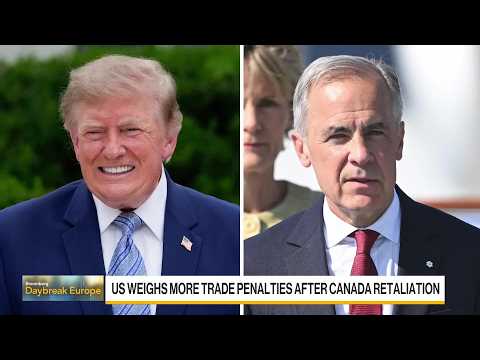
Trump threatens Canada with a 50% tariff, escalating a trade war that could impact U.S. air travel
Fastcompany· 2026-01-30 18:01
Group 1 - President Trump threatened Canada with a 50% tariff on aircraft sold in the U.S. as part of an ongoing trade dispute, following a previous threat of a 100% tariff if Canada proceeded with a trade deal with China [1] - The threat was a response to Canada's refusal to certify jets from Gulfstream Aerospace, with Trump stating that the U.S. would decertify all Canadian aircraft, including those from Bombardier [1] - There are currently 150 Bombardier Global Express aircraft registered in the U.S., operated by 115 operators, highlighting the significance of this market for Bombardier [1] Group 2 - Bombardier has noted the president's threat and is in contact with the Canadian government, asserting that its aircraft meet FAA standards and that it is expanding U.S. operations [1] - The potential decertification of Bombardier aircraft is unprecedented and raises concerns about safety and trade implications, as certification is a critical step for aircraft operation [1] - Other major Canadian aircraft manufacturers include De Havilland Aircraft of Canada and Airbus, which also have significant operations in the U.S. market [1]
Are South Korean ETFs Under Fire Post Trump's 25% Tariff Threat?
ZACKS· 2026-01-27 15:16
Core Insights - U.S. President Donald Trump has threatened to increase tariffs on South Korean imports from 15% to 25%, citing the South Korean National Assembly's failure to ratify a "Historic Trade Agreement" [1][2] Impact on Industries and Companies - The proposed tariff hike targets key sectors of the South Korean economy, specifically automobiles, pharmaceuticals, and lumber, along with other "reciprocal" goods [5] - The automotive industry, which constitutes 27% of South Korea's exports to the U.S., will be significantly impacted, with Hyundai Motor Co. and Kia Corp. being the most exposed [6][7] - Major pharmaceutical companies like Samsung Biologics and Celltrion are also at risk, as their direct exports of biosimilars could be affected by the tariffs [8] - South Korean semiconductor manufacturers, including Samsung Electronics and SK Hynix, are on alert due to the broader "reciprocal" tariff policy, although the impact may be limited [9] Long-Term Outlook for South Korean ETFs - Despite immediate volatility, the long-term outlook for South Korean ETFs is supported by the South Korean government's efforts to address tariff threats through diplomacy and proposed legislation for a $350 billion investment in the U.S. [10][11] - South Korea's diversified export base and strong balance sheets of leading conglomerates provide a more constructive view for the future [12] - The restoration of the 15% tariff cap is anticipated once the National Assembly clarifies the investment timeline, presenting a potential recovery opportunity for investors [13] ETFs to Watch - **iShares MSCI South Korea ETF (EWY)**: Net assets of $11.24 billion, top holdings include Samsung Electronics (26.48%), SK Hynix (18.37%), and Hyundai Motors (3.11%), with a 116.1% increase over the past year [14][15] - **Franklin FTSE South Korea ETF (FLKR)**: Net assets of $316.2 million, top holdings include Samsung Electronics (20.26%), SK Hynix (18.75%), and Hyundai Motors (3.13%), with a 106.5% increase over the past year [16] - **Matthews Korea Active ETF (MKOR)**: Active fund with net assets of $85.9 million, top holdings include Samsung Electronics (24.9%), SK Square (4.6%), and SK Hynix (4.4%), with an 87.5% increase over the past year [17][18]
Stock market today: Dow surges 550 points, S&P 500, Nasdaq jump as Trump backs off Greenland tariff threats
Yahoo Finance· 2026-01-21 21:00
Corporate Developments - Netflix (NFLX) stock declined after the company's quarterly results failed to impress investors, indicating a challenging environment for earnings reports as S&P 500 companies' earnings beats are met with historically poor share-price reactions [6] - A busy earnings season included reports from Johnson & Johnson (JNJ), Charles Schwab (SCHW), and other mid-sized financial institutions, highlighting the mixed performance across sectors [6] Market Reactions - The Dow Jones Industrial Average rose approximately 1.2%, gaining over 550 points, while both the Nasdaq Composite and S&P 500 also increased by about 1.2%, with the S&P 500 turning positive for the year following these gains [2] - Stocks experienced a surge in the afternoon after President Trump's announcement regarding a framework for a deal on Greenland, which alleviated some market fears [3][4]
Markets Are Looking Shaky. How to Ride Out Another Trade War.
Barrons· 2026-01-20 20:05
Group 1 - Renewed tariff fears have triggered a selloff in bonds and most stocks [1] - Gold and silver, along with energy and small-cap stocks, are performing better amid the market turmoil [1]
Why Advance Auto Parts Stock Was Sliding Today
Yahoo Finance· 2026-01-20 19:42
Core Viewpoint - Shares of Advance Auto Parts are experiencing a decline due to a broader market sell-off linked to renewed trade war fears and a lowered price target from a Wall Street analyst [1][4][6] Group 1: Market Context - The S&P 500 index fell by 1.8% amid concerns over President Trump's trade policies, including proposed tariffs on eight European countries, which could provoke retaliatory measures from Europe [3] - Advance Auto Parts, like other auto parts stocks, is exposed to tariff risks, primarily sourcing products from China, Canada, and Mexico [4] Group 2: Company Performance - Despite being a laggard in its sector, Advance Auto Parts reported a comparable sales growth of 3% in the third quarter and raised its full-year bottom-line guidance [5] - The aftermarket auto parts sector typically performs well during economic downturns, which may benefit Advance Auto Parts if a recession occurs [5] Group 3: Analyst Insights - TD Cowen analyst Max Rakhlenko reduced the price target for Advance Auto Parts from $62 to $46, reflecting recent stock pullbacks and adjustments in the hardlines sector [4] - Investors are encouraged to focus on the company's turnaround efforts, with an update expected in early February when fourth-quarter results are released [7]
Markets Reel Amid Geopolitical Tensions, Bitcoin Sees Aggressive Institutional Buying
Stock Market News· 2026-01-20 19:08
Market Overview - U.S. stock markets continued to decline, with the Nasdaq Composite falling 2.00%, S&P 500 futures down 1.6%, and Dow Jones Industrial Average futures dropping 1.5% due to renewed trade war fears linked to President Trump's tariff threats against Europe [2][9] - Citigroup downgraded European equities to neutral, citing concerns over tariff uncertainty affecting earnings, while Asian stocks also declined, reflecting a global risk-off sentiment [3] Cryptocurrency Insights - Bitcoin experienced significant volatility, dropping over 8% to around $89,800, driven by geopolitical tensions and regulatory uncertainty [4][9] - Despite the price drop, institutional investors like MicroStrategy demonstrated strong long-term conviction, acquiring an additional 22,305 bitcoins for approximately $2.13 billion, raising total holdings to 709,715 BTC at an average price of $75,979 [5][9] Corporate Developments - Moody's upgraded Nvidia's senior unsecured rating to AA1, maintaining a positive outlook, reflecting confidence in the company's financial strength and future prospects [6][9] - UK-based brewer Fuller, Smith & Turner PLC completed its initial share buyback program, repurchasing one million shares for £6.25 million and extending the program for an additional one million shares [7][9] Federal Reserve Operations - The Federal Reserve's overnight reverse repo operation saw increased demand, with 16 counterparties taking $3.506 billion, up from $1.222 billion, indicating a key tool for managing liquidity in the financial system [10][9]
[DowJonesToday]Dow Jones Plunges Amid Geopolitical Tensions Over Greenland Tariff Threats
Stock Market News· 2026-01-20 16:09
Market Overview - The Dow Jones Industrial Average declined by 559.24 points (-1.13%) on January 20th, 2026, due to escalating geopolitical tensions and the threat of new tariffs from President Trump on eight NATO allies [1] - Investor confidence was shaken, leading to a sell-off in equities and a shift towards safe-haven assets like gold and silver [1] Company Performance - Technology and industrial stocks were significantly affected, with 3M Company (MMM) experiencing the largest drop at -6.50%, influenced by post-earnings movements [2] - IBM (IBM) also faced a notable decline of -4.47%, while Nvidia (NVDA) and Amazon (AMZN) fell by -2.57% and -1.77% respectively, indicating a broader sell-off among major tech firms [2] Resilient Stocks - Despite the overall market downturn, some Dow components showed gains, with UnitedHealth Group (UNH) rising by +1.05% [3] - Travelers Companies (TRV) increased by +0.71%, and Procter & Gamble (PG) gained +0.70%, demonstrating resilience in a challenging market [3] - Boeing (BA) and Nike (NKE) also recorded modest increases of +0.14% each, highlighting pockets of strength amidst the decline [3]
Trump's battle for Greenland: Why the stock market hates it all
Yahoo Finance· 2026-01-20 14:58
Market Reaction - The stock market is experiencing significant losses, with the Dow Jones Industrial Average, S&P 500, and Nasdaq Composite all suffering heavy declines, prompting investors to seek safe-haven assets like gold [2] Tariff Announcement - President Trump announced a 10% tariff on eight European countries, which will escalate to 25% in June unless the U.S. gains control of Greenland, affecting key trading partners such as the UK and Germany [3] Trade Tensions - The recent escalation in transatlantic tensions and tariff uncertainty is expected to negatively impact the near-term investment outlook for European equities, leading to a downgrade of continental Europe to Neutral for the first time in over a year [6] Sector Impact - The uncertainty surrounding tariffs has led to a downgrade of "internationally exposed" sectors, particularly in autos and chemicals, due to the potential negative effects on earnings per share (EPS) growth in 2026 [6] Analyst Commentary - Analysts, including those from Citi, suggest that the latest tariff developments will have lasting implications and should be considered in the context of global stock markets [5]