Value Function

Search documents
Ilya Sutskever 重磅3万字访谈:AI告别规模化时代,回归“研究时代”的本质
创业邦· 2025-11-27 03:51
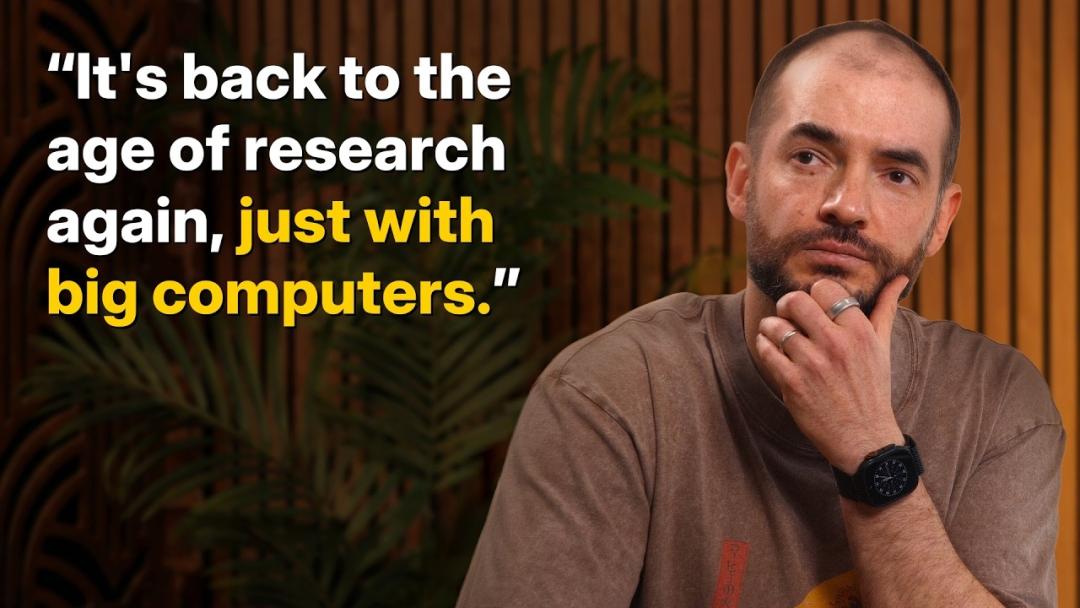
Core Insights - The AI industry is transitioning from a "Scaling Era" back to a "Research Era," emphasizing fundamental innovation over mere model size expansion [4][7][40]. - Current AI models exhibit high performance in evaluations but lack true generalization capabilities, akin to students who excel in tests without deep understanding [10][25]. - SSI's strategy focuses on developing safe superintelligence without commercial pressures, aiming for a more profound understanding of AI's alignment with human values [15][16]. Group 1: Transition from Scaling to Research - The period from 2012 to 2020 was characterized as a "Research Era," while 2020 to 2025 is seen as a "Scaling Era," with a return to research now that computational power has significantly increased [4][7][40]. - Ilya Sutskever argues that simply scaling models will not yield further breakthroughs, as the data and resources are finite, necessitating new learning paradigms [7][39]. Group 2: Limitations of Current Models - Current models are compared to students who have practiced extensively but lack the intuitive understanding of true experts, leading to poor performance in novel situations [10][25]. - The reliance on pre-training and reinforcement learning has resulted in models that excel in benchmarks but struggle with real-world complexities, often introducing new errors while attempting to fix existing ones [20][21]. Group 3: Pursuit of Superintelligence - SSI aims to avoid the "rat race" of commercial competition, focusing instead on building a safe superintelligence that can care for sentient life [15][16]. - Ilya emphasizes the importance of a value function in AI, akin to human emotions, which guides decision-making and learning efficiency [32][35]. Group 4: Future Directions and Economic Impact - The future of AI is predicted to be marked by explosive economic growth once continuous learning challenges are overcome, leading to a diverse ecosystem of specialized AI companies [16][18]. - Ilya suggests that human roles may evolve to integrate with AI, maintaining balance in a world dominated by superintelligent systems [16][18].


AI 顶尖科学家、前 OpenAI 联创 Ilya Sutskever 的 18 个最新思考
Founder Park· 2025-11-26 13:06
Group 1 - The era of scaling is over, and the focus has shifted to research, emphasizing the importance of model generalization over mere computational power [4][8][34] - Emotional value functions are expected to play a crucial role in future AI developments, enhancing the efficiency of reinforcement learning [10][14][18] - The generalization ability of current models is still significantly inferior to that of humans, raising fundamental questions about AI's learning capabilities [13][19][25] Group 2 - The current models exhibit a "zigzag" capability, performing well in evaluations but struggling with real-world applications, indicating a disconnect between training and practical performance [27][30] - Companies that continue to pursue a scaling strategy may generate substantial revenue but could face challenges in achieving profitability due to intense competition [34][35] - The deployment of AI on a large scale could potentially lead to rapid economic growth, although the exact pace of this growth remains uncertain [35] Group 3 - Good research taste is essential, requiring a multi-faceted approach to identify beauty and simplicity in AI development [36][38] - The ultimate goal for AI development should be to create systems that genuinely care for and perceive life, rather than merely focusing on self-evolving AI [39][43] - The timeline for achieving superintelligence is projected to be within the next 5 to 20 years, contingent on advancements in understanding reliable generalization [44][46] Group 4 - SSI's current focus is on research, with plans to gradually deploy AI while ensuring that the first products released are meaningful and impactful [50][56] - SSI differentiates itself through a unique technical approach, aiming to create AI that is aligned with human values and capable of meaningful interaction [58]

房间里的大象:Ilya挑明AI的“高分低能”,呼吁要从研究到scale到再重回研究时代|Jinqiu Select
锦秋集· 2025-11-26 07:01
Core Insights - The article discusses the transition from the "scaling era" to a "research era" in AI development, emphasizing the need for innovative paradigms that enhance generalization capabilities and economic properties of models [6][11][59]. Group 1: Model Performance and Limitations - Current AI models exhibit high performance in evaluations but lag in real-world economic impact, indicating a disconnect between evaluation metrics and practical applications [17][18]. - Models can perform impressively in one context but fail in another, often due to overfitting to evaluation criteria rather than generalizing to real-world tasks [19][22]. - The phenomenon of "reward hacking" is highlighted, where researchers design training environments that prioritize evaluation scores over real-world applicability [24][25]. Group 2: The Need for Paradigm Shift - The article argues for a return to a research-focused approach to address fundamental issues of generalization in AI, moving away from merely scaling existing models [6][11][59]. - The scaling dilemma is discussed, where the focus on increasing compute and data may not yield transformative results without innovative research [57][59]. - The importance of understanding the underlying mechanisms of human learning and decision-making is emphasized, suggesting that AI should incorporate similar principles [73][75]. Group 3: Human Learning vs. AI Learning - Human learning is characterized by high sample efficiency and the ability to learn from minimal data, contrasting sharply with current AI models that require extensive data [66][70]. - The article posits that human learning mechanisms, such as continual learning and robust self-correction, are not adequately replicated in AI systems [72][74]. - The discussion includes the role of emotions and value functions in human decision-making, which are often overlooked in AI development [51][53]. Group 4: Future Directions and Research Focus - The article suggests that the future of AI research should focus on developing models that can learn and adapt in real-world environments, rather than just optimizing for specific tasks [97][99]. - The potential for rapid economic growth driven by AI deployment is acknowledged, but the complexities of this growth are also highlighted [100]. - The need for a robust alignment of AI systems with human values and the importance of gradual deployment strategies are emphasized as critical for the safe development of superintelligent AI [103][106].

Ilya罕见发声:大模型“大力出奇迹”到头了
3 6 Ke· 2025-11-26 06:54
Core Insights - The core viewpoint is that AI is transitioning from a "scaling era" back to a "research era," as stated by Ilya Sutskever, highlighting the limitations of the current "pre-training + scaling" approach and the need to refocus on the reconstruction of research paradigms [1][51][53]. Group 1: AI Development Trends - The mainstream "pre-training + scaling" approach is encountering significant bottlenecks, suggesting a shift in focus towards the fundamental research paradigms [1][51]. - The period from 2012 to 2020 is characterized as the research era, while 2020 to 2025 is seen as the scaling era, indicating a cyclical nature in AI development [52][53]. - There is skepticism about whether merely increasing scale will lead to transformative changes, as the industry is returning to a research-focused mindset with access to powerful computational resources [53][70]. Group 2: Model Performance and Generalization - Current AI models exhibit a significant gap between their performance in evaluations and their practical economic impact, raising questions about their generalization capabilities [12][56]. - The models' tendency to oscillate between errors during tasks suggests a lack of awareness and adaptability, which may stem from overly focused reinforcement learning training [15][16]. - The discussion emphasizes that the generalization ability of these models is far inferior to that of humans, which is a critical and challenging issue in AI development [56][60]. Group 3: Future Directions in AI Research - The future of AI research may involve exploring new methods such as "reinforcement pre-training" or other distinct paths, as the limitations of data availability in pre-training become apparent [51][70]. - The importance of value functions in enhancing reinforcement learning efficiency is highlighted, suggesting that understanding and utilizing these functions could lead to significant improvements in model performance [55][66]. - The need for a paradigm shift in how models are trained is emphasized, focusing on the efficiency of learning mechanisms rather than solely on data and scale [64][67]. Group 4: Economic Implications of AI Deployment - The potential for rapid economic growth driven by the deployment of AI systems capable of learning and executing tasks efficiently is discussed, with varying predictions on the extent of this growth [96][97]. - The role of regulatory frameworks in shaping the pace and nature of AI deployment is acknowledged, indicating that different countries may experience varying growth rates based on their regulatory approaches [97][98]. - The conversation suggests that the deployment of advanced AI could lead to unprecedented changes in economic structures and societal interactions, necessitating careful planning and consideration of safety measures [99][100].
Ilya 离开 OpenAI 后的首期播客,久违地被人类智慧安慰到了 | 42章经
42章经· 2025-11-26 05:14
Core Insights - The article discusses the insights shared by Ilya regarding the future of AI and the development of superintelligence, emphasizing a shift back to research-focused approaches after a period of scaling [3][5]. Group 1: Era Transition - Ilya outlines a clear timeline for the evolution of AI, indicating that the period from 2012 to 2020 was focused on research, while 2020 to 2025 is characterized by scaling, particularly after the emergence of GPT-3. He predicts that from 2025 onwards, the limitations of pre-training scaling laws will necessitate a return to research-focused methodologies [5]. Group 2: SSI's Strategy - Ilya's company, SSI (Safe Superintelligence), plans to focus on developing superintelligence without intermediate products, aiming to avoid market distractions that lead to compromises in quality [3][4]. Group 3: Learning Mechanisms - Ilya emphasizes the importance of developing a value function in AI, which allows for more intuitive learning processes similar to human decision-making. He believes that breakthroughs in this area could significantly enhance AI efficiency [6][10]. Group 4: Reinforcement Learning (RL) Insights - Ilya presents a contrarian view on RL, suggesting that it may hinder the capabilities of models by forcing them to conform to narrow human-defined metrics, potentially sacrificing broader intelligence [7][8]. He also notes that RL is becoming more resource-intensive than pre-training, indicating a shift in the industry's focus [8]. Group 5: Empathy and AI - Ilya argues that empathy could be a crucial element in developing superintelligence, proposing that AI should be designed to care for sentient life, akin to how human evolution has hardcoded empathy into our brains [13][14][19]. Group 6: Language and Research Direction - The language used in the AI field can shape research directions, with terms like AGI and scaling influencing the focus of development. Ilya warns against the overemphasis on these buzzwords, which may lead to neglecting other important aspects of intelligence [20][22]. Group 7: Market Dynamics - Ilya predicts that the future AI market will not be dominated by a single entity but will instead feature specialization, where companies focus on specific applications, creating a balanced ecosystem similar to biological evolution [22].

Ilya两万字最新访谈:人类的情感并非累赘,而是 AI 缺失的“终极算法”
3 6 Ke· 2025-11-26 04:26
Core Insights - The discussion centers on the limitations of current AI models and the new pathways toward superintelligence, emphasizing the disconnect between model performance in evaluations and real-world applications [3][4][20] - Ilya Sutskever highlights the need to transition back to a research-focused paradigm, moving away from mere scaling of models, as the diminishing returns of scaling become evident [3][34] - The concept of a "value function" is introduced as a critical element that enables human-like learning efficiency, which current AI lacks [3][5][6] Group 1: Current AI Limitations - Current AI models perform well in evaluation tests but often make basic errors in practical applications, indicating a lack of true understanding and generalization [4][18][20] - The over-optimization of reinforcement learning (RL) for evaluations has led to models that excel in competitive programming but struggle with real-world problem-solving [4][21] - Sutskever compares AI models to competitive programmers who are skilled in solving specific problems but lack the broader intuition and creativity of more versatile learners [4][22] Group 2: Human Learning Insights - Human learning is characterized by high sample efficiency, allowing individuals to learn complex skills with minimal data, attributed to innate value functions that guide decision-making [5][6][40] - The evolutionary advantages in human learning, particularly in areas like vision and motor skills, suggest that humans possess superior learning algorithms compared to current AI systems [5][38] - The discussion emphasizes the importance of emotional and intuitive feedback in human learning, which AI currently lacks [6][30][31] Group 3: Strategic Directions for SSI - Ilya Sutskever's new company, SSI, aims to explore safe superintelligence, advocating for a gradual release of AI capabilities to raise public awareness about safety [7][52] - The shift from a secretive development approach to a more transparent, gradual release strategy is seen as essential for fostering a collaborative safety environment [7][52] - SSI's focus on research over immediate market competition is intended to prioritize safety and ethical considerations in AI development [52][54] Group 4: Research Paradigm Shift - The transition from an era of scaling (2020-2025) back to a research-focused approach is necessary as the limits of scaling become apparent [34][46] - Sutskever argues that while scaling has been beneficial, it has also led to a homogenization of ideas, necessitating a return to innovative research [34][46] - The need for a more efficient use of computational resources in research is highlighted, suggesting that breakthroughs may come from novel approaches rather than sheer scale [35][46]