
纺织服装

Search documents
2025年服装行业词条报告
Tou Bao Yan Jiu Yuan· 2025-10-13 13:50
Investment Rating - The report provides a positive investment rating for the apparel industry, highlighting growth potential driven by government support, competitive pricing, and market expansion opportunities [4]. Core Insights - The apparel industry is undergoing a transformation characterized by the integration of technology and fashion, with e-commerce and live-streaming commerce significantly boosting market growth [4]. - China's apparel exports are expected to grow due to favorable government policies, price advantages, and competitive quality in the global market [4]. Industry Definition - The apparel industry encompasses clothing, footwear, and accessories, serving functions such as protection, decoration, and identification [5]. - Apparel can be categorized by gender into men's and women's clothing, each with distinct design and functional characteristics [6]. Industry Characteristics - High raw material costs dominate the cost structure, with raw materials accounting for 76.1% of costs in upstream suppliers and 60% in midstream manufacturing [6][7]. - The export market is diversified, with growth in traditional markets like the US and EU, while emerging markets show mixed results [7]. - The industry exhibits strong cyclicality, with retail sales closely tied to economic growth rates [8]. Development History - The apparel industry in China has evolved through four key stages: industrialization, OEM rise, globalization, and brand and technology upgrades, currently transitioning into a phase driven by national pride and technological innovation [9]. Industry Chain Analysis - The apparel industry chain includes upstream raw material production, midstream manufacturing, and downstream brand sales, with varying levels of bargaining power across segments [14][15]. - Midstream manufacturers face challenges in negotiating with upstream suppliers due to industry fragmentation, leading to lower average profit margins [15]. - Labor cost increases are prompting a shift of the apparel supply chain to Southeast Asian countries [16]. Market Size and Growth - The apparel market size grew from 1,918.03 billion RMB in 2019 to 2,074.29 billion RMB in 2023, with a projected CAGR of 2.15% from 2024 to 2028 [36]. - E-commerce penetration and live-streaming commerce are key drivers of market growth, with significant increases in online shopping users [38][39]. Export Market Dynamics - China's apparel exports are benefiting from a recovery in overseas demand due to loose monetary policies and economic recovery in major markets [40]. - The export market is characterized by structural differentiation, with varying performance across different regions and product categories [40]. Policy Support - Government policies aimed at upgrading the industry and promoting digitalization and innovation are expected to drive future growth in the apparel sector [41][42]. - The competitive pricing of Chinese apparel products is anticipated to enhance export growth, particularly in the context of rising demand for affordable quality products in international markets [42].

电力服务升级“一键三连” 赋能石狮产业焕新
Xin Hua Cai Jing· 2025-10-13 06:43
Core Viewpoint - The textile and apparel industry in Shishi City is undergoing a transformation towards green and intelligent development, supported by innovative electricity services that enhance the operational efficiency of enterprises [1]. Group 1: Electricity Service Innovations - The Shishi Power Supply Company has improved the electricity service process for enterprises in the Jinshang Intelligent Manufacturing Park, allowing companies to enjoy power supply services from the moment they enter the park, thus saving time and effort [2]. - A new cost-sharing mechanism for electricity connection has been implemented, significantly reducing the electricity costs for companies, with one company saving approximately 500,000 yuan [2]. Group 2: Green Energy Initiatives - The development of distributed photovoltaic systems is becoming a key method for companies in Shishi to promote green transformation, with the local power supply company providing clear guidelines and support for project registration and grid connection [3]. - The preparation time for project registration materials has been significantly reduced due to the detailed guidelines provided by the power supply company, enabling companies to create better implementation plans and lower overall costs [3]. Group 3: Smart Upgrade Support - The Shishi Power Supply Company has introduced a "dual manager system" for key projects, enhancing service quality and responsiveness to electricity demands, exemplified by a company that received a customized transformer capacity increase [4]. - The installation of a new 2000 kVA transformer for a company has reduced the electricity connection time by 40%, facilitating the smooth progress of their "5G smart factory" project [4].
双节期间,消费表现出现分化
Ping An Securities· 2025-10-13 04:57
Investment Rating - The industry investment rating is "stronger than the market," indicating an expected performance exceeding the market by more than 5% within the next six months [34]. Core Insights - The consumer sector showed mixed performance during the recent holiday period, with certain segments like textiles and apparel outperforming the market, while others like media and consumer services lagged [3][8]. - The overall market remains stable, with expectations for improved consumer demand due to macroeconomic policies and increased liquidity [3]. - The travel and tourism sector experienced significant growth, with domestic travel reaching 8.88 billion person-trips and generating revenue of 809 billion yuan during the holiday [11]. - The beauty market is evolving, with domestic brands gaining traction as they respond quickly to consumer needs [4]. - The food and beverage sector, particularly high-end liquor, is expected to maintain strong demand, while non-premium products face challenges [5][22]. Summary by Sections Market Overview - The A-share market saw a slight decline, with the CSI 300 index down by 0.51% during the week of October 6-10 [3][8]. - The textile and apparel sector rose by 1.67%, while consumer services and media sectors fell by 2.81% and 3.58%, respectively [3][8]. Social Services - The travel sector benefited from increased travel during the holiday, with a notable rise in both domestic and outbound tourism [11]. - Recommendations include focusing on OTA platforms and leading hotel groups that are likely to benefit from the travel surge [4]. Food and Beverage - The holiday period saw a 41.1% increase in jewelry sales, driven by rising gold prices and consumer spending [4][18]. - The liquor market is characterized by a clear divide between premium and non-premium products, with premium brands expected to gain market share [5][22]. Retail and Consumer Goods - Retail sales during the holiday period showed positive growth, with specific categories like organic food and national brands performing particularly well [18]. - Major retail players reported significant sales increases, with some achieving over 40% growth in specific categories [14]. Media and Entertainment - The film industry faced challenges during the holiday, with total box office receipts down 13% year-on-year [5][20]. - Companies with strong IP reserves in gaming and film are recommended for investment [5]. Key Company Updates - Companies like Huazhu Group and Ctrip reported significant increases in guest numbers and bookings during the holiday, indicating strong performance in the hospitality sector [12]. - Retailers such as Chongqing Department Store and Pinduoduo saw substantial sales growth, highlighting the effectiveness of targeted marketing strategies [14].
海关总署:前三季度我国对共建国家进出口同比增长6.2%
Xin Hua Cai Jing· 2025-10-13 03:13
Core Insights - In the first three quarters, China's import and export to countries involved in the Belt and Road Initiative reached 17.37 trillion yuan, a year-on-year increase of 6.2%, surpassing the overall growth rate of China's imports and exports by 2.2 percentage points [1] Import Data - Among the bulk commodity imports, 64.6% came from countries involved in the Belt and Road Initiative, an increase of 1.1 percentage points compared to the same period last year [1] - The value of agricultural product imports from these countries accounted for 69.1%, rising by 3.1 percentage points year-on-year [1] Export Data - Exports of electronic information products to Belt and Road countries increased by 16.6%, high-end equipment by 37%, and wind turbine generators by 58% [1] - Exports of essential goods such as textiles, clothing, food, furniture, and automobiles also saw growth [1]
ETF日报-A股三大股指全线收跌,规模最大化工ETF(159870)获资金逆市布局,净申购超6亿份,连续四个交易日实现资金净流入
Xin Lang Cai Jing· 2025-10-13 01:30
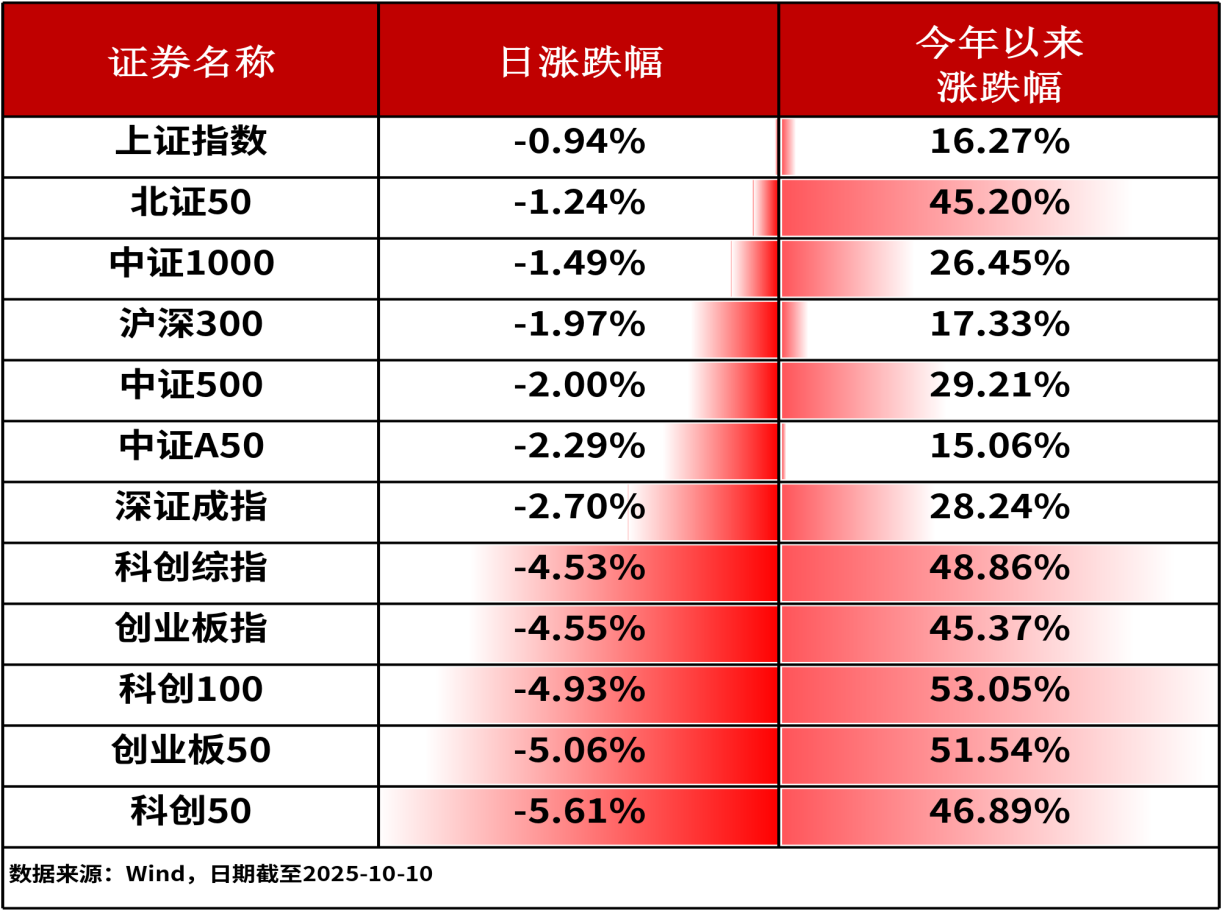
Market Overview - On October 10, A-shares saw all three major indices decline, with the Shanghai Composite Index down 0.94%, the Shenzhen Component Index down 2.70%, and the ChiNext Index down 4.55% [1] - The STAR 50 Index experienced the largest drop at 5.61% [1] - Approximately 2,770 stocks in the market rose, while the total trading volume in the Shanghai and Shenzhen markets was 25,156 billion RMB, showing a slight decrease compared to the previous trading day [1] - The financing balance reached a new high of 24,257 billion RMB on October 10 [1] Index Performance - The daily and year-to-date performance of major indices is as follows: - Shanghai Composite Index: -0.94%, +16.27% YTD - Shenzhen Component Index: -2.70%, +28.24% YTD - ChiNext Index: -4.55%, +45.37% YTD - STAR 50 Index: -5.61%, +46.89% YTD [2] Sector Performance - The top-performing sectors included: - Building Materials: +1.92% - Coal: +1.37% - Textile and Apparel: +1.30% - The sectors with the largest declines were: - Electronics: -4.71% - Electrical Equipment: -4.46% - Computers: -3.70% [6] Fund Flow Analysis - On the previous trading day, the ETF market saw a significant net inflow of 27.956 billion RMB, primarily driven by stock ETFs, which accounted for 27.461 billion RMB of the inflow [7] - The inflow for thematic ETFs was particularly strong at 18.658 billion RMB, while broad-based and sector ETFs saw inflows of 5.180 billion RMB and 4.120 billion RMB, respectively [8] - Notably, the semiconductor chip ETF and the STAR 50 ETF were among the top beneficiaries of fund inflows, receiving 7.077 billion RMB and 5.857 billion RMB, respectively [9] Industry Insights - In the chemical sector, a new policy aims for an average annual growth of over 5% in the value added of the petrochemical industry from 2025 to 2026, which could improve the long-term supply-demand dynamics and profitability of cyclical products [10] - In the livestock sector, there is an increasing expectation of a market reversal as the price of live pigs decreased by 4.6% in late September, prompting analysts to recommend focusing on high-quality pig farming companies with strong financials [11] - The insurance sector reported a 2.4% year-on-year increase in health insurance premium income, indicating potential for recovery in insurance stocks following a period of adjustment [12]

机构重点锁定:算力+具身智能+固态电池+芯片
Zheng Quan Shi Bao· 2025-10-12 23:52
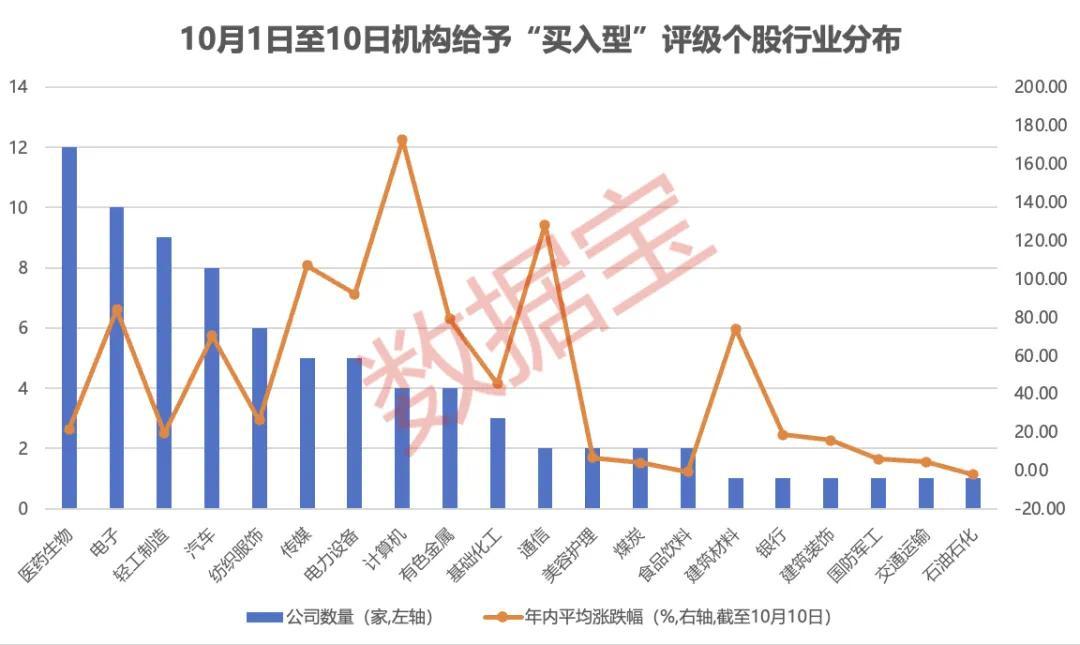
Core Insights - During the National Day and Mid-Autumn Festival holiday, 28 institutions conducted 90 "buy" ratings covering 80 stocks, indicating strong institutional interest in the market [1] Industry Distribution - The 80 stocks are distributed across 20 industries, with the pharmaceutical, electronics, automotive, and textile sectors having the highest representation, each with no fewer than 5 stocks [2] Pharmaceutical Sector - The pharmaceutical sector has 12 stocks under institutional coverage, including several innovative drug companies. The total scale of China's innovative drug licensing transactions reached $61.8 billion in the first half of the year, surpassing the record of $51.9 billion for the entire year of 2024, indicating increased global recognition of Chinese innovative drugs [5] - As a benchmark for Chinese innovative drug companies, BeiGene is expected to achieve profitability by 2025, marking its transition from a research investment phase to a commercialization phase [5] Electronics Sector - The electronics sector has 10 stocks under institutional coverage, focusing on chips and large models. The demand for global computing power, storage, and high-speed connectivity is entering an exponential growth phase, benefiting key areas such as AI server manufacturing and optical communication [5] Textile and Apparel Sector - The textile and apparel sector has 6 stocks under institutional coverage, including segments like gold jewelry and clothing. The industry has seen numerous brand activities, with outdoor brands continuing to grow rapidly due to effective cost management [6] - The demand for gold jewelry is expected to remain strong due to rising gold prices and the consumption peak season [6] Notable Stocks - Among the stocks receiving "buy" ratings, 7 stocks have garnered attention from 2 or more institutions, including BYD, Seres, and New Australia Holdings, which received attention from 3 institutions [7] - New Australia Holdings benefits directly from the rising prices of Australian wool, with the Eastern Market Composite Index increasing by 7.7% month-on-month and 41.8% year-on-year [10] - Xizi Clean Energy has also received attention from 2 institutions, with a strong recommendation based on its innovative solar thermal power technology [10] Technology Sector - 18 companies involved in popular technology fields such as computing power, artificial intelligence, and semiconductors have received "buy" ratings. Notable performers include Kaipu Cloud and Chip Origin, with year-to-date gains exceeding 100% [13] - Chip Origin, a leading semiconductor IP service provider, expects significant revenue growth, with a projected 145.8% year-on-year increase in new orders by Q3 2025 [14] Institutional Research - Four companies have received over 100 institutional research inquiries this year, indicating strong interest and confidence in their growth potential [15]


消费中观策略、投资建议:关注景气修复中特估
SINOLINK SECURITIES· 2025-10-12 13:59
Consumer Macro Strategy - The report highlights three major events that influenced consumer market trends over the past two weeks, including stable growth in overall consumption during the Mid-Autumn and National Day holidays, with a notable increase in outbound tourism but fewer domestic consumption highlights leading to a post-holiday decline in related sectors [3][10] - The Q3 earnings preview indicates that while the overall consumer service sector remains stable compared to Q2, consumption-related products face high base pressure in Q4, and other sectors are in a positioning phase after negative earnings surprises in Q3 [3][10] - The ongoing US-China technological competition is expanding into the consumer sector, with new tariffs announced by the US on imports from China, posing challenges for export-oriented consumer companies [3][10] New Consumption Manufacturing - The two-wheeler market showed strong performance in Q3, with healthy inventory levels in downstream channels, but the industry faces a critical test in Q1 2026 [21] - The pet industry is experiencing weaker performance in the off-season, but the upcoming Double Eleven shopping festival is expected to act as a catalyst [21] Light Industry Manufacturing - In the home furnishing sector, domestic demand remains weak due to unhealed real estate issues, while external demand faces increased tariff risks, with significant tariff hikes announced by the US [24] - The new tobacco sector is seeing intensified actions against illegal e-cigarettes in the US, benefiting legitimate brands, while HNB products maintain strong production schedules in Japan and Europe [27] - The packaging paper market is experiencing a bullish sentiment with frequent price increases expected [27] Textile and Apparel - The apparel retail sector showed a year-on-year growth of 3.1% in August, but sales weakened in September and during the National Day holiday due to weather conditions and timing changes [29] - The report suggests focusing on brands with unique market positions and those showing significant performance advantages in sub-sectors [29][30] Beauty and Personal Care - The beauty sector is recovering after a previous decline, with cosmetic retail sales increasing by 5.1% year-on-year in August, indicating a positive trend [31] - Recommendations include focusing on leading brands with strong performance and those undergoing successful reforms [31] Home Appliances - TV panel prices remained stable in early October, with various sizes maintaining consistent pricing [32] - Gree Electric's new product line aims to capture the online market segment, enhancing its competitive position [32][33] Retail and E-commerce - Offline retail shows signs of stabilization, with supermarkets performing well while department stores face slight pressure [34] - The jewelry sector is benefiting from rising gold prices, enhancing consumer acceptance and brand premium capabilities [34] Social Services - The report expresses optimism for high-value dining and the recovery of mid-to-high-end restaurants, alongside stable growth in tourism and education sectors [35] - The tea beverage market is expected to see a decline in performance due to policy impacts, with leading brands like Mixue Ice City and Gu Ming showing growth potential [36]
家用电器:假期消费专题:出境游、线下演出高景气——25W40周观点-20251012
Huafu Securities· 2025-10-12 10:11
Investment Rating - The report maintains an "Outperform" rating for the industry [7] Core Insights - The report highlights a significant increase in holiday travel and consumption, with an average of 3.04 billion people traveling daily from October 1 to 8, a year-on-year increase of 6.3% [3][11] - Domestic consumption is showing steady improvement, with average daily sales in related sectors increasing by 4.5% during the holiday period, driven by strong performance in digital products, jewelry, and cultural services [3][15] - The offline performance of the entertainment sector is robust, with a 39.5% year-on-year increase in audience numbers for live performances during the holiday [3][20] Summary by Sections Holiday Consumption Trends - The report notes a rise in domestic travel, with 8.88 billion domestic trips taken during the holiday, an increase of 1.23 billion trips compared to the previous year [11][12] - The average spending per person decreased by 13% despite the increase in total expenditure, which reached 809 billion yuan [11][12] Retail and E-commerce Performance - Key retail and catering enterprises saw a 2.7% year-on-year increase in sales during the holiday [19] - E-commerce platforms experienced a surge in sales of green organic foods (up 27.9%), smart home products (up 14.3%), and domestic fashion brands (up 14.1%) [19][20] Investment Recommendations - The report suggests focusing on several sectors for potential investment, including: 1. Major appliances benefiting from trade-in programs, recommending companies like Midea Group, Haier Smart Home, and Gree Electric [4][23] 2. The pet industry, which is expected to remain resilient, with recommendations for companies like Guai Bao Pet and Zhongchong Co [4][23] 3. Small appliances and branded apparel, which may see a rebound in demand, with recommendations for companies like Bear Electric and Anta Sports [4][23] 4. Electric two-wheelers, with a strong outlook for domestic sales improvement, recommending companies like Ninebot and Yadea [4][23] Global Market Opportunities - The report emphasizes the long-term theme of international expansion, recommending companies like Ecovacs and Roborock in the cleaning appliance sector, and Midea and Haier in the major appliance sector [5][24] - It also highlights the potential for motorcycle brands to increase their market share overseas, suggesting companies like Chunfeng Power and Longxin General [5][24] Market Data - The home appliance sector saw a slight decline of 0.4% this week, with specific segments showing varied performance: white goods up 0.8%, black goods down 0.3%, and kitchen appliances down 1.0% [25]





券商评级一周速览:61只个股获券商关注,珂玛科技目标涨幅达23.14%
Mei Ri Jing Ji Xin Wen· 2025-10-12 06:57
Group 1 - A total of 61 stocks received ratings from brokers between October 5 and October 11, with 36 stocks receiving a "buy" rating [1] - The stocks with the highest expected price increases based on the latest closing prices are Kema Technology (301611.SZ) at 23.14%, WuXi AppTec (603259.SH) at 15.45%, and Silis (601127.SH) at 15.18% [1] - The stocks that received attention from multiple brokers include Goldwind Technology (002202.SZ), Silis (601127.SH), and WuXi AppTec (603259.SH) [1] Group 2 - The industries with the highest number of stocks receiving broker attention are light industry manufacturing, textile and apparel, and automotive [2]



市场呈现大市值风格,机构调研组合超额收益显著:——量化组合跟踪周报20251011-20251011
EBSCN· 2025-10-11 10:50
Quantitative Models and Construction - **Model Name**: PB-ROE-50 **Model Construction Idea**: The model combines Price-to-Book ratio (PB) and Return on Equity (ROE) to construct a stock selection strategy[25] **Model Construction Process**: The PB-ROE-50 model selects stocks based on their PB and ROE metrics. Stocks with favorable PB and ROE values are included in the portfolio. The model uses a monthly rebalancing approach to optimize the portfolio[25][26] **Model Evaluation**: The model demonstrates positive excess returns in most stock pools, indicating its effectiveness in capturing value and profitability factors[25][26] - **Model Name**: Institutional Research Tracking Strategy **Model Construction Idea**: This strategy leverages institutional research activities (public and private) to identify stocks with potential excess returns[27] **Model Construction Process**: The strategy tracks stocks that are frequently researched by public and private institutions. Stocks with higher research frequency are included in the portfolio. The portfolio is rebalanced periodically to reflect updated research trends[27][28] **Model Evaluation**: The strategy shows consistent positive excess returns, suggesting that institutional research activities can be a reliable indicator for stock selection[27][28] - **Model Name**: Block Trade Strategy **Model Construction Idea**: The strategy identifies stocks with high block trade activity and low volatility to construct a portfolio[31] **Model Construction Process**: Stocks are selected based on two criteria: high block trade transaction ratios and low 6-day transaction volatility. The portfolio is rebalanced monthly to maintain these characteristics[31][32] **Model Evaluation**: The strategy has mixed results, with negative excess returns in the recent 2-week period, but positive performance over the year[31][32] - **Model Name**: Directed Issuance Strategy **Model Construction Idea**: The strategy focuses on stocks involved in directed issuance events to capture potential investment opportunities[36] **Model Construction Process**: Stocks are selected based on the announcement date of directed issuance events. The strategy considers market capitalization, rebalancing frequency, and position control to construct the portfolio[36][37] **Model Evaluation**: The strategy shows negative excess returns in the recent 2-week period, raising questions about its effectiveness under current market conditions[36][37] Model Backtesting Results - **PB-ROE-50 Model**: - Excess return in CSI 500: -0.82% - Excess return in CSI 800: 1.45% - Excess return in the entire market: 0.75%[25][26] - **Institutional Research Tracking Strategy**: - Public research excess return: 1.03% - Private research excess return: 1.89%[27][28] - **Block Trade Strategy**: - Excess return relative to CSI All Index: -0.57%[31][32] - **Directed Issuance Strategy**: - Excess return relative to CSI All Index: -1.13%[36][37] Quantitative Factors and Construction - **Factor Name**: Liquidity Factor **Factor Construction Idea**: Measures the liquidity of stocks to identify those with higher trading activity[20] **Factor Construction Process**: The liquidity factor is calculated using metrics such as turnover rate and trading volume. Stocks with higher liquidity scores are assigned positive weights[20] **Factor Evaluation**: The factor shows positive returns in the recent 2-week period, indicating its effectiveness in capturing market liquidity trends[20] - **Factor Name**: Leverage Factor **Factor Construction Idea**: Evaluates the financial leverage of companies to identify those with higher risk-adjusted returns[20] **Factor Construction Process**: The leverage factor is derived from financial ratios such as debt-to-equity and interest coverage. Companies with optimal leverage levels are favored[20] **Factor Evaluation**: The factor demonstrates positive returns, suggesting its utility in identifying financially stable companies[20] - **Factor Name**: Profitability Factor **Factor Construction Idea**: Captures the profitability of companies to identify those with strong earnings performance[20] **Factor Construction Process**: The profitability factor is calculated using metrics such as ROE, ROA, and net profit margin. Stocks with higher profitability metrics are given positive weights[20] **Factor Evaluation**: The factor shows positive returns, indicating its effectiveness in identifying profitable companies[20] - **Factor Name**: Valuation Factor **Factor Construction Idea**: Measures the relative valuation of stocks to identify undervalued opportunities[20] **Factor Construction Process**: The valuation factor is derived from metrics such as Price-to-Earnings (P/E) and Price-to-Book (P/B) ratios. Stocks with lower valuation scores are assigned positive weights[20] **Factor Evaluation**: The factor demonstrates positive returns, supporting its use in identifying undervalued stocks[20] - **Factor Name**: Non-linear Market Capitalization Factor **Factor Construction Idea**: Captures the non-linear relationship between market capitalization and stock returns[20] **Factor Construction Process**: The factor is constructed using a non-linear transformation of market capitalization data. Stocks with optimal market capitalization are assigned positive weights[20] **Factor Evaluation**: The factor shows positive returns, indicating its ability to capture market capitalization trends effectively[20] - **Factor Name**: Beta Factor **Factor Construction Idea**: Measures the sensitivity of a stock's returns to market movements[20] **Factor Construction Process**: The beta factor is calculated using historical return data and market indices. Stocks with lower beta values are assigned positive weights[20] **Factor Evaluation**: The factor shows negative returns, suggesting its limited effectiveness in the current market environment[20] - **Factor Name**: Residual Volatility Factor **Factor Construction Idea**: Evaluates the idiosyncratic risk of stocks to identify those with stable performance[20] **Factor Construction Process**: The residual volatility factor is derived from the standard deviation of residuals in a regression model of stock returns against market returns[20] **Factor Evaluation**: The factor shows negative returns, indicating its limited utility in the recent market conditions[20] - **Factor Name**: Growth Factor **Factor Construction Idea**: Captures the growth potential of companies based on their financial performance[20] **Factor Construction Process**: The growth factor is calculated using metrics such as revenue growth and earnings growth. Stocks with higher growth rates are assigned positive weights[20] **Factor Evaluation**: The factor shows negative returns, suggesting its limited effectiveness in the current market environment[20] Factor Backtesting Results - **Liquidity Factor**: Return: 0.36%[20] - **Leverage Factor**: Return: 0.34%[20] - **Profitability Factor**: Return: 0.27%[20] - **Valuation Factor**: Return: 0.18%[20] - **Non-linear Market Capitalization Factor**: Return: 0.18%[20] - **Market Capitalization Factor**: Return: 0.11%[20] - **Beta Factor**: Return: -0.65%[20] - **Residual Volatility Factor**: Return: -0.55%[20] - **Growth Factor**: Return: -0.21%[20]