Trucking

Search documents
Union Pacific's Q4 Earnings & Revenues Lag Estimates, Down Y/Y
ZACKS· 2026-01-27 20:15
Core Insights - Union Pacific Corporation (UNP) reported disappointing fourth-quarter 2025 results, with earnings and revenues missing the Zacks Consensus Estimate [1][9] Financial Performance - Quarterly earnings (excluding 25 cents from non-recurring items) were $2.86 per share, missing the Zacks Consensus Estimate of $2.90 and decreasing 1.7% year-over-year [1] - Operating revenues were $6.08 billion, missing the Zacks Consensus Estimate of $6.14 billion and falling 1% year-over-year due to lower volume, partially offset by core pricing gains and fuel surcharge revenue [2] - Revenue carloads declined 4% year-over-year, with freight revenues (94.5% of total revenues) falling 1% year-over-year to $5.75 billion [2] - Operating income decreased 5% year-over-year to $2.40 billion, while total operating expenses increased 2% year-over-year to $3.68 billion [3] - The operating ratio improved by 190 basis points year-over-year to 60% on an adjusted basis [3] Segment Performance - Bulk freight revenues increased 3% year-over-year to $1.91 billion, with segmental revenue carloads also up 3% [4] - Industrial freight revenues rose 1% year-over-year to $2.11 billion, with segmental revenue carloads increasing 1% [4] - Premium division freight revenues decreased 6% year-over-year to $1.72 billion, with premium revenue carloads down 10% [5] Liquidity and Financial Outlook - Union Pacific ended Q4 2025 with cash and cash equivalents of $1.26 billion, up from $808 million in the prior quarter, while debt remained flat at $30.29 billion [6] - For 2026, earnings per share are expected to grow in the mid-single digits, with capital expenditure projected at approximately $3.3 billion [7] - The company aims to improve its operating ratio and continue generating strong cash while increasing annual dividend payouts [7]


Driverless Trucking Firm Gatik Signs Major $600M Deal
Bloomberg Technology· 2026-01-27 18:55
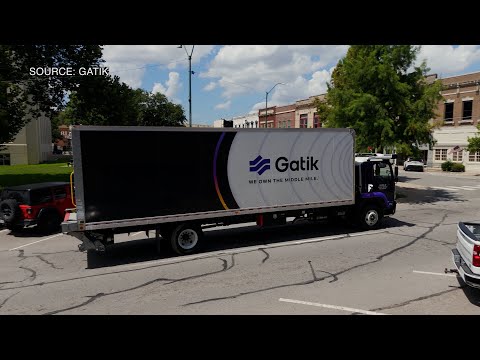
Autonomous trucking company Gatik says it has brought in more than $600 million in contracted revenue. Gatik CEO and co-founder Gautam Narang discusses what comes next for the company with Caroline Hyde and Ed Ludlow on “Bloomberg Tech.” -------- Like this video? Subscribe to Bloomberg Technology on YouTube: https://www.youtube.com/channel/UCrM7B7SL_g1edFOnmj-SDKg Watch the latest full episodes of "Bloomberg Technology" with Caroline Hyde and Ed Ludlow here: https://www.youtube.com/playlist?list=PLfAX25ZLrP ...
UPS Q4 Earnings & Revenues Surpass Estimates, Down Year Over Year
ZACKS· 2026-01-27 18:10
Core Insights - United Parcel Service, Inc. (UPS) reported strong fourth-quarter 2025 results, with earnings and revenues exceeding the Zacks Consensus Estimate [1][10] - Quarterly earnings per share (EPS) of $2.38 surpassed the estimate of $2.22 but represented a 13.5% decline year over year [1][10] - Revenues reached $24.4 billion, exceeding the estimate of $24 billion, but decreased by 3.3% year over year [1][10] Q4 Earnings Summary - U.S. Domestic Package revenues were $16.8 billion, down 3.2% year over year, attributed to a decline in volume, while revenue per piece increased by 8.3% [3] - The segment's adjusted operating profit fell 2.7% year over year to $1.71 billion, with an adjusted operating margin of 10.2% [3] - International Package revenues totaled $5.05 billion, up 2.5% year over year, driven by a 7.1% increase in revenue per piece, although adjusted operating profit decreased by 14.5% to $908 million [4] - Supply Chain Solutions revenues were $2.67 billion, down 12.7% year over year, with an adjusted operating profit of $276 million, reflecting a 2.8% decline [5] 2026 Outlook - Management provided optimistic guidance for full-year 2026, projecting revenues of approximately $89.7 billion, surpassing the Zacks Consensus Estimate of $87.9 billion and the 2025 figure of $88.7 billion [2][6] - Estimated capital expenditures for 2026 are around $3 billion, with expected dividend payments of approximately $5.4 billion, pending board approval [6]


Triumph Financial TFIN Q4 2025 Earnings Transcript
Yahoo Finance· 2026-01-27 16:42
Core Insights - The company reported progress towards its long-term goals, emphasizing revenue growth and operational efficiency despite challenging market conditions in the trucking industry [3][4][5] - The management team aims to enhance transaction confidence in the industry by strengthening their network for secure data and payment transmission [4][6] - Load Pay is expected to significantly contribute to revenue growth, with a target of tripling its annualized revenue from $1.5 million in 2025 to $4.5 million in 2026 [10][11] Financial Performance - The company achieved a 30% EBITDA margin in its core payments business, with expectations to maintain or exceed this level in 2026 [5][27] - The factoring segment's pretax margin improved to approximately 33% in Q4 2025, driven by technology and automation enhancements [20][22] - The company anticipates continued revenue growth in the payments segment, with a projected 25% increase in payments revenue for 2026 [25][30] Strategic Initiatives - The company plans to open between 7,000 to 12,000 new accounts in Load Pay, aiming for higher utilization rates to increase revenue per account [10][11] - There is a focus on cross-selling opportunities, with only 22% of customers currently using both payments and audit services, indicating significant room for growth [16][17] - The management is optimistic about leveraging artificial intelligence and machine learning to enhance operational efficiency and drive margins higher in the factoring business [22][23] Market Positioning - The company has successfully integrated JB Hunt into its network, which is expected to bolster revenue contributions [5][25] - The management acknowledges the evolving nature of the payments network and its potential to create efficiencies for factoring companies, although adoption rates may vary [36][40] - The company is committed to maintaining a strong balance sheet to navigate unforeseen market cycles while pursuing growth opportunities [6][7]

X @Bloomberg
Bloomberg· 2026-01-27 14:40
FedEx Freight is marketing its first investment-grade dollar bonds ahead of the trucker’s planned June 1 spinoff from FedEx Corp https://t.co/jnHtMEVk19 ...
Key trucking voices note possible market lift, limitations for 2026
Yahoo Finance· 2026-01-27 09:54
Core Insights - Early signs of recovery in the freight market suggest a potential shift from a prolonged downturn, with analysts predicting a "crazy year" ahead in 2026 [1] - Incremental and inflationary increases in freight demand are anticipated for the trucking industry in 2026, as indicated by industry analysts and executives [1] Group 1: Market Conditions - In 2025, capacity tightened, which may be necessary for a significant market shift, with consumer spending showing mixed signals of growth [2] - Tonnage has been inconsistent, but spot rates have remained stable following spikes at the end of the year [2] - Forecasts indicate that 2026 may mirror the demand levels of 2025, with potential for rates to rise in line with inflation or possibly below it [4] Group 2: Structural Changes - Some industry experts believe that structural changes are taking root, while others predict a continuation of the lackluster demand seen in 2025 [3] - Uber Freight forecasts multiple scenarios, including a baseline of incremental growth each month or an inflationary scenario [5] - A potential regulation by the FMCSA on non-domiciled carriers could lead to significant market tightening and double-digit growth in spot rates [6] Group 3: Spot Rates and Employment Trends - Spot rates have shown unusual increases, with a notable 15% rise from November to December, indicating a possible structural shift [6] - Year-over-year metrics suggest changing market conditions, including declines in long-distance truckload employment and weak tractor sales [6]
Knight-Swift’s intermodal segment nearly broke even in Q4
Yahoo Finance· 2026-01-26 10:24
Core Insights - The freight market remains weak, prompting Knight-Swift to prioritize cost control until demand improves [3] - The intermodal segment is a focus area for growth, with a recent multiyear agreement with Canadian Pacific Kansas City to manage rail shipments in Mexico [4] - A proposed merger between Union Pacific and Norfolk Southern could enhance Knight-Swift's intermodal operations, leading to faster deliveries and reduced fuel usage [5] Financial Performance - Knight-Swift's intermodal segment nearly reached a breakeven operating ratio in Q4, reporting an adjusted operating ratio of 100.1%, a 140 basis point improvement from the previous year [7] - Revenue per load increased by 2.8%, contributing to the improved operating ratio, despite a 3.4% year-over-year decline in intermodal revenue to $95.7 million due to a 6% drop in load count [7]

X @Bloomberg
Bloomberg· 2026-01-26 08:12
Chinese trucking tech startup DeepWay raises $173 million ahead of a planned Hong Kong IPO https://t.co/F7kVsaCQLy ...
CSX Q4 Earnings & Revenues Lag Estimates, Both Down Year Over Year
ZACKS· 2026-01-23 14:50
Core Insights - CSX Corporation reported disappointing fourth-quarter 2025 results, with earnings per share of 39 cents falling short of the Zacks Consensus Estimate of 42 cents, marking a 7.1% decline year-over-year [1][10] - Total revenues of $3.51 billion missed the Zacks Consensus Estimate of $3.55 billion and decreased by 1% year-over-year, primarily due to lower export coal revenues and a decline in merchandise volume [2][10] Financial Performance - Operating income for the fourth quarter decreased to $1.11 billion year-over-year, while total expenses increased by 1% [3] - CSX's operating margin for the December quarter was reported at 31.6%, with total volumes increasing by 1% year-over-year, driven by intermodal volumes [3] Segment Performance - Merchandise revenues fell by 2% year-over-year to $2.16 billion, slightly below the estimate of $2.2 billion, with merchandise volumes also declining by 2% [4] - Intermodal revenues increased by 7% year-over-year to $562 million, surpassing the estimate of $540.7 million, with segmental volumes up by 5% [4] - Coal revenues decreased by 5% year-over-year to $472 million, falling short of the estimate of $489.8 million, while trucking revenues totaled $196 million, also below the estimate of $223.7 million [5] Liquidity and Debt - CSX ended the fourth quarter of 2025 with cash and cash equivalents of $670 million, down from $933 million at the end of 2024, while long-term debt increased to $18.2 billion from $17.9 billion in 2024 [6] Future Outlook - CSX's guidance for 2025 includes low single-digit revenue growth, an improvement in operating margin by 200 to 300 basis points, and an increase in free cash flow of at least 50%, with capital expenses expected to be below $2.4 billion [7]


Knight-Swift Misses Earnings Estimates as Impairment Charges Weigh on Results
Financial Modeling Prep· 2026-01-22 20:49
Core Viewpoint - Knight-Swift Transportation reported fourth-quarter adjusted earnings that fell short of analyst expectations, despite revenue meeting forecasts [1] Financial Performance - The company posted adjusted earnings per share of $0.31 for Q4 2025, below the consensus estimate of $0.36 [2] - Revenue totaled $1.9 billion, matching analyst expectations but declining 0.4% year over year [2] - Consolidated operating income dropped 66.1% to $26.5 million, primarily due to $52.9 million in non-cash impairment charges related to the integration of the Abilene truckload brand into Swift operations [2] Segment Analysis - The truckload segment, Knight-Swift's largest business, reported a 2.4% year-over-year decline in revenue excluding fuel surcharges, with loaded miles decreasing by 3.3% [3] - The segment's adjusted operating ratio worsened to 92.9%, an increase of 70 basis points from the prior year [3] Future Outlook - For Q1 2026, Knight-Swift forecasts adjusted earnings per share of $0.28 to $0.32 [4] - Truckload revenue is expected to decline slightly, with operating margins remaining relatively stable compared to the same period last year [4] - Full-year 2026 net cash capital expenditures are projected to range between $625 million and $675 million [4]