新材料

Search documents
新材料50ETF(516710)红盘向上,一键布局新材料领域
Sou Hu Cai Jing· 2025-12-15 06:19
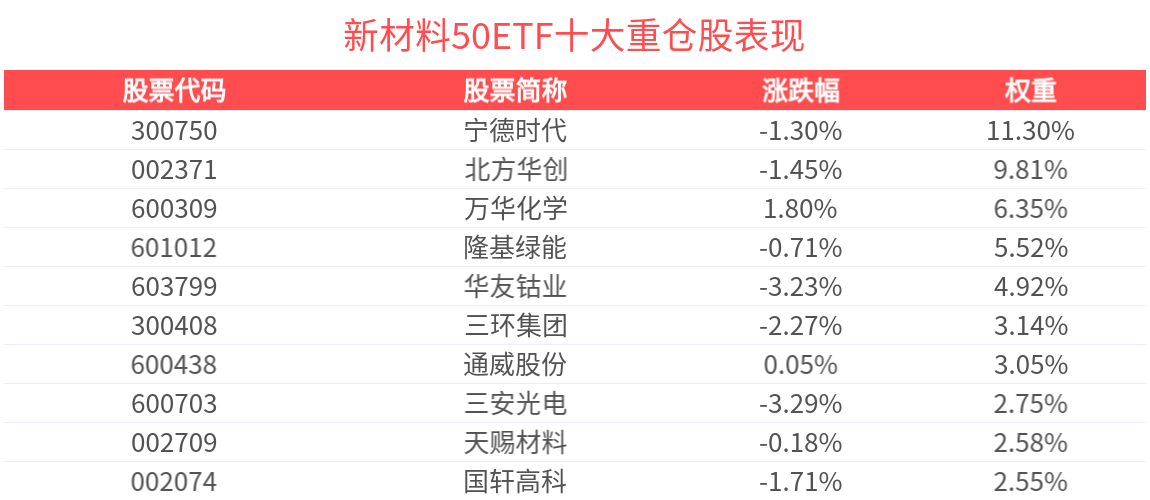
Core Viewpoint - The New Materials 50 ETF (516710) has shown a slight increase of 0.15% as of December 15, 2025, with a recent price of 0.66 yuan, indicating a stable performance in the new materials sector [1]. Group 1: Performance Metrics - The New Materials 50 ETF has experienced a significant growth in scale, increasing by 712.25 million yuan over the past three months [2]. - The ETF's net asset value has risen by 41.72% over the last six months, showcasing strong performance [2]. - Since its inception, the ETF has achieved a maximum monthly return of 25.40% and a longest consecutive monthly gain of 4 months with a total increase of 45.91% [2]. - The average return during the rising months is 7.80%, and the ETF has outperformed its benchmark with an annualized excess return of 1.14% since inception [2]. - The Sharpe ratio for the past year stands at 1.12, indicating a favorable risk-adjusted return [2]. Group 2: Risk and Recovery - The maximum drawdown for the ETF over the past six months is 9.67%, with a relative benchmark drawdown of 0.13% [3]. - The recovery period after the drawdown was 27 days, reflecting the ETF's resilience [3]. Group 3: Fees and Tracking Accuracy - The management fee for the New Materials 50 ETF is set at 0.50%, while the custody fee is 0.10% [4]. - The tracking error over the past three months is 0.019%, indicating a high level of tracking accuracy to the underlying index [5]. - The ETF closely follows the CSI New Materials Theme Index, which includes 50 companies involved in advanced steel, non-ferrous metals, chemicals, inorganic non-metallic materials, and other strategic materials [5]. Group 4: Component Stocks - Key component stocks include CATL (300750) with a weight of 11.30% and a decline of 1.30%, and North Huachuang (002371) with a weight of 9.81% and a decline of 1.45% [7]. - Other notable stocks include Wanhua Chemical (600309) with a gain of 1.80% and Jiangqi Green Energy (601012) with a decline of 0.71% [7].

贝特瑞等在深圳成立新材料公司
Zheng Quan Shi Bao Wang· 2025-12-15 04:28
Group 1 - Shenzhen Beian New Materials Co., Ltd. has been established with a registered capital of 10 million yuan [1] - The legal representative of the company is Li Zikun [1] - The business scope includes synthetic material manufacturing (excluding hazardous chemicals), new material technology research and development, new material technology promotion services, and sales of surface functional materials [1] Group 2 - The company is jointly held by Shenzhen Betterray New Energy Technology Research Institute Co., Ltd., a wholly-owned subsidiary of Betterray, and Shenzhen Taike Juneng New Energy Materials Co., Ltd. [1]
从“广交天下”到“科交未来”:一场跨越六十余载的“交响”
Guang Zhou Ri Bao· 2025-12-15 01:57
Core Insights - The 2025 Higher Education Technology Achievement Trading Conference will take place from December 15 to 17 at the Canton Fair Complex, marking a significant shift from "Made in China" to "Created in China" [1][6] - The conference aims to facilitate the market value of technological achievements, transforming dormant academic innovations into market-ready products [2][4] Historical Context - The first China Export Commodities Fair (Canton Fair) was held in 1957, symbolizing China's commitment to connecting with the world [2] - The mission of the upcoming conference is to break through core technology barriers, allowing for the efficient trading of technological achievements [2][3] Innovation Spirit - Guangdong's history of innovation is highlighted by the 1986 introduction of the first local regulation on technology market management, which established the concept of "technology goods" [3] - This innovative spirit is reflected in the conference's approach to technology transactions, emphasizing practical and efficient solutions [3] Industrial Landscape - The conference will gather over 600 universities with cutting-edge technologies, providing a platform for industries seeking technological innovation for transformation [4][5] - Guangzhou's industrial investment is projected to grow from 103 billion yuan in 2020 to 171 billion yuan by 2024, a 66% increase, indicating a robust industrial foundation [4] Event Highlights - The conference will focus on strategic emerging industries such as new information technology, biomedicine, and autonomous driving, facilitating direct interactions between universities and industries [6][11] - A comprehensive ecosystem for technology transfer will be established, ensuring that every technology can find its application scenario [10][12] Networking and Collaboration - The event will serve as a platform for deep collaboration among government, industry, academia, and finance, fostering innovation ecosystems [7][14] - Various initiatives will be introduced to connect university research with industry needs, including a "supermarket" for high-value patents and a "one-stop" service area for technology transfer [12][14]
高质量高标准推进郑州市 要素市场化配置综合改革试点
Zheng Zhou Ri Bao· 2025-12-15 00:40
Core Viewpoint - The State Council has approved a comprehensive reform pilot for market-oriented allocation of factors in Zhengzhou and nine other regions, aiming to enhance the quality and efficiency of resource allocation through 70 specific measures outlined in the reform plan [1] Group 1: Technological Innovation and Market Development - The reform plan emphasizes the importance of technological factors in driving innovation and proposes reforms in the management of scientific achievements in universities and research institutions [2] - It aims to establish a resource library for scientific achievements and promote the transformation of these achievements to support small and medium-sized enterprises [2] - The plan includes the construction of 30 concept verification centers and pilot bases in high-end equipment, new materials, and biomedicine [2] Group 2: Land Resource Optimization - The plan seeks to improve the efficiency of industrial land use by implementing standardized land transfer and ensuring immediate project commencement upon land acquisition [4] - It proposes measures to revitalize existing land resources and establish a unified urban-rural construction land market [4] - The plan includes policies to support the transformation of old industrial areas into cultural industries [4] Group 3: Talent Attraction and Management - The reform plan aims to relax household registration conditions to facilitate the settlement of agricultural migrants and other residents in Zhengzhou [5] - It proposes the establishment of a digital ecosystem for skilled talent and the development of a talent evaluation system linked to public services [6] - The plan includes initiatives to attract high-end talent and support innovation and entrepreneurship through various programs [6] Group 4: Data and Computing Infrastructure - The plan outlines the establishment of a comprehensive data registration and trading system, along with a national supercomputing center in Zhengzhou [7] - It aims to create benchmark data application scenarios in key sectors such as transportation, healthcare, and education [7] - The plan emphasizes the importance of data asset evaluation and the development of a data-driven economy [7] Group 5: Financial Services for Innovation - The reform plan introduces "Technology Talent Loans" to provide comprehensive financial services for technology-driven enterprises [8][9] - It aims to enhance the capital market's vitality and support the development of various financial products for small and medium-sized enterprises [8] - The plan includes measures to increase the proportion of RMB settlements in foreign trade [9] Group 6: Resource Market Mechanisms - The plan proposes improvements to the market mechanisms for resource allocation, particularly in the electricity and water sectors [10] - It emphasizes the need for a green trading mechanism and participation in national carbon trading [10] - The plan aims to facilitate market-oriented water rights trading to support industrial development [10] Group 7: Advanced Production Factors - The reform plan focuses on the innovative allocation of production factors in emerging industries such as healthcare, artificial intelligence, and low-altitude economy [11] - It aims to establish a comprehensive analysis system for various production factors to enhance decision-making and resource allocation [11] - The plan includes measures to ensure fair distribution of benefits from land use changes to various stakeholders [11]
把握年前行情的布局点
Orient Securities· 2025-12-15 00:16
Core Viewpoints - The market is expected to experience a "first dip, then rise" pattern next week, presenting a favorable opportunity for positioning before the year-end market [3][13]. Market Analysis - After a high on Monday, the market entered a phase of fluctuation and adjustment, indicating significant investor divergence. The recent developments, including the Federal Reserve's interest rate decision and the economic work conference, aligned with expectations, providing more certainty and potentially lowering risk assessments. The upcoming "super central bank week" and Japan's interest rate trends may introduce uncertainties that could temporarily suppress risk evaluations [4][14]. Industry Comparison - From March 2023 to the present, the market has seen a consensus expectation for technology and dividend stocks. The report suggests that the trend of extreme risk styles is nearing its end, with future investment opportunities likely to emerge in mid-cap blue-chip stocks, which are anticipated to rise again after a four-year lull [5][15]. Industry Allocation - Investment opportunities are identified in mid-risk stocks, focusing on three main lines: 1. The consumer sector, which has been dormant for years, is approaching a turning point. Stocks in this sector, such as mid-sized liquor, restaurant supply chains, snacks and beverages, home appliances, hotels, human resources, and beauty care, are expected to rebound due to price corrections and supply constraints [6][16]. 2. The cyclical sector is undergoing a revaluation driven by technological empowerment and supply constraints. Attention is drawn to new materials and strategic minor metals (like antimony and rare earths), as well as industrial metals (copper and aluminum) that are experiencing improved supply-demand dynamics, alongside traditional commodities like live pigs and rubber [6][16]. Thematic Investments - The report highlights several thematic investment areas: - **Aerospace and Satellites**: The sector is gaining strength, with expectations for continued event-driven catalysts, particularly in reusable rockets and accelerated industry IPOs [7][17]. - **Nuclear Fusion**: After a prolonged adjustment, the nuclear fusion sector is beginning to rebound, with anticipated industrial catalysts and a shift from theoretical research to engineering practice, suggesting significant future investment demand [7][17]. - **Consumer Sector**: Recent government initiatives to boost consumption indicate that policies aimed at improving domestic demand may become a central theme in 2026, particularly in service consumption [7][17]. - **Semiconductors**: Anticipated expansions in domestic wafer fabrication and the capitalization of leading domestic storage chip manufacturers present opportunities in domestic chip manufacturers, equipment suppliers, and semiconductor materials [8][18]. - **Upstream Price Increases**: The report notes a continuing trend of price increases in the short term, with structural growth in demand and supply constraints providing upward price elasticity for related commodities, particularly in non-ferrous metals, new energy upstream, and chemicals [8][17].
河南省人民政府正式印发《郑州市要素市场化配置综合改革试点工作方案》 给土地“松绑” 为人才铺路
He Nan Ri Bao· 2025-12-14 23:41
Core Viewpoint - The Zhengzhou government has officially issued a comprehensive reform pilot plan for market-oriented allocation of factors, aiming to enhance the efficiency of resource allocation and promote high-quality development in the region [2][4]. Group 1: Reform Initiatives - The plan includes 70 reform measures focusing on key factors such as technology, land, human resources, data, capital, and environmental resources [2]. - Zhengzhou will establish 30 concept verification centers and pilot bases, along with over 100 provincial-level technology innovation platforms to facilitate the commercialization of research outcomes [2][3]. Group 2: Land and Human Resource Policies - The plan promotes long-term leasing of industrial land, a "standard land" transfer system, and a "land acquisition upon commencement" policy to reduce costs for enterprises [4]. - It aims to attract talent by relaxing household registration conditions for agricultural migrants and improving public service access for all residents [4][5]. Group 3: Data and Technology Development - The plan emphasizes the establishment of a data asset evaluation system and aims to cultivate over 50 benchmark data application scenarios in sectors like transportation, healthcare, and education [6]. - Zhengzhou will build a national supercomputing center and a core hub for supercomputing internet [6]. Group 4: Talent Development - The plan includes reforms in the salary system for public institutions and the establishment of a talent-sharing mechanism to meet the demands of emerging industries [5]. - It aims to attract top talent by adding 20 leading talents and over 200 technology leaders [5].
弄潮江海风正劲——解码万亿南通产业升级路
Shang Hai Zheng Quan Bao· 2025-12-14 19:43
Core Viewpoint - Nantong is accelerating its transformation into a significant growth pole for high-quality development in Jiangsu, leveraging its historical industrial foundation and geographical advantages to foster innovation and economic growth [5][13]. Economic Performance - Nantong's GDP reached 1 trillion yuan in 2020 and is projected to reach 1.24 trillion yuan in 2024, with a year-on-year growth of 6.2% [7]. - In the first three quarters of this year, Nantong's GDP was 978.89 billion yuan, reflecting a year-on-year increase of 5.4%, which is higher than the national average [10]. Industrial Development - Nantong is home to six major industrial clusters, with shipbuilding and high-end textiles recognized as national advanced manufacturing clusters, contributing significantly to the national output [11]. - The high-end textile industry is transitioning from "weaving" to "intelligent manufacturing," driven by technological innovation and global market expansion [11]. Historical Legacy - The legacy of Zhang Jian, a pioneer of modern industry in Nantong, continues to influence local entrepreneurs and the city's industrial ethos, emphasizing education and practical skills [8][10]. - The establishment of "Nantong Entrepreneur Day" and the "Zhang Jian Cup" awards institutionalizes the spirit of entrepreneurship in the region [9]. Strategic Initiatives - Nantong is focusing on coastal development as a key strategy for achieving the next trillion yuan in GDP, with a modern marine industry system being established [14][15]. - The city is enhancing its connectivity with Shanghai and Suzhou through multiple infrastructure projects, facilitating regional collaboration and industrial integration [16]. Innovation and Future Industries - Nantong is prioritizing future industries such as aerospace, marine technology, and renewable energy, aiming to capture technological advancements and drive economic growth [16]. - The establishment of "offshore incubators" in various districts is fostering innovation and attracting technology projects to the region [16].



会通股份,收购热门新材料“黑马”!
DT新材料· 2025-12-14 13:32
Core Viewpoint - The article discusses the strategic acquisition of a majority stake in Donghua Composite Technology Co., Ltd. by Huitong Co., focusing on the growing market for high-performance thermoplastic composite materials, particularly in the aerospace and automotive sectors [2][4]. Group 1: Company Overview - Huitong Co. has been actively expanding its presence in high-end new materials, moving beyond its traditional appliance sector [2]. - Donghua Composite was established on September 30, 2021, with an initial investment of 10 million yuan, primarily focusing on high-performance thermoplastic composite materials [3]. - The core team of Donghua originates from the East China University of Science and Technology, specializing in the development of various thermoplastic composite materials [3]. Group 2: Acquisition Details - On December 11, Huitong Co. signed a share transfer agreement to acquire 55.46% of Donghua Composite, making it a subsidiary [2]. - The acquisition is seen as timely, targeting the hot market of thermoplastic composite materials, which are gaining traction due to their recyclability and lightweight properties [4]. Group 3: Market Potential - The global thermoplastic composite materials market is experiencing strong growth, particularly in aerospace and automotive industries, driven by their unique advantages [4]. - Challenges remain, including high costs and low standardization in manufacturing processes [4]. Group 4: Product Development - Huitong Co. has developed ultra-high-strength carbon fiber reinforced polyamide materials for robotics, with tensile strength exceeding 400 MPa [5]. - The company is also working on lightweight materials for the low-altitude economy and has launched products addressing thermal management issues in electric vehicles and AI data servers [5]. Group 5: Financial Performance - For the first three quarters of 2025, Huitong Co. reported revenues of 4.721 billion yuan, a year-on-year increase of 10.03%, and a net profit of 166 million yuan, up 8.96% [6].


太力科技(301595) - 投资者关系活动记录表2025012
2025-12-14 13:18
Group 1: Company Overview and Market Expansion - The company has seen rapid growth in overseas business, with a 47% year-on-year increase in Amazon channel performance in the first half of the year [2] - The company achieved a 26% year-on-year growth in its IKEA business, successfully integrating its self-developed silicone pressure-sensitive adhesive materials into IKEA's supply chain [2][3] - Future plans include expanding into emerging markets such as Canada, Europe, and Southeast Asia to accelerate global business development [3] Group 2: Research and Development Focus - The company prioritizes R&D innovation, focusing on three main areas: attracting high-end talent, building advanced laboratories, and collaborating with academic institutions [3] - The company is the exclusive supplier of compression bags for China's manned space program, with products used in 29 space missions [3] - New technologies developed include a waste collection system for microgravity environments and a biological culture box cover for astronauts, utilizing advanced nano-materials [3] Group 3: Product Development and Market Strategy - The company is enhancing its safety protection product line, particularly in cut-resistant gloves, while increasing efforts in the consumer market [3] - A comprehensive supply chain has been established, providing both core materials and finished products for safety protection [3] - The company is focusing on the robotics industry, developing ultra-thin cut-resistant materials suitable for industrial and domestic robots [5] Group 4: Cost Management and Operational Efficiency - The company plans to improve operational efficiency through AI and digital tools to manage costs effectively [5] - Emphasis will be placed on core differentiated products with market competitiveness to enhance profitability [5] - The strategy includes streamlining the product matrix to reduce waste and focus resources on high-growth areas [5]
大湾区这所大学,跑出中国最牛创业军团
盐财经· 2025-12-14 10:18
Core Viewpoint - The Guangdong-Hong Kong-Macao Greater Bay Area is emerging as a leading hub for entrepreneurship, particularly in the field of smart hardware, due to its comprehensive industrial chain and unique advantages in innovation [2][3]. Group 1: Advantages of the Greater Bay Area - The Greater Bay Area serves as a global hub for the consumer electronics industry, facilitating a smooth transition from idea to startup for entrepreneurs [2][3]. - The region has attracted a concentration of global tech entrepreneurs, contributing to the emergence of numerous innovative companies [5][6]. - Hong Kong University of Science and Technology (HKUST), established in 1991, has rapidly become a leader in engineering and technology innovation, producing over 1,700 tech startups [8][9]. Group 2: Factors Behind HKUST's Success - HKUST's unique environment fosters a strong sense of national pride, a free academic atmosphere, and institutional innovation, which are crucial for nurturing entrepreneurial talent [11][14][17]. - The university's founding aimed to transform Hong Kong into an international innovation center, attracting top-tier talent from around the world [13]. - The academic culture at HKUST encourages the integration of research with practical applications, providing students and professors the freedom to innovate [16][20]. Group 3: Institutional Support for Innovation - HKUST has established a Knowledge Transfer Office to manage intellectual property and support researchers in patent applications, enhancing the commercialization of research [19]. - The university provides substantial financial support for early-stage ventures, including seed funding and the establishment of a HK$2 billion "Red Bird Fund" to support startups in key sectors [19][20]. - The combination of high academic standards and a relatively free innovation environment increases the likelihood of producing successful tech entrepreneurs [20]. Group 4: Unique Position in Global Context - The integration of industry, academia, and research in China offers a unique advantage compared to the U.S. and Europe, particularly in the field of smart hardware [21][25]. - The rapid prototyping capabilities in Shenzhen and Dongguan allow entrepreneurs to quickly test and iterate their products, a significant advantage over other global regions [25][26]. - The strong industrial base not only creates job opportunities but also drives the growth of Chinese tech enterprises [26]. Group 5: Future Opportunities and Educational Needs - The trend towards technological self-sufficiency in China will reshape global supply chains and create opportunities for domestic innovation [28][29]. - Future talent development in engineering and science must focus on interdisciplinary and cross-disciplinary education to meet the demands of emerging industries [30]. - HKUST's approach to education emphasizes integration and collaboration across various fields, preparing students for the complexities of modern technological challenges [30][32].