
光电子器件

Search documents
成都仁研轩光电科技有限公司成立,注册资本200万人民币
Sou Hu Cai Jing· 2026-02-27 02:12
Core Viewpoint - Chengdu Renyanxuan Optoelectronic Technology Co., Ltd. has been established with a registered capital of 2 million RMB, fully owned by Shanghai Renyanxuan Information Technology Co., Ltd. [1] Company Information - The legal representative of Chengdu Renyanxuan Optoelectronic Technology Co., Ltd. is Tong Lei [1] - The company is classified under the manufacturing industry, specifically in the sector of computer, communication, and other electronic device manufacturing, focusing on electronic component manufacturing [1] - The registered address is located at No. 1, 1st Floor, Building 2, 468 Yuelong Road, Shiban Tan Street, Xindu District, Chengdu, Sichuan Province, within the Xindu High-tech Industrial Park [1] - The company type is a limited liability company, wholly owned by a natural person [1] - The business license allows the company to independently conduct operations, except for projects that require approval [1] Business Scope - The business scope includes research and development, manufacturing, and sales of electronic special materials and optoelectronic devices [1] - Additional activities include sales of electronic products, mechanical equipment, non-residential real estate leasing, and optical glass sales [1]
跑起来!眉山开启“争先竞速”
Xin Lang Cai Jing· 2026-02-23 21:43
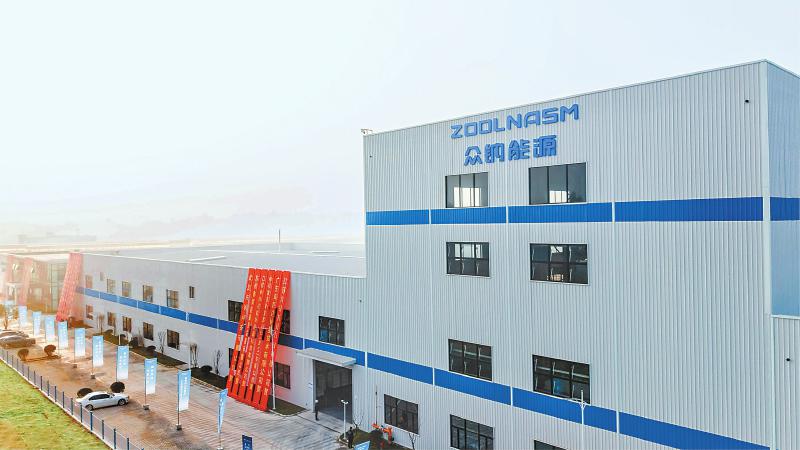
Core Insights - The establishment of the Jiangsu Zhongna Energy Technology Co., Ltd. headquarters in Meishan marks a significant breakthrough in the large-scale preparation of sodium-ion battery key materials, filling a gap in the region's sodium battery core material sector [1][4] - The project has received over 5,000 tons of orders and has nearly 20,000 tons in intended orders, with an investment of 2 billion yuan and an annual production capacity of 10,000 tons for the first phase [1][3] - Meishan aims to expand its industrial layout from a single "lithium battery track" to a "lithium-sodium dual-drive" model, positioning itself advantageously in the sodium battery industry [4][6] Company Developments - The Meishan sodium base has entered continuous production, achieving a monthly output of over 600 tons, with the first batch of sodium iron sulfate cathode materials ready for shipment to downstream companies for validation [2][3] - The project was initiated in April 2025, with the local government's deep understanding of the industry and long-term service commitment being key factors in attracting the investment [3][4] Industry Trends - Sodium batteries are seen as an important supplement to lithium batteries, with the current stage of industrialization being in its early phases [3] - The rapid production launch of the Meishan sodium base is part of a broader strategy to attract upstream and downstream supporting enterprises, accelerating the formation of an industrial cluster [4][6] Economic Impact - Meishan has announced a total of 284 key projects with a total investment of 238.77 billion yuan, including 80 advanced manufacturing projects aimed at establishing a "manufacturing strong city" [6] - The local government is focused on enhancing project execution and service support to ensure timely commencement, construction, and operational efficiency of key projects [6]

浙江蓝特光学股份有限公司关于全资子公司变更注册资本暨完成工商变更登记的公告
Shang Hai Zheng Quan Bao· 2026-02-10 19:15
Core Viewpoint - Zhejiang Lante Optical Co., Ltd. has announced a change in the registered capital of its wholly-owned subsidiary, Zhejiang Lanchuang Optoelectronic Technology Co., Ltd., to support business development, with the necessary registration procedures completed [1][3]. Group 1: Change Details - The registered capital of the subsidiary has been changed to 350 million yuan [1][3]. - The change was approved by the fifth board of directors at the eighth meeting and the first extraordinary general meeting of shareholders in 2024 [1]. - The change falls within the approval authority of the company's general manager, thus does not require further board or shareholder meeting approval [1]. Group 2: Business Scope - The business scope of the subsidiary includes technology services, development, consulting, exchange, transfer, and promotion; manufacturing and sales of optical glass; manufacturing and sales of optical instruments; manufacturing and sales of optoelectronic devices; and manufacturing of electronic components [1]. Group 3: Company Information - The subsidiary is registered as a limited liability company with a natural person investment or control [3]. - The legal representative of the subsidiary is Xu Yunming [3]. - The registered address is located at 1288 Kanghe Road, Jiaxing Photovoltaic Science and Technology Innovation Park, Room 1513-32, Xiuzhou District, Jiaxing City, Zhejiang Province [3].

(粤港澳大湾区)粤澳“一单两报”实现进出口全覆盖
Xin Lang Cai Jing· 2026-02-05 13:06
Core Viewpoint - The launch of the "one declaration, two reports" function for import goods between Guangdong and Macau marks a significant advancement in trade facilitation, achieving full coverage of import and export processes [1][2]. Group 1: Import Functionality - A truck loaded with electronic components successfully completed the first import declaration using the new "one declaration, two reports" function, reducing the customs clearance time significantly [1]. - The new import function allows for data to be entered once in Guangdong's "single window" system, which is then automatically translated and sent to the Macau platform for confirmation, streamlining the process [1]. - The implementation of this function is expected to greatly reduce human resources and clearance time, as it simplifies the declaration process [1]. Group 2: Export Functionality - The export function has been operational for nearly four years, significantly aiding in the supply of daily necessities to Macau [2]. - The recent upgrade to the import system includes a transition from a "code extraction" method to a "direct push" model, which simplifies the data entry process [2]. - The number of mandatory fields for manual entry has been reduced from 24 to 3, saving approximately half an hour in declaration time per shipment [2].
2025年中国光电子器件产量为19233.9亿只(片、套) 累计增长8.8%
Chan Ye Xin Xi Wang· 2026-02-03 03:07
Core Viewpoint - The report by Zhiyan Consulting highlights the trends and forecasts for the optoelectronic device industry in China from 2026 to 2032, indicating a slight decline in production in December 2025 but an overall growth in annual production for the year [1] Group 1: Industry Overview - In December 2025, China's optoelectronic device production reached 173.3 billion units, reflecting a year-on-year decrease of 0.6% [1] - For the entire year of 2025, the cumulative production of optoelectronic devices in China was 1,923.39 billion units, showing a cumulative growth of 8.8% [1] Group 2: Market Research and Insights - Zhiyan Consulting is recognized as a leading industry consulting firm in China, specializing in in-depth industry research reports, business plans, feasibility studies, and customized services [1] - The firm emphasizes its commitment to providing comprehensive industry solutions to empower investment decisions through professional insights and quality services [1]





31省份GDP全部出炉:广东、江苏、山东位列前三
21世纪经济报道· 2026-01-30 16:00
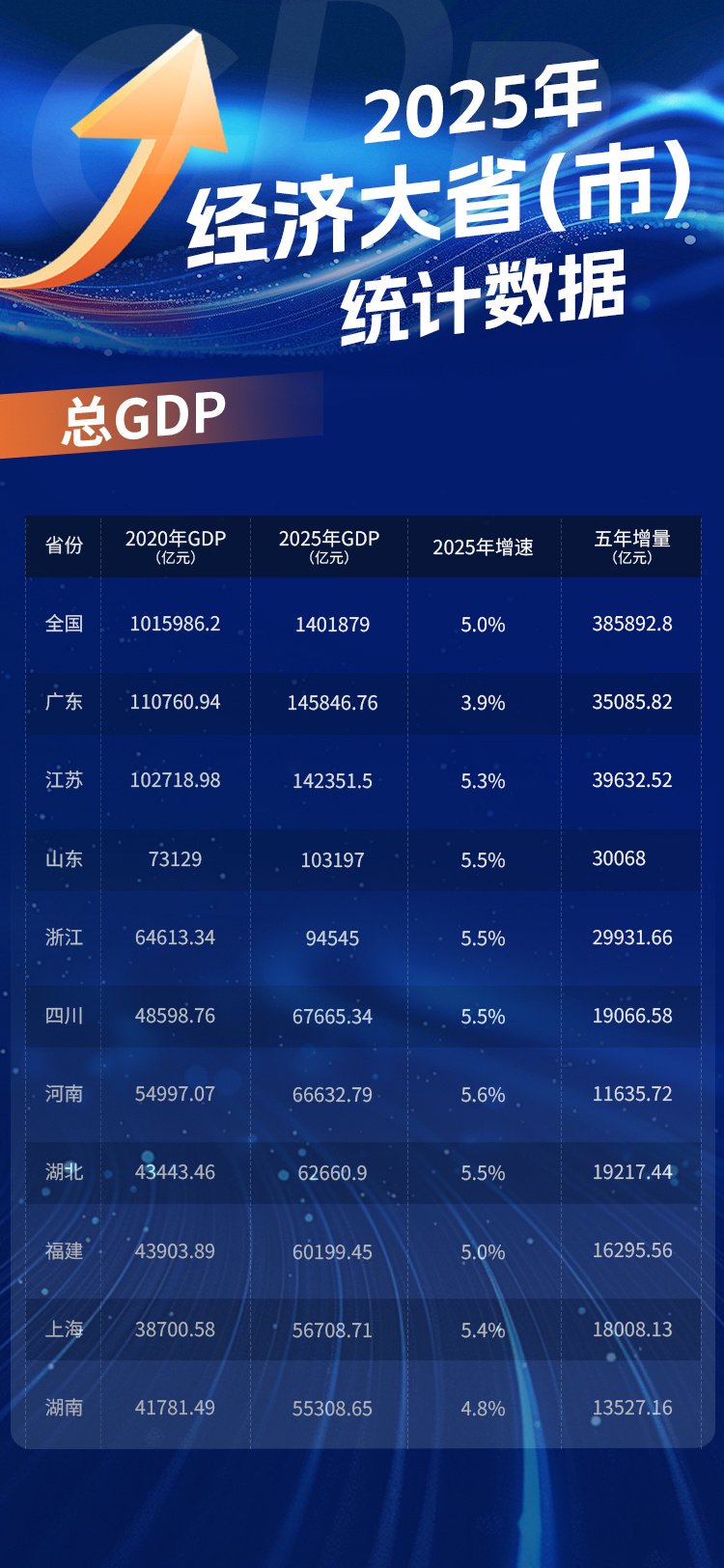
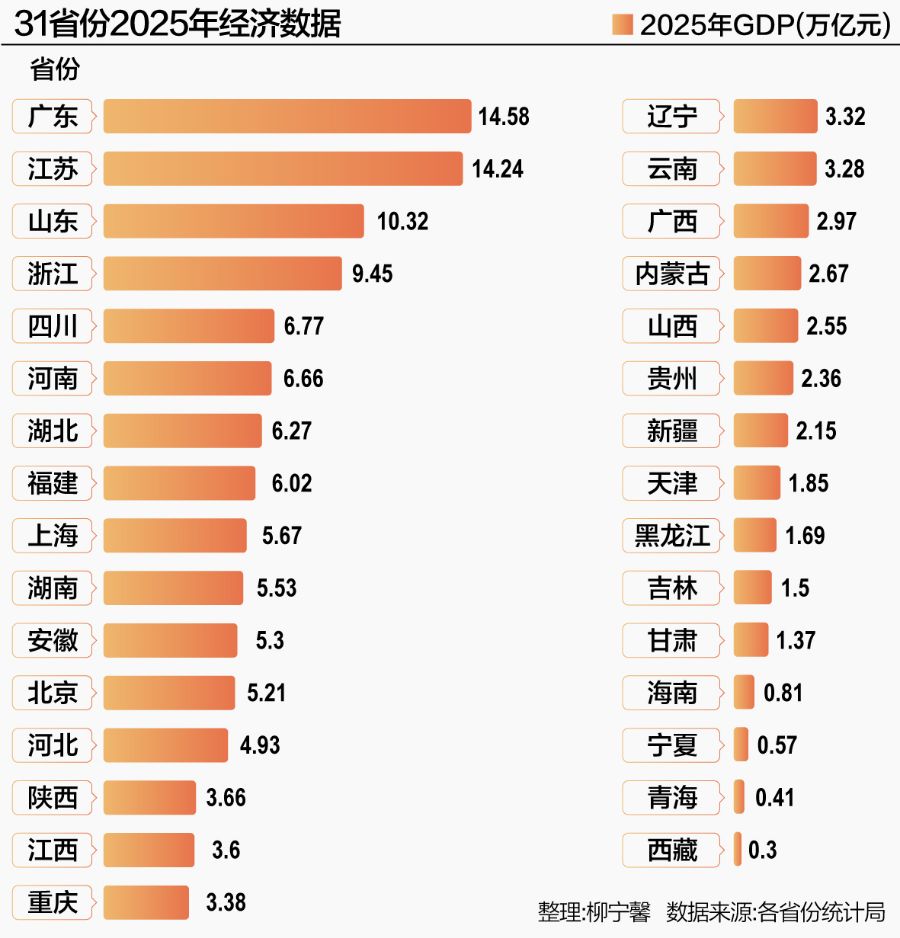
Core Viewpoint - In 2025, despite increasing uncertainties in external demand, China's major provinces have stabilized their economic foundations, with several economic powerhouses achieving record GDP growth [1][3]. Economic Performance - In 2025, three provinces surpassed a GDP of 10 trillion yuan, with Guangdong leading at 14.58 trillion yuan, followed by Jiangsu at 14 trillion yuan, and Shandong breaking the 10 trillion yuan mark for the first time [3][6]. - Guangdong's GDP reached 145,846.76 billion yuan, marking its 37th consecutive year at the top of the national GDP rankings, with advanced manufacturing and high-tech manufacturing growing by 5.1% and 6.2% respectively [6]. - Jiangsu's GDP was 142,351.5 billion yuan, a 5.3% increase year-on-year, while Shandong's GDP reached 103,197 billion yuan, growing by 5.5% [6][7]. Industrial Development - The industrial sector remains a core support for Jiangsu's growth, with notable performance in high-end manufacturing, particularly in electronics and transportation equipment [6][7]. - Shandong's equipment manufacturing sector saw an 11.4% increase in value added, with significant growth in automotive and rail transport industries [7]. - In 2025, 20 provinces achieved GDP growth rates above the national average of 5%, with western provinces like Tibet leading at 7% [8]. Trade Resilience - Despite uncertainties, foreign trade showed resilience, with new energy vehicles, lithium batteries, and photovoltaic products becoming significant contributors to exports [8]. - Anhui's foreign trade exceeded 1 trillion yuan for the first time, with a 1.1 times increase in exports of the "new three items" [8]. Regional Strategies - Various provinces emphasized tailored industrial planning during their local meetings, focusing on upgrading existing industries rather than simply moving away from traditional sectors [10]. - Guangdong aims to build a competitive modern industrial system, emphasizing high-quality manufacturing and integrating artificial intelligence into its industrial framework [10][11]. - Zhejiang's strategy includes embedding AI into industrial upgrades, leveraging its strong digital economy and private sector participation [12]. Traditional Industry Enhancement - Provinces like Hubei and Henan are focusing on enhancing their traditional industries while also promoting new sectors [14][15]. - Hubei's plan includes upgrading traditional sectors like automotive and steel while fostering emerging industries such as integrated circuits and artificial intelligence [14][15]. - The strategy of "three lines advancing" aims to strengthen the competitiveness of traditional industries while supporting new and future industries [15][16].

前十经济省份五年GDP增加23万亿元 相当于再造两个山东|省情研究所
Xin Lang Cai Jing· 2026-01-30 15:35
Core Insights - The article emphasizes the role of major economic provinces as stabilizers for the national economy and pillars for high-quality development, with a focus on the expected GDP growth of the top ten provinces by 2025 [1] Economic Overview - By 2025, the GDP of the top ten provinces is projected to reach 85.5 trillion yuan, accounting for 60.99% of the national total, reflecting an increase from 2024 [1] - The cumulative GDP increase during the "14th Five-Year Plan" period for these provinces is expected to be 23.25 trillion yuan, equivalent to creating an economy the size of France [1] Provincial GDP Projections - The GDP figures for 2025 are as follows: - Guangdong: 14.58 trillion yuan - Jiangsu: 14.24 trillion yuan - Shandong: 10.32 trillion yuan - Other provinces like Sichuan and Henan are also showing significant growth [3][4][5] Structural Changes - The entry threshold for the top ten provinces has risen to a GDP of 5.5 trillion yuan, with three provinces exceeding 10 trillion yuan [5] - The economic landscape is shifting, with eastern provinces dominating, while central and western provinces are also gaining ground due to strategic initiatives [5][6] Competitive Dynamics - Guangdong has maintained its position as the top province for 37 consecutive years, while Jiangsu is closing the gap, with the difference in GDP narrowing from over 800 billion yuan to less than 350 billion yuan [7] - The growth rates vary among provinces, with Jiangsu leading in absolute GDP increase, while Shanghai shows the highest growth rate at 46.5% compared to 2020 [7][8] Industrial Changes - The three major industries in the top provinces accounted for 49.0%, 63.7%, and 60.7% of the national total, indicating a strong industrial base [9] - The service sector is becoming a key driver of economic growth, although eight provinces have service sector contributions below the national average [12] Consumption and Trade - The top ten provinces contributed 65% of the national retail sales, with Guangdong, Jiangsu, and Shandong each exceeding 4 trillion yuan in retail sales [16] - The provinces are also significant players in foreign trade, contributing over 75% of the national import and export volume, with several provinces achieving growth despite a challenging international environment [20][21]
从10万亿到14万亿:经济大省的“产业方法论”正在分野
2 1 Shi Ji Jing Ji Bao Dao· 2026-01-30 12:50
Core Viewpoint - In 2025, despite increasing uncertainties in external demand, various provinces in China have stabilized their economic fundamentals, with several major economic provinces achieving record-high GDPs [1] Economic Performance of Major Provinces - In 2025, Guangdong's GDP reached 14.58 trillion yuan, maintaining its position as the largest economy in China for the 37th consecutive year, with advanced manufacturing and high-tech manufacturing growing by 5.1% and 6.2% respectively [5] - Jiangsu's GDP reached 14.23515 trillion yuan, marking a 5.3% year-on-year growth, while Shandong's GDP surpassed 10 trillion yuan for the first time, growing by 5.5% [5][6] - The industrial sector remains a core support for Jiangsu's growth, with significant performance in high-end manufacturing, particularly in optical electronics and lithium-ion battery manufacturing, which grew by 17.5% and 18.4% respectively [5] - Shandong's equipment manufacturing sector saw an 11.4% increase in added value, with double-digit growth in automotive, railway, and electrical machinery industries [6] Industrial and Trade Resilience - In 2025, Anhui's industrial added value grew by 9.4%, with high-tech manufacturing increasing by 30.4%, while Henan's industrial economy showed strong momentum with an 8.4% growth [7] - External trade remained resilient, with new energy vehicles, lithium batteries, and photovoltaics becoming significant contributors to trade growth, particularly in central and western provinces [8] Regional Development Strategies - As of late January, 23 provinces held local two sessions, emphasizing tailored industrial planning and structural upgrades rather than simply moving away from traditional industries [9][10] - Provinces with strong industrial foundations, such as Guangdong, Jiangsu, Shandong, and Zhejiang, are focusing on systematic layouts in artificial intelligence and advanced manufacturing while promoting the transformation of traditional industries [10] Future Industry Planning - Guangdong aims to build a competitive modern industrial system, emphasizing high-quality manufacturing and the integration of artificial intelligence with robotics [11] - Zhejiang's development plan prioritizes embedding AI into industrial upgrades, leveraging its unique economic landscape to enhance flexibility and resilience in production [13] Traditional Industry Enhancement - Provinces like Hubei and Henan are focusing on enhancing their industrial advantages, with Hubei planning to implement a traditional industry renewal project to upgrade key sectors such as automotive and steel [14][15] - The strategy of "three lines advancing" in Hubei aims to strengthen its industrial competitiveness while supporting national economic resilience [15]
广西财政发力助推人工智能高质量发展
Xin Lang Cai Jing· 2026-01-28 22:02
Group 1 - The core focus of Guangxi is on cultivating new productive forces and supporting the high-quality development of artificial intelligence and digital infrastructure since 2025, with high-tech manufacturing value-added expected to grow by 25.2% [1] - The production of optoelectronic devices and service robots is projected to increase by 64% and 22.4% respectively, while the core industry output of artificial intelligence is anticipated to exceed 80 billion yuan [1] Group 2 - Guangxi is establishing a supportive institutional framework for the high-quality development of artificial intelligence and the digital economy, with a focus on optimizing the industrial development ecosystem and allocating 2.038 billion yuan in various funding resources [2] - The budget for digital infrastructure construction has been significantly increased to 700 million yuan, representing a 133% year-on-year growth, with a focus on artificial intelligence, digital economy, and digital security [2] - The region is also promoting international digital cooperation through projects like the China-ASEAN AI model development and application services [2] Group 3 - Guangxi has initiated the establishment of an artificial intelligence industry fund with a total scale of no less than 10 billion yuan, including a guiding fund of 3 billion yuan, to support key industries and project implementations [3] - The region is actively engaging with national funds to invest in critical areas such as integrated circuits and artificial intelligence, with a commitment of 1 billion yuan to the national integrated circuit fund [3] - Financial support is being strengthened to establish the Guangxi Data Group, which aims to be a driving force for the development of the digital economy in the region [3]
深圳海森姆光学科技有限公司成立,注册资本200万人民币
Sou Hu Cai Jing· 2026-01-28 20:02
Core Viewpoint - Shenzhen Haisenm Optical Technology Co., Ltd. has been established with a registered capital of 2 million RMB, focusing on various sectors including artificial intelligence, optical instruments, and electronic measurement instruments [1] Company Summary - The legal representative of Shenzhen Haisenm Optical Technology Co., Ltd. is Shi Qiang [1] - The company has a registered capital of 2 million RMB [1] - The shareholders and their respective ownership percentages are as follows: Shi Qiang (60%), Huitong Internet of Things (Shenzhen) Co., Ltd. (15%), Luo Songsheng (15%), and Shanghai Qingzhou Angel Technology Development Co., Ltd. (10%) [1] Business Scope - The company’s business scope includes: - Artificial intelligence industry application system integration services - Research and development of motors and control systems - Research and development of electronic special materials - Software development - Manufacturing and sales of optical instruments - Manufacturing and sales of optoelectronic devices - Manufacturing and sales of intelligent instruments and meters - Manufacturing and sales of electronic measuring instruments - Manufacturing, retail, and wholesale of sports goods and equipment - Research and development and sales of mechanical equipment - Import and export of goods and technology [1] Company Type and Duration - Shenzhen Haisenm Optical Technology Co., Ltd. is classified as a limited liability company [1] - The business duration is set from January 28, 2026, with no fixed term [1]