Solar

Search documents
Alibaba's $53 Billion AI Push Is The Threat Nvidia Can't Ignore
Benzinga· 2025-09-29 16:08
Core Insights - Alibaba Group is aggressively expanding its AI capabilities, potentially threatening Nvidia's market dominance and profit margins [1][6] - Nvidia has enjoyed high gross margins above 70% due to premium pricing of its GPUs, but this could be challenged by Alibaba's scale-driven, lower-cost approach [2][6] - Historical precedents in the solar industry illustrate how rapid market saturation by lower-cost competitors can lead to significant margin erosion [3][5] Company Analysis - Alibaba's commitment to surpassing $53 billion in AI investments indicates a strategic move to disrupt the AI compute market, reminiscent of past strategies in other industries [1][6] - Nvidia's current strategy, termed "Physical AI," aims to integrate hardware and services to maintain its competitive edge and prevent commoditization of its GPUs [4][6] - The potential for Alibaba to flood the market with cheaper AI compute resources poses a structural risk to Nvidia's long-term profitability [6] Industry Context - The solar industry experienced a dramatic decline in margins from 30-40% to 5-15% following the entry of Chinese manufacturers, highlighting the risks of market saturation [3][5] - The AI hardware sector is entering a competitive phase, where historical trends suggest that lower-cost providers often prevail, raising concerns for Nvidia's sustained high margins [6]



First Solar to Ride the High-Tech PV Module Wave With Its CuRe Program
ZACKS· 2025-09-29 15:16
Core Insights - The global demand for high-tech photovoltaic (PV) solar modules is surging due to advancements in solar cell efficiency and lower production costs, with First Solar Inc. (FSLR) launching its CuRe program to enhance module performance by replacing copper in semiconductors [1][7] Group 1: First Solar's CuRe Program - FSLR's CuRe modules are expected to produce more energy than traditional crystalline silicon modules, thereby increasing demand [2][7] - Limited commercial production of CuRe modules began in late 2024, with sales to customers starting in the first half of 2025 [2] - The company plans to gradually roll out CuRe technology across selected manufacturing facilities starting in early 2026, aiming to set a new standard for module efficiency [3] Group 2: Competitors and Industry Trends - Canadian Solar (CSIQ) is enhancing its solar modules using TOPCon cell technology, with a new series introduced in May 2025 achieving conversion efficiencies between 23.3% and 24.4% [4] - JinkoSolar (JKS) is advancing perovskite/silicon tandem technology, achieving a conversion efficiency of 33.84% with its N-type TOPCon-based tandem cells in January 2025 [5] Group 3: Market Performance and Valuation - FSLR shares have gained 14.3% in the past month, outperforming the industry's growth of 9.9% [6] - The company's shares are trading at a forward 12-month Price/Earnings ratio of 10.43X, compared to the industry's average of 15.50X, indicating a relative discount [8] - The Zacks Consensus Estimate for FSLR's near-term earnings has declined over the past 60 days, except for projections for 2025 and 2026 [9]

Shoals Technologies Group (SHLS) is a Great Momentum Stock: Should You Buy?
ZACKS· 2025-09-26 17:00
Group 1 - Momentum investing involves following a stock's recent trend, with the aim of buying high and selling higher, capitalizing on established price movements [1] - Shoals Technologies Group (SHLS) currently holds a Momentum Style Score of B, indicating potential as a momentum pick [2][11] - The Zacks Rank for SHLS is 2 (Buy), suggesting a favorable outlook based on historical performance of stocks with similar ratings [3] Group 2 - SHLS shares have increased by 5.96% over the past week, while the Zacks Solar industry has remained flat during the same period [5] - Over the last month, SHLS has seen a price change of 15.02%, outperforming the industry average of 3.3% [5] - In the last three months, SHLS shares have risen by 26.76%, and by 32.98% over the past year, compared to the S&P 500's increases of 8.73% and 17.21%, respectively [6] Group 3 - The average 20-day trading volume for SHLS is 5,053,139 shares, which serves as a bullish indicator when combined with rising stock prices [7] - In the past two months, five earnings estimates for SHLS have been revised upwards, increasing the consensus estimate from $0.35 to $0.38 [9] - For the next fiscal year, three estimates have also moved higher, with no downward revisions noted [9]

X @Bloomberg
Bloomberg· 2025-09-25 23:32
Trade Investigation - US Customs and Border Protection 正在调查 Waaree Energies 和 Waaree Solar Americas 是否规避了对来自中国和其他东南亚国家的太阳能电池的反倾销和反补贴税 [1]
Why the Market Dipped But Array Technologies, Inc. (ARRY) Gained Today
ZACKS· 2025-09-25 23:16
Company Performance - Array Technologies, Inc. (ARRY) shares increased by 2.51% to $8.17, outperforming the S&P 500's daily loss of 0.5% [1] - Over the past month, shares of Array Technologies have declined by 11.74%, while the Oils-Energy sector gained 3.33% and the S&P 500 gained 2.74% [1] Financial Expectations - Analysts expect Array Technologies to report earnings of $0.22 per share, reflecting a year-over-year growth of 29.41% [2] - The Zacks Consensus Estimate for revenue is projected at $315.49 million, which is a 36.33% increase from the previous year [2] - Full-year estimates predict earnings of $0.67 per share and revenue of $1.2 billion, indicating year-over-year changes of +11.67% and +31.17%, respectively [3] Analyst Estimates and Valuation - Recent changes in analyst estimates for Array Technologies are important as they reflect short-term business trends [4] - The Zacks Rank system, which ranges from 1 (Strong Buy) to 5 (Strong Sell), indicates that Array Technologies is currently rated 3 (Hold) [5] - The Forward P/E ratio for Array Technologies is 11.92, compared to the industry average of 17.18, suggesting that the company is trading at a discount [5] Growth Metrics - Array Technologies has a PEG ratio of 0.55, which is lower than the average PEG ratio of 0.7 for the Solar industry [6] - The Solar industry, part of the Oils-Energy sector, holds a Zacks Industry Rank of 51, placing it in the top 21% of over 250 industries [6][7]

Canadian Solar Stock Earns RS Rating Upgrade
Investors· 2025-09-25 17:32
Core Insights - The article discusses the rising Relative Strength Ratings (RS Ratings) of solar stocks, particularly Canadian Solar and First Solar, indicating a positive trend in the solar sector [1][4]. Group 1: Company Performance - Canadian Solar's RS Rating improved from 63 to 71, reflecting a stronger market position [1]. - First Solar achieved an RS Rating of over 80, showcasing its leadership in the market [2][4]. - Nextracker's RS Rating rose to 93, indicating significant investor interest and confidence in its growth potential [4]. Group 2: Market Trends - Solar stocks have seen a collective increase of 17%, suggesting a robust recovery and investor optimism in the sector [4]. - The article highlights a shift in market sentiment towards solar stocks, which were previously thought to be declining under political pressures [4].

On The One Year Anniversary Of China's Stealthy But Stunning Stock Market Rally
ZeroHedge· 2025-09-25 01:02
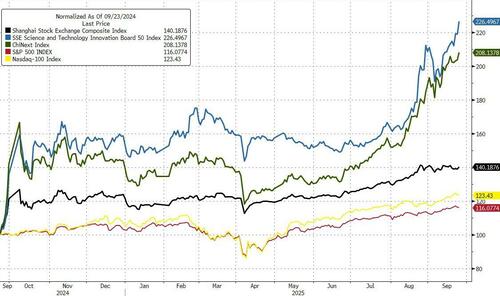
Core Viewpoint - China's financial markets have experienced a significant rally over the past year, driven by stimulus measures and positive investor sentiment, particularly in the technology sector [1][3][4]. Market Performance - The total market capitalization of China A-shares surpassed 100 trillion yuan, marking a 45% increase from 70 trillion yuan [4]. - The Shanghai Composite Index (SHCOMP) rose from 2700 to 3900, while tech-focused benchmarks like STAR50 and ChiNEXT saw increases of 115% and 110%, respectively [4]. - Over 3000 A-shares gained more than 50% in the past year, with nearly 1500 stocks more than doubling in value, particularly in the tech sector [5]. Investor Sentiment - David Tepper's bullish stance on Chinese assets, including ETFs and futures, was validated as the market rallied significantly [3]. - Despite adverse weather conditions in Hong Kong, the equity market posted solid gains, indicating strong momentum [6]. Sector Highlights - Alibaba's stock gained nearly 10%, with a month-to-date increase of 50%, supported by consistent net buying from Southbound flows [7]. - Other major players like Meituan and JD also saw stock price increases, attributed to regulatory changes aimed at stabilizing the food delivery market [9]. - The semiconductor sector showed positive momentum, with Goldman's China Semis basket rising by 4.6% following favorable earnings from Micron and strategic plans from Huawei [10]. Future Outlook - The current market setup suggests the potential for a "slow bull" market in A-shares, with elevated activity levels since early August [12][13]. - Chinese households hold only 11% of their assets in equities, indicating substantial cash reserves available for potential market inflows [17]. - Additional equity inflows could arise from wealth management products and new money seeking deployment amid a weaker property market [18]. Institutional Participation - Domestic and foreign institutions currently represent a small portion of the overall market, with potential for significant institutional buying in the future [20][23]. - Recent inflows into China-dedicated equity funds reached $5.4 billion, the largest weekly inflow since April [25].
GLW's Diverse Portfolio Fuels Customer Growth: Will it Drive Revenues?
ZACKS· 2025-09-24 15:40
Core Insights - Corning Incorporated (GLW) is experiencing significant customer growth across various end markets, including consumer electronics, telecom, semiconductors, and solar products [1][9]. Consumer Electronics - Apple is investing $2.5 billion to develop cover glass for iPhones and Apple Watches at Corning's Kentucky facilities, part of a broader $600 billion multiyear investment plan in the U.S. [2] - Samsung is utilizing Corning's advanced Gorilla Glass in its flagship smartphones, alongside other clients like OnePlus, Google, and Xiaomi [2]. Telecom Sector - Lumen is accelerating its network infrastructure deployment in the U.S. using Corning's next-generation fiber optic cables [3]. - AT&T is also leveraging Corning's fiber and connectivity solutions for its network expansion [3]. - Corning has entered a multi-year collaboration with Broadcom to integrate its optical components into Broadcom's Bailly CPO system, addressing the needs of large-scale AI clusters [3]. Solar Market - Corning's U.S.-made solar products are gaining traction, with T1 Energy Inc. opting for Corning's solar components to enhance supply chain reliability [4]. Manufacturing and Supply Chain - Corning is expanding its U.S. manufacturing capacity, benefiting from a strategy that addresses geopolitical volatility and trade uncertainties, leading companies to source domestically [5]. Financial Performance - Corning shares have increased by 81.3% over the past year, slightly below the industry's growth of 84.2% [8]. - Earnings estimates for 2025 have risen by 5.11% to $2.47 per share, while 2026 estimates increased by 5.88% to $2.88 [12]. - The company's shares currently trade at a price/earnings ratio of 29.46, lower than the industry average of 33.18 [10].

Here's Why Sunrun (RUN) Fell More Than Broader Market
ZACKS· 2025-09-23 23:16
Core Viewpoint - Sunrun is experiencing fluctuations in its stock price, with a recent decline of 6.59%, while the company is expected to report significant earnings growth in its upcoming earnings report [1][2]. Company Performance - Sunrun's stock closed at $16.45, down 6.59% from the previous trading session, underperforming the S&P 500, which lost 0.55% [1]. - Over the past month, Sunrun's shares have increased by 7.51%, outperforming the Oils-Energy sector's gain of 1.1% and the S&P 500's gain of 3.64% [1]. Earnings Expectations - The upcoming earnings report is anticipated to show an EPS of $0.03, representing a 108.11% increase year-over-year [2]. - Revenue is expected to reach $606.24 million, indicating a 12.86% increase compared to the same quarter of the previous year [2]. Full Year Projections - For the full year, earnings are projected at $0.71 per share, reflecting a decrease of 46.62% from the previous year, while revenue is expected to be $2.27 billion, showing an increase of 11.2% [3]. Analyst Estimates - Recent changes to analyst estimates for Sunrun are being closely monitored, as upward revisions typically indicate positive sentiment regarding the company's business operations and profit generation capabilities [4]. Zacks Rank and Valuation - Sunrun currently holds a Zacks Rank of 1 (Strong Buy), with the consensus EPS estimate remaining unchanged over the last 30 days [6]. - The company is trading at a Forward P/E ratio of 24.81, which is higher than the industry average Forward P/E of 17.09 [7]. Industry Context - The Solar industry, part of the Oils-Energy sector, has a Zacks Industry Rank of 43, placing it in the top 18% of over 250 industries [7]. - The Zacks Industry Rank measures the strength of industry groups based on the average Zacks Rank of individual stocks, with top-rated industries outperforming lower-rated ones by a factor of 2 to 1 [8].

CSLM Acquisition Corp. (SPWR) Declines More Than Market: Some Information for Investors
ZACKS· 2025-09-23 23:16
Company Performance - CSLM Acquisition Corp. (SPWR) closed at $1.69, reflecting a -4.52% change from the previous day, underperforming the S&P 500's 0.55% loss [1] - Over the past month, shares of CSLM Acquisition Corp. have gained 9.94%, outperforming the Oils-Energy sector's gain of 1.1% and the S&P 500's gain of 3.64% [1] Financial Expectations - The upcoming financial results for CSLM Acquisition Corp. are anticipated to show an EPS of -$0.12, indicating a 71.43% growth compared to the same quarter last year [2] - Revenue is expected to reach $70 million, representing a significant 1163.54% increase compared to the year-ago quarter [2] - Full-year Zacks Consensus Estimates project earnings of -$0.2 per share and revenue of $290.3 million, reflecting year-over-year changes of 0% and +166.96%, respectively [3] Analyst Insights - Recent changes to analyst estimates for CSLM Acquisition Corp. suggest positive short-term business trends, which are generally viewed as favorable for the business outlook [3] - The Zacks Rank system, which assesses estimate changes, currently ranks CSLM Acquisition Corp. at 3 (Hold), with a notable 750% decrease in the Zacks Consensus EPS estimate over the last 30 days [5] Industry Context - The Solar industry, part of the Oils-Energy sector, holds a Zacks Industry Rank of 43, placing it in the top 18% of over 250 industries [6] - The Zacks Industry Rank measures the strength of industry groups based on the average Zacks Rank of individual stocks, indicating that the top 50% rated industries outperform the bottom half by a factor of 2 to 1 [6]