
Consumer Electronics

Search documents
【太平洋科技-每日观点&资讯】(2026-01-07)
远峰电子· 2026-01-06 11:58
Market Overview - Major indices showed positive performance with the STAR Market 50 up by 1.84%, the Northern Exchange 50 up by 1.82%, the Shanghai Composite Index up by 1.50%, the Shenzhen Component Index up by 1.40%, and the ChiNext Index up by 0.75% [1] - The TMT sector led the gains, with the SW Panel sector increasing by 5.21%, SW Semiconductor Materials by 4.41%, and SW Vertical Application Software by 3.86% [1] - Conversely, the TMT sector also saw declines, with SW Communication Network Equipment and Devices down by 1.70%, SW Communication Cables and Supporting down by 0.68%, and SW Printed Circuit Boards down by 0.60% [1] Domestic News - Luxshare Precision is set to add a new VR glasses production line with an annual capacity of 9 million units, alongside an increase in the production capacity of VR glasses charging cases by 4.5 million units [2] - A semiconductor equipment R&D and production base project in Suzhou has been signed with a total investment of 1.05 billion yuan, expected to achieve an annual output value of over 1 billion yuan upon full production [2] - Deep Tianma has signed a long-term OLED materials supply and licensing agreement with UDC to support its OLED display production [2] - The new factory of Jinglong Technology for high-end semiconductor testing has been put into operation with a total investment of 4 billion yuan, covering AI, automotive-grade, and industrial-grade chip testing [2] Overseas News - Appfigures data indicates that the Manus mobile app is projected to reach approximately 4.5 million downloads by 2025, primarily from emerging markets like Brazil, Egypt, and India, with an estimated in-app revenue of 13 million USD for the year [3] - AMD has launched the Helios platform, boasting an AI computing capability of 2.9 exaflops and equipped with 31TB of HBM4 memory [3] - Texas Instruments has introduced the TDA5 chip for autonomous vehicles, utilizing a 5nm process and enhancing computation speed from 100 trillion operations per second to up to 1.2 quadrillion [3] - METI plans to increase its overall budget by approximately 50% to around 3.07 trillion yen, with significant funding directed towards the semiconductor and AI sectors [3] AI News - NVIDIA has officially launched the "Vera Rubin" platform, featuring the Vera CPU with 88 customized Olympus cores and the Rubin GPU capable of 50 quintillion floating-point operations per second [4] - WeChat has initiated the "AI Mini Program Growth Plan," committing resources to support developers and aiming for a significant increase in AI applications by 2026 [4] - The National Radio and Television Administration announced a month-long special governance initiative starting January 1, 2026, targeting the misuse of AI tools in altering classic content [4] Industry Tracking - Brain-computer interface startup Strong Brain Technology has completed approximately 2 billion yuan in financing, producing products that assist disabled individuals in controlling prosthetic limbs [5] - New Times has released the first "industrial-grade" embodied intelligent robot, SYNDA R1, designed for various operational tasks [5] - Dongfang Boiler has successfully completed a key phase of a national key R&D project related to stable and clean combustion technology [5] - Beijing has announced an action plan for building an AI innovation hub, aiming to achieve a core industry scale exceeding 1 trillion yuan within two years [5]




Garmin and Meta announce automotive OEM proof of concept with Garmin Unified Cabin and Meta Neural Band
Prnewswire· 2026-01-06 11:58
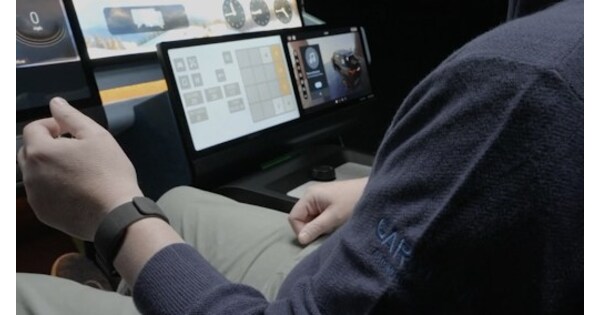
Core Viewpoint - Garmin and Meta have collaborated to create a proof-of-concept for in-vehicle command and control capabilities using the Meta Neural Band and Garmin's Unified Cabin technology, showcased at CES 2026 [1][2][3] Group 1: Technology Integration - The proof-of-concept allows passengers to control vehicle infotainment functions through gestures detected by the EMG band, utilizing thumb, index, and middle fingers [1][2] - Meta Neural Band translates subtle neural signals from wrist muscles into digital actions, enabling natural interfacing with devices [3][4] - Garmin's Unified Cabin offers a digital cockpit that provides scalable and personalized entertainment experiences, featuring a single control module [4] Group 2: Features and Capabilities - New features of the Unified Cabin include a digital key, AI Virtual Assistant, seat-scoped audio and visuals, enhanced personalization, Cabin Chat, Cabin Lighting Show, and Personal Audio Sphere [4] - The collaboration aims to enhance convenience and situational awareness in vehicle entertainment systems [3] Group 3: Company Background - Garmin Automotive OEM leverages expertise in user experience and hardware design across automotive, avionics, and marine sectors to develop comprehensive infotainment solutions [6] - The company has a diverse manufacturing capability and provides solutions to major automobile manufacturers including BMW, Ford, Honda, and others [6]


联想申请电子设备散热结构专利,提高外观品质
Jin Rong Jie· 2026-01-06 10:29
Group 1 - Lenovo (Singapore) Private Limited has applied for a patent titled "Electronic Device" with publication number CN121277314A, filed on June 2025 [1] - The patent summary indicates that the electronic device is designed to ensure cooling performance while enhancing aesthetic quality [1] - The electronic device includes a housing with an air intake on the bottom surface, a fan located within the housing, and leg components positioned on the bottom surface of the housing, which partially cover the air intake at a raised position relative to the opening surface [1]

全球领先!中国自研!CES绽放绚烂中国色彩,这场发布会见证中国制造高光时刻,网友:定义标准,海信RGB领先一代
Xin Lang Cai Jing· 2026-01-06 10:26
Core Viewpoint - The article highlights the impressive achievements of Chinese manufacturing showcased at CES, emphasizing the leadership of Hisense in the RGB technology sector, which is setting new standards in the industry [1] Group 1 - Hisense has been recognized for its advancements in RGB technology, positioning itself as a leader in the market [1] - The event at CES is described as a significant moment for Chinese manufacturing, showcasing the country's capabilities in innovation and technology [1] - The article reflects a positive sentiment from netizens, who believe that these developments are defining new industry standards [1]

CES 2026: 戴尔宣布正在研发轻薄型Alienware游戏本
Huan Qiu Wang Zi Xun· 2026-01-06 09:07
Core Insights - The competition in the lightweight gaming laptop market is intensifying, with Dell announcing the development of two new Alienware laptops during CES 2026, featuring 14-inch and 16-inch versions [1][2] Group 1: Product Features - The new Alienware laptops will have a thickness of approximately 17mm, making them ultra-thin while still equipped with dedicated graphics cards to handle large games and professional graphics tasks [2] - High-quality displays will be included to ensure clarity, detail, and accurate color reproduction, suitable for both gaming and creative work [2] - The laptops will feature an RGB backlit keyboard, enhancing both aesthetics and functionality in low-light environments, with customizable lighting effects for personalization [2] Group 2: Market Positioning - The new Alienware laptops are not positioned as high-end products like the $3000 "museum piece," but rather aim for a more affordable market segment, making them competitively priced compared to similar hardware laptops [2] - The 16-inch Alienware ultra-thin laptop boasts a significant size advantage, being nearly 50% smaller than the latest 16-inch Alienware Area-51 gaming laptop [2]


TCL Q10M系列产品发布,应用SQD-Mini LED显示技术
Zheng Quan Shi Bao Wang· 2026-01-06 08:50
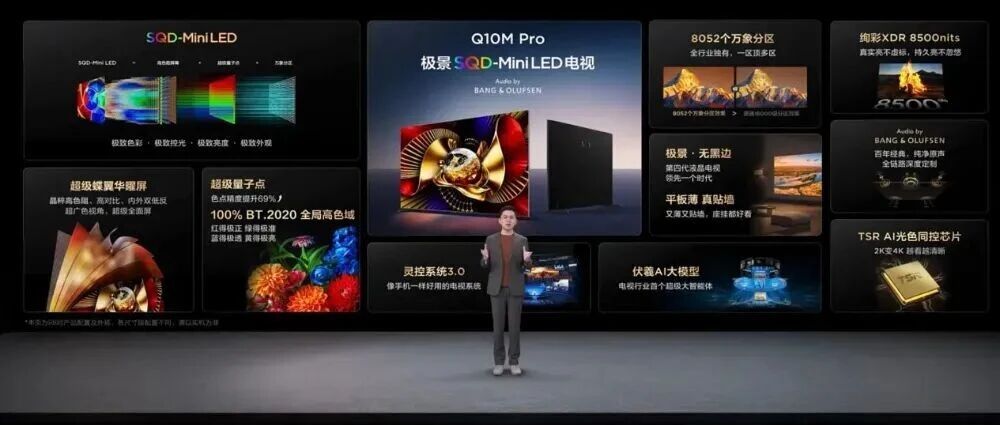
Core Viewpoint - In 2025, advancements in television color gamut technology are noted, but the industry is criticized for focusing solely on high color gamut while neglecting the essential multi-dimensional collaboration required for quality picture. TCL emphasizes that true picture quality must integrate high contrast, high peak brightness, and high color gamut, forming a "picture quality triangle" that is indispensable [1] Group 1 - On January 5, 2026, TCL held a product launch for the SQD-Mini LED television, introducing the TCL Q10M Pro and TCL Q10M, aiming to penetrate the mid-to-high-end market with advanced display technology [1] - TCL has made significant technological breakthroughs over the past year, achieving extreme light control, industry-leading peak brightness, and the highest stable 100% BT.2020 full color gamut in its flagship product, the X11L [1] - The TCL Q10M Pro features super quantum dots and a super butterfly screen, achieving the industry's highest standard of 100% BT.2020 full color gamut [1]

vivo旗舰影像功能“原生光影”1月陆续上线X200系列、X100 Ultra
Feng Huang Wang· 2026-01-06 08:13
Core Viewpoint - Vivo officially announced that its flagship imaging feature "Native Light and Shadow" will be gradually pushed to users of the vivo X200 series and vivo X100 Ultra starting in January [1] Group 1: Product Features - The "Native Light and Shadow" feature is designed to minimize algorithmic intervention, providing a more authentic photography experience compared to other industry solutions that rely heavily on algorithms [1] - Vivo product manager Han Boxiao emphasized that while the feature is not intended for everyday use by average users, it offers a unique experience for those who seek it [1] Group 2: User Experience - The feature allows users to explore photography in a different emotional context, suggesting that it can provide a distinct experience when used occasionally [1] - The product aims to balance both traditional photography and computational photography, catering to diverse user preferences [1]
2026年或成AI眼镜元年,产业链迎新机遇
Huan Qiu Wang Zi Xun· 2026-01-06 07:46
从业绩层面看,相关上市公司也展现出强劲的增长预期。根据5家及以上机构一致预测,20只AI眼镜概 念股2025年全年净利润将大幅改善。其中,TCL科技、豪鹏科技、思特威等公司净利润有望实现翻倍。 豪鹏科技表示,公司正处于动能转换期,AI眼镜等新兴端侧项目的能源解决方案已陆续量产出货,增 长曲线陡峭;思特威则推出了专为AI眼镜设计的1200万像素CMOS图像传感器产品,具备小尺寸、低功 耗等优势。随着SoC、电池、散热、通信、光学等关键零组件技术的不断升级,AI眼镜产业链正迎来前 所未有的发展机遇。 有行业分析师指出,雷鸟创新获得10亿元巨额融资,不仅是对该公司技术实力的认可,更是整个AI眼 镜产业进入爆发期的信号。2026年,随着大模型在端侧的落地应用以及硬件成本的进一步优化,AI眼 镜有望复刻TWS耳机的崛起路径,成为下一个消费电子爆款。目前产业链上游的光学显示、下游的整 机组装以及相关零部件供应商均处于订单驱动的关键阶段。建议投资者重点关注在核心技术上有护城河 且已经进入头部大厂供应链的标的,特别是那些在AI眼镜轻量化、低功耗及独立通信方面有技术储备 的公司,有望在新一轮的终端置换潮中率先受益。(文馨) 市 ...
9999元起售,TCL 发布SQD-Mini LED电视
WitsView睿智显示· 2026-01-06 07:29
Core Viewpoint - TCL has launched its flagship SQD-Mini LED TVs, Q10M Pro and Q10M, with a starting price of 9999 yuan, emphasizing advanced display technology and sound systems [1]. Group 1: Q10M Pro Features - The Q10M Pro features 8052 local dimming zones and achieves 100% coverage of the BT.2020 color gamut, with a peak brightness of 8500 nits [2]. - It incorporates proprietary light control algorithms, supports transient response, and features a native contrast ratio of 7000:1, which is five times that of standard IPS screens [4]. - The audio system is developed in collaboration with BANG&OLUFSEN, featuring a 2.2.2 professional acoustic system with advanced sound technologies [4]. - The Q10M Pro is equipped with the Ling Control System 3.0, offering high-speed transmission and the first AI model in the TV industry, named Fuxi [4]. Group 2: Q10M Features - The Q10M utilizes SQD-Mini LED technology with 4032 local dimming zones and a peak brightness of 6000 nits, aimed at enhancing picture detail and depth [6]. - It features super quantum dot technology, achieving 100% coverage of the BT.2020 color gamut, and supports a refresh rate of up to 300Hz [8]. - The design emphasizes a borderless display and thin profile, while the audio system includes a 2.2.2 Hi-Fi sound system with Dolby Atmos certification [8]. Group 3: Pricing Information - The pricing for the Q10M Pro varies by size: 98 inches at 31999 yuan, 85 inches at 21999 yuan, 75 inches at 16999 yuan, and 65 inches at 11999 yuan [4]. - The Q10M series is priced as follows: 65 inches at 9999 yuan, 75 inches at 12999 yuan, 85 inches at 15999 yuan, and 98 inches at 24999 yuan [8].
Evercore看高苹果(AAPL.US)至325美元:12月App Store营收趋稳,非游戏业务强劲增长
智通财经网· 2026-01-06 06:57
Core Viewpoint - Despite a weak performance in the gaming sector, Apple's App Store revenue appears to have stabilized in December, with a year-over-year growth of 6% [1] Group 1: App Store Performance - The revenue from the App Store in December showed a year-over-year increase of 6% [1] - Revenue from gaming applications declined by 4% year-over-year in December, compared to a 2% decline in November [1] - Gaming applications account for approximately 44% of the App Store's total revenue, making this decline significant [1] Group 2: Regional Performance - The gaming market in China and Japan showed poor performance, with revenues declining by 13% and 15% year-over-year, respectively [1] - In the U.S., App Store revenue grew by 3% year-over-year, while China and Japan experienced declines of 5% and 3% [1] Group 3: Other Business Segments - The music business saw a strong performance with a year-over-year revenue growth of 15% [1] - Photo and video services also performed well, achieving an 18% year-over-year growth [1] - Social networking services grew by 11%, and entertainment services saw a 3% increase year-over-year [1] Group 4: Future Outlook - The current weakness in the gaming business, particularly in China and Japan, is a key factor hindering overall business growth [2] - There is an expectation for improvement in the overall gaming business performance by Q1 2026 [2] - App Store revenue is estimated to account for about 20% of total service revenue, with potential growth in areas like Apple Pay, iCloud, and licensing to offset the gaming sector's underperformance [2]
