出口制造业

Search documents
出口链,何去何从
2025-04-15 00:58
Summary of Conference Call on Export Chain Industry Industry Overview - The conference call focused on the export chain industry, particularly the impact of recent U.S. tariff policies on Southeast Asian manufacturing and the overall market dynamics [3][4]. Key Points and Arguments - Recent fluctuations in export volumes were significantly influenced by the U.S. announcement to suspend tariffs on other countries for 90 days, which provided marginal improvement for the industry [3]. - The imposition of higher tariffs in Southeast Asian countries (e.g., Vietnam, Indonesia, Cambodia) exceeded market expectations, leading to a notable decline in stock prices [4]. - Domestic listed companies have accelerated the transfer of production capacity to Southeast Asia since the first trade war in 2018, aiming for cost optimization [4]. - Despite high tariffs, the overall impact on revenue and profit is limited due to the existing production capacity in Southeast Asia, which has higher profit margins compared to domestic operations [5]. - The 10% basic tariff is typically borne by customers or shared between manufacturers and customers, with manufacturers' share being less than 50%, thus having a limited effect on profit margins [6]. - The concentration of factories in Vietnam and Southeast Asia may increase, enhancing localization advantages and reducing risks associated with policy fluctuations [7]. - The demand from the U.S., particularly in the real estate sector, is crucial for determining the downstream economic trends in light industry [8]. Additional Important Insights - Current inventory levels in the U.S. have reached historical medians, indicating that inventory is not low, which could affect future demand [8]. - Several export chain companies have seen their stock prices drop below critical profit points, revealing mid-term value opportunities as recent policy changes have led to stock price rebounds [9]. - The call highlighted specific companies such as Zhejiang Natural, Jiayi, Jiangxin, Gongshang Turf, Gujia, and Minhua as key investment targets due to their potential benefits from the current market conditions [9].
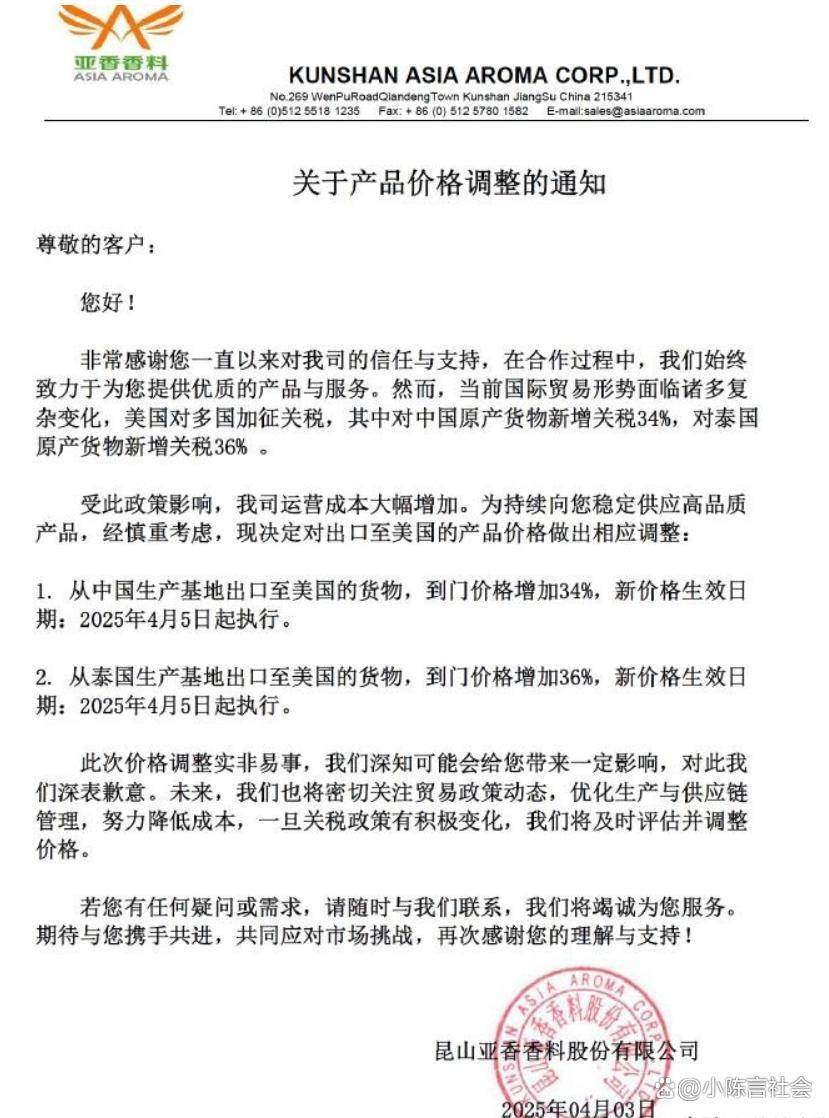
牛啊!有中国企业强硬回击美国的加关税政策了
Sou Hu Cai Jing· 2025-04-04 18:57
Core Viewpoint - The article discusses a recent increase in tariffs by the U.S. on certain Chinese exports, which has prompted a strong response from a Chinese company that decided to raise prices for U.S. customers by the same percentage as the tariff increase, signaling a shift in the dynamics of international trade relations [1][3][10]. Group 1: Company Response - The Chinese company has taken a firm stance by notifying U.S. clients that prices will increase in direct correlation to the new tariffs, demonstrating a refusal to absorb the costs [1][3]. - This action is seen as a significant shift from previous practices where Chinese companies were more accommodating, indicating a newfound confidence and willingness to confront U.S. trade policies [5][8]. - The company’s decision is not impulsive but rather a calculated response to ongoing tariff disputes that have persisted since 2018, reflecting a strategic approach to negotiations [7][12]. Group 2: Industry Implications - The price increase by this company could set a precedent for the entire industry, potentially leading to a broader movement among other Chinese firms to adopt similar pricing strategies in response to U.S. tariffs [5][12]. - The article suggests that if more companies follow suit, it could transform the situation from isolated incidents to a systemic response, which would challenge U.S. trade tactics [5][10]. - The response from the Chinese company is framed as a tactical maneuver that could pressure U.S. consumers to hold their government accountable for the increased costs, thereby shifting the burden back onto the U.S. government [10][12].