
加密货币金融服务

Search documents
Cryptocurrency Exchange Gemini Launches Credit Card That Earns Solana Rewards
PYMNTS.com· 2025-10-20 18:26
Core Viewpoint - Gemini has launched a new credit card that allows users to earn Solana rewards on select purchases and automatically stake these rewards directly, capitalizing on Solana's growing ecosystem and community engagement [1][4]. Group 1: Credit Card Features - The Gemini Credit Card offers users the ability to earn up to 4% back on gas, electric vehicle charging, and rideshare, 3% back on dining, 2% back on groceries, and 1% back on other purchases [2]. - Customers can earn as much as 10% back on qualifying purchases at select merchants [2]. Group 2: Staking and Rewards - Users can automatically stake their Solana credit card rewards, allowing them to earn additional rewards by participating in the validation of transactions and maintaining the security of the Solana network [3]. Group 3: Strategic Rationale - The decision to launch a Solana edition of the Gemini Credit Card is attributed to Solana's momentum and its active community, which has established it as a leading ecosystem for new developers [4]. - Solana's rewards performance is noted to be among the highest of available cryptocurrencies on the Gemini platform [4]. Group 4: Historical Context - Gemini announced plans for a cryptocurrency rewards credit card in January 2021 after acquiring Blockrize, which was developing such a card [5]. - The CEO of Gemini emphasized that the card provides consumers with an easy way to invest in cryptocurrencies through everyday purchases [5]. Group 5: Previous Collaborations - In August, Gemini collaborated with Ripple to release an XRP Edition of the Gemini Credit Card, which allows users to earn rewards in the form of XRP [6]. - The XRP edition aims to make cryptocurrency more accessible and appealing to a broader audience [7].


Strategy Posts Q3 Profit, Keeping it on Radar for S&P 500 inclusion.
Yahoo Finance· 2025-10-01 11:59
Core Insights - Strategy (MSTR) is expected to report a profit for the second consecutive quarter in Q3, driven by an increase in bitcoin prices, which may qualify the company for potential inclusion in the S&P 500 [1][3] - The estimated net income for MSTR is projected at $2.9 billion, translating to approximately $10 per share, with trailing twelve-month earnings per share (EPS) estimated at $22.80 [2][3] - MSTR meets several criteria for S&P 500 inclusion, including positive latest quarter results, over 50% public float, and average daily trading volume exceeding 250,000 shares [3] Financial Performance - MSTR's earnings for the past four quarters are estimated to be around $22.80 per share, with Q2 and Q3 2025 projected EPS of $32.6 and $10.1, respectively [2] - The analysis includes a deferred tax liability of $970 million, which impacts the net income calculation [2] Dividend Information - Strategy has increased its dividend rate on perpetual preferred stock STRC from 10% to 10.25%, with cash dividends payable on October 31 [4] - The current price of STRC is $97, and the company plans to continue raising the rate to approach its $100 par value [4] Market Reaction - MSTR shares rose by 2.9% in premarket trading, coinciding with a 3% increase in bitcoin prices to $116,700 [5]

21Shares Launches Jupiter ETP, Offering Investors Exposure to the Trading Hub of Solana
Globenewswire· 2025-09-30 07:00
Core Insights - 21Shares AG has launched the 21Shares Jupiter ETP (ticker: AJUP) on the SIX Swiss Exchange, expanding its leadership in the cryptocurrency exchange-traded products (ETPs) market with over 50 physically backed ETPs available to European investors [1][5] Company Overview - 21Shares is one of the largest issuers of cryptocurrency ETPs globally, managing over $11 billion in assets under management (AUM) and offering the largest suite of physically-backed crypto ETPs in the market [5][6] - The company aims to bridge the gap between traditional finance and decentralized finance, having listed the world's first physically-backed crypto ETP in 2018 [6] Product Details - The 21Shares Jupiter ETP provides institutional-grade exposure to Jupiter (JUP), a leading trading hub on the Solana blockchain, which powers over 90% of Solana's trade aggregation [1][2] - Jupiter has achieved over $1 trillion in lifetime trading volume and maintains around $8 billion in weekly trading volumes, establishing itself as a central liquidity engine in Solana's decentralized finance (DeFi) ecosystem [2] Innovations and Future Plans - Jupiter has evolved into a full-stack DeFi platform, offering services such as perpetual futures, limit orders, and a token launchpad, with its liquid staking derivative, JupSOL, being the fourth-largest on Solana [3] - The recent launch of JupLend has attracted over $750 million in total value locked (TVL), contributing to multiple revenue streams for the protocol [3] - Future plans include the development of JupNet, a multi-chain liquidity network that will connect various blockchains, wallets, and identities, enhancing its role as a cross-chain brokerage layer [4]

Strategy Stock Has Outperformed Bitcoin Since January 2024. Should Investors Be Worried About Its Recent 20% Pullback?
Yahoo Finance· 2025-09-22 11:33
Core Viewpoint - Strategy (NASDAQ: MSTR) has experienced a remarkable 450% increase since January 2024, significantly outperforming Bitcoin's 167% rise. However, concerns have emerged as its stock price has dropped to around $350 since mid-July, raising questions about investor confidence in the Bitcoin treasury company model [1][4]. Group 1: Company Performance - Strategy's stock surged to 450 in the summer but has since declined by 20% since July, indicating a potential loss of investor faith in its business model [2][4]. - The company holds 638,985 BTC valued at approximately $75 billion, while its market cap stands at $100 billion, suggesting it may be overvalued as the gap between its holdings and market cap is narrowing [6]. Group 2: Market Sentiment - The narrative surrounding Bitcoin treasury companies, including Strategy, is perceived as becoming stale, with many new companies entering the market to raise funds for Bitcoin purchases, diluting the uniqueness of the model [2][3]. - Investors are recalibrating their expectations, which may lead to a tightening performance gap between Strategy and Bitcoin, potentially impacting Strategy's stock price negatively [4][6]. Group 3: Investment Perspective - The long-term outperformance of Strategy over Bitcoin raises skepticism about the sustainability of this trend, leading to a cautious stance on investing in Bitcoin treasury companies [7].
瑞穗银行上调Coinbase目标价至300美元
Ge Long Hui· 2025-09-18 10:44
Core Viewpoint - Mizuho Bank has raised the target price for Coinbase (COIN.US) to $300 from a previous target of $267 [1] Company Summary - The new target price reflects a positive outlook on Coinbase's performance in the cryptocurrency market [1] - The adjustment indicates confidence in Coinbase's ability to navigate market challenges and capitalize on growth opportunities [1] Industry Summary - The cryptocurrency industry continues to evolve, with companies like Coinbase positioned to benefit from increasing adoption and regulatory developments [1] - Analysts are closely monitoring market trends that could impact the valuation of cryptocurrency exchanges [1]

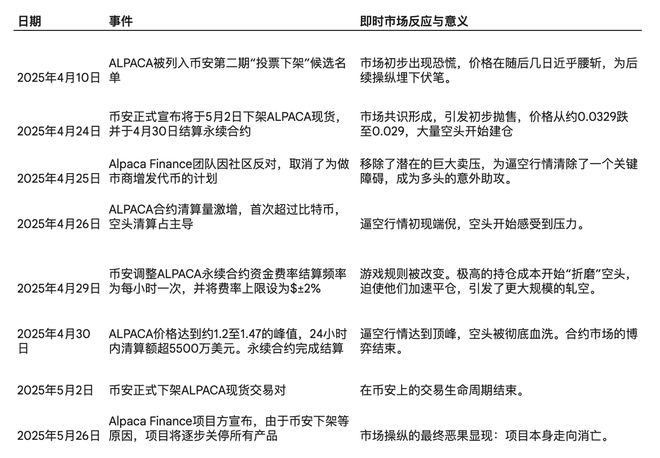
合约算法镰刀:Alpaca 下架前逼空收割之因与合约悖论之果
Xin Lang Cai Jing· 2025-08-24 13:55
Core Viewpoint - The Alpaca Finance ($ALPACA) perpetual contract incident exemplifies the "short squeeze" phenomenon, revealing the true nature of perpetual contracts under extreme market pressure [1][2][26]. Group 1: Market Reaction and Mechanism - Traditional market logic suggests that delisting from an exchange is a strong bearish signal, leading to price declines due to reduced liquidity. However, in the Alpaca case, a significant negative catalyst resulted in an explosive price surge of thousands of percentage points, driven by the unique mechanisms of its perpetual contract market [2][6]. - The "perpetual contract paradox" indicates that a negative catalyst can trigger an extreme positive price reaction, with the perpetual contract itself serving as both the stage and the weapon for this financial game [2][3]. Group 2: Timeline of Events - On April 24, 2025, Binance announced the delisting of ALPACA, leading to initial panic and a price drop to approximately $0.029. This set the stage for a short-selling frenzy [5]. - Following the announcement, the short open interest (OI) for ALPACA perpetual contracts surged, creating a crowded short position that became a perfect "short trap" [7]. - By April 30, 2025, ALPACA's price peaked at approximately $1.47, marking a dramatic increase of over 2,160% from its low of around $0.065 [15][17]. Group 3: Psychological and Structural Factors - The delisting announcement created a "zero-sum" consensus among traders, leading to a widespread belief that the asset's value would plummet to zero, which in turn fueled aggressive short-selling [6][10]. - The market's structure, characterized by low liquidity and a small market cap of about $5 million, allowed manipulators to create significant price volatility with relatively little capital [9][24]. Group 4: Funding Rate Mechanism - The funding rate mechanism of perpetual contracts became a tool for punishing short positions. Binance's adjustment of the funding rate settlement frequency to hourly and increasing the rate cap to ±4% significantly impacted short traders, leading to unsustainable holding costs [12][13][20]. - As the funding rate turned negative, short traders faced exorbitant costs, compelling them to close their positions, which further fueled the price increase [13][20]. Group 5: Conclusion and Market Implications - The Alpaca incident serves as a cautionary tale about the vulnerabilities of low liquidity assets in the perpetual contract market, where structural imbalances can lead to outcomes contrary to fundamental value [22][24]. - The event has sparked a new speculative narrative around "delisting coins," where traders seek to replicate the short squeeze phenomenon seen with ALPACA by targeting low market cap assets [23][26].
“加密货币超级多头”高呼“金库公司”风口已过 押注RWA浪潮将至
智通财经网· 2025-08-06 03:41
Core Viewpoint - The cryptocurrency "vault company" trend may have peaked, and the next major trend will be the migration of traditional assets to blockchain through Real-World Assets (RWA) [1][4] Group 1: Cryptocurrency Vault Companies - Michael Novogratz, CEO of Galaxy Digital, suggests that the peak of "vault companies" holding cryptocurrencies on their balance sheets has likely been reached [1] - Companies like MicroStrategy have pioneered this model, and new entrants are now diversifying into Ethereum and other lesser-known tokens [2] - Galaxy Digital has partnered with over 20 crypto vault investment firms, generating approximately $2 billion in assets for its custody platform, creating a recurring revenue stream [2] Group 2: Financial Performance of Galaxy Digital - Galaxy Digital reported a net profit of approximately $30.7 million for Q2 2025, a significant recovery from a loss of $177 million in the same period last year [3] - The company's diluted earnings per share for the quarter was $0.08, slightly below analyst expectations, leading to a 4% drop in stock price [3] Group 3: RWA and Tokenization Trends - Novogratz believes that crypto vault companies and cryptocurrency ETFs provide important exposure for hedge funds wary of directly holding tokens [4] - Major financial institutions like Goldman Sachs and JPMorgan are increasingly focusing on RWA as a new business trend [4] - The concept of tokenization involves mapping traditional financial assets onto the blockchain, which could lead to a market size exceeding $18 trillion by 2033, with a projected CAGR of 53% since 2025 [5][6] Group 4: Advantages of RWA for Traditional Banks - RWA offers a more straightforward regulatory framework compared to pure crypto assets, making it easier for traditional banks to adopt [7] - The underlying assets like bonds and loans provide stable cash flows, aligning well with traditional banking business models [7]